Tenses Chart with Examples: All 12 English Tenses in One Table (Formula, Use and Mistakes)
 Vishaleni
Content Writer
Published
Time to read
10 minutes
Vishaleni
Content Writer
Published
Time to read
10 minutes
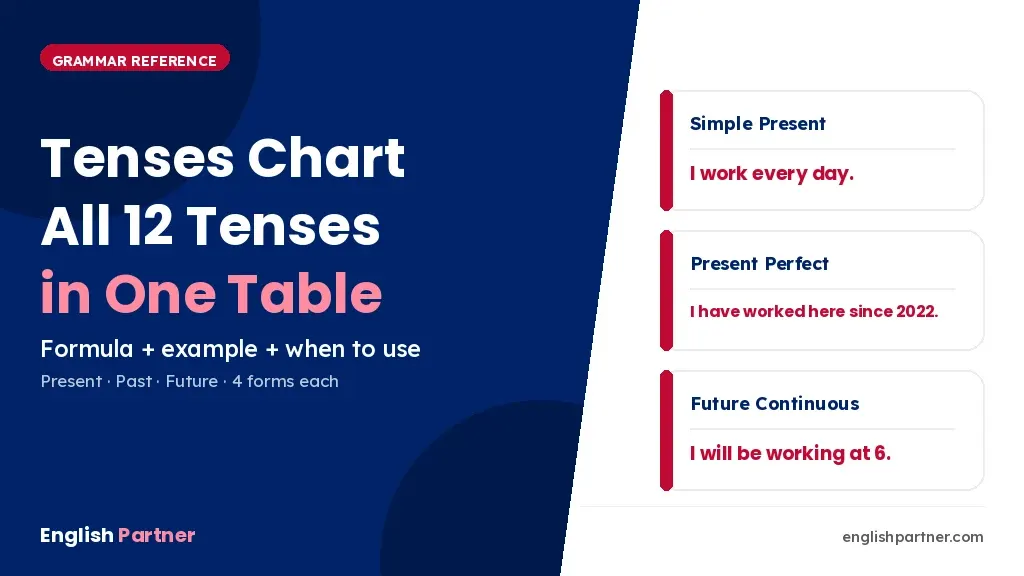
Quick answer: English has 12 tenses – three times (present, past, future) × four forms (simple, continuous, perfect, perfect continuous). The full chart is below with formula and example for each. But for speaking, you need only five: Simple Present, Simple Past, Present Continuous, Present Perfect and will. Learn those first; the rest are reference.
Why one chart beats twelve lessons
Most learners were taught tenses as twelve separate topics, one per week, with a test at the end of each. By the time they reached Future Perfect Continuous they had forgotten Simple Past – and, more importantly, they had never spoken any of them.
Trainers at English Partner take the opposite approach. Show the whole system on one page, so you can see that it is really just three helper patterns repeated, then spend the time on the five tenses that carry 90% of daily conversation.
That is what this post does. The complete chart first, for reference. Then the five that matter, with the mistakes that come up in almost every batch.
The three patterns behind all twelve tenses
Before the chart, notice this: every tense is built from the same three building blocks.
| Pattern | Formula | What it does |
|---|---|---|
| Continuous | be + V-ing | Action in progress at a time |
| Perfect | have + V3 | Action completed before a time |
| Future | will + verb | Moves anything to the future |
So Past Perfect Continuous is not a new thing to memorise. It is past (had) + perfect (been) + continuous (V-ing): I had been working. Once you see that, the chart stops looking like twelve rules and starts looking like one.
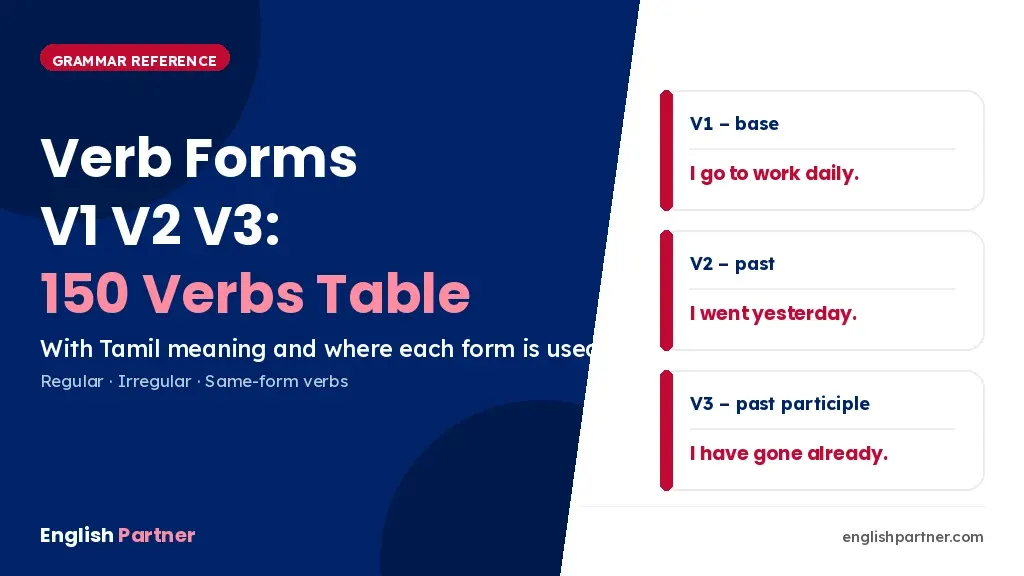
V1, V2, V3 mean the verb forms: go / went / gone, work / worked / worked. If those are new to you, our is, am, are guide and the existing types of tenses post cover the basics.
Present tenses
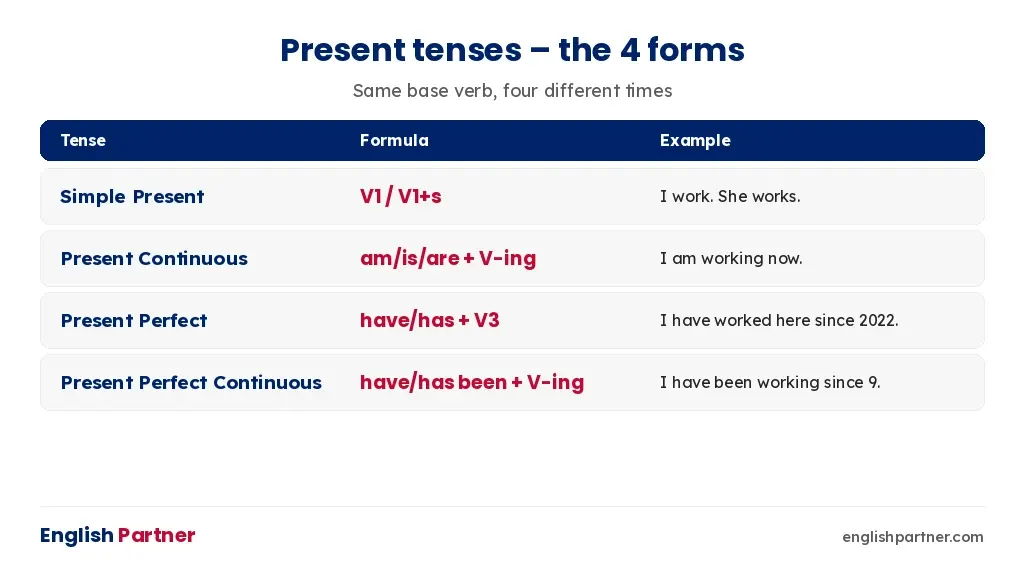
| Tense | Formula | Example | Use it for |
|---|---|---|---|
| Simple Present | V1 (+s for he/she/it) | I work in Coimbatore. She works at a bank. | Habits, facts, routines, timetables |
| Present Continuous | am/is/are + V-ing | I am working from home today. | Right now; temporary; fixed future plans |
| Present Perfect | have/has + V3 | I have worked here since 2022. | Experience; result now; unfinished time |
| Present Perfect Continuous | have/has been + V-ing | I have been working since nine. | How long something has continued |
Past tenses
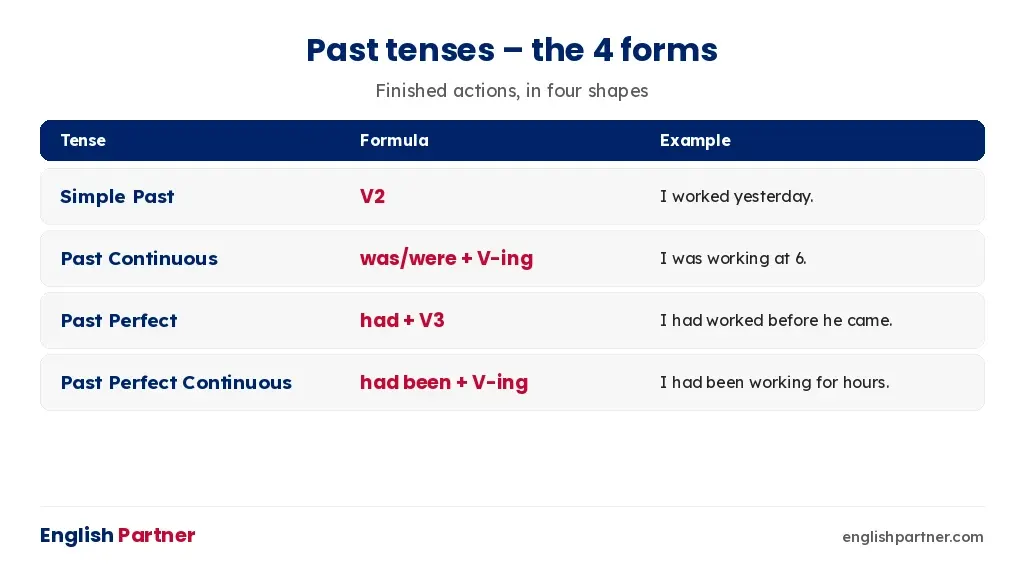
| Tense | Formula | Example | Use it for |
|---|---|---|---|
| Simple Past | V2 | I worked late yesterday. | Finished action at a finished time |
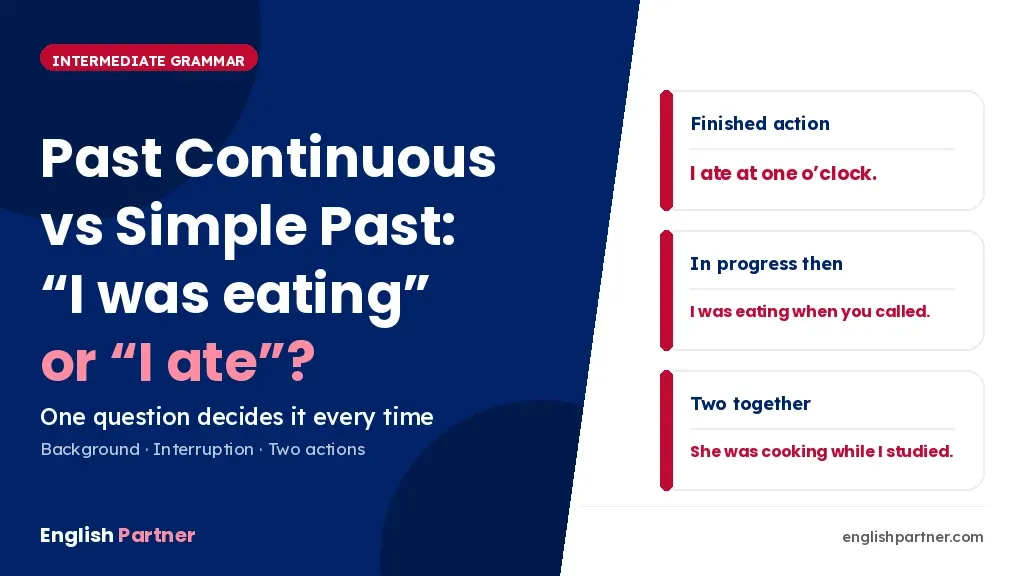
| Past Continuous | was/were + V-ing | I was working when you called. | Action in progress at a past moment |
| Past Perfect | had + V3 | I had worked there before I moved. | Earlier of two past actions |
| Past Perfect Continuous | had been + V-ing | I had been working for hours when the power went. | Duration before a past moment |
Future tenses
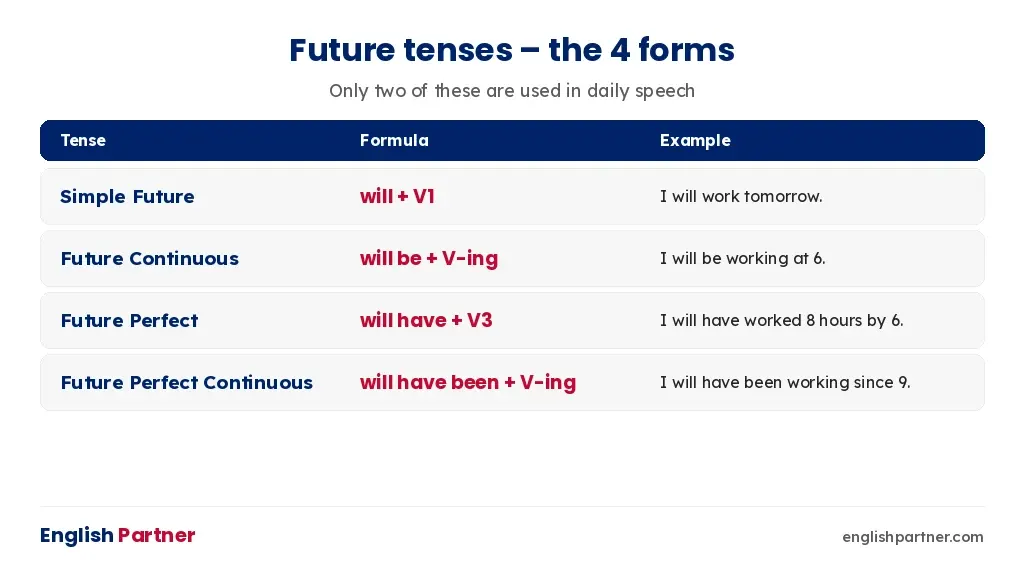
| Tense | Formula | Example | Use it for |
|---|---|---|---|
| Simple Future | will + V1 | I will work on it tomorrow. | Promises, decisions, predictions |
| Future Continuous | will be + V-ing | I will be working at six. | In progress at a future moment |
| Future Perfect | will have + V3 | I will have worked eight hours by six. | Completed before a future moment |
| Future Perfect Continuous | will have been + V-ing | By June I will have been working here for a year. | Duration up to a future moment |
Honest note: the last two future tenses appear in grammar books far more than in real life. You can speak English for a year without saying will have been working. Know they exist; do not lose sleep over them.
The 5 tenses you actually need for speaking
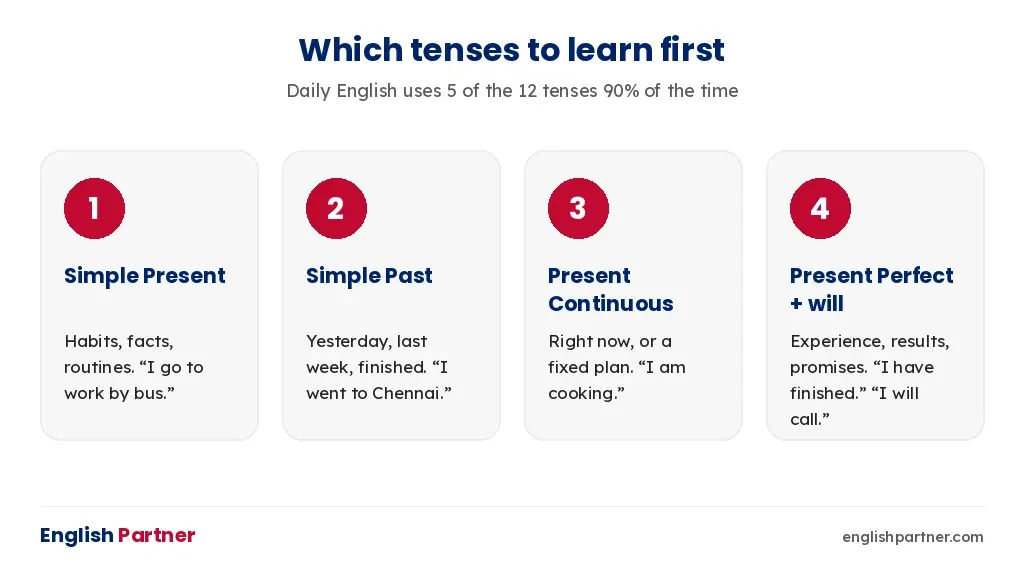
Listen to any real conversation – at the shop, in a meeting, on a call – and count the tenses. You will hear these five almost every time, and the other seven almost never.
1. Simple Present – your routine and your facts. I go to work by bus. My office opens at nine. I don’t eat non-veg.
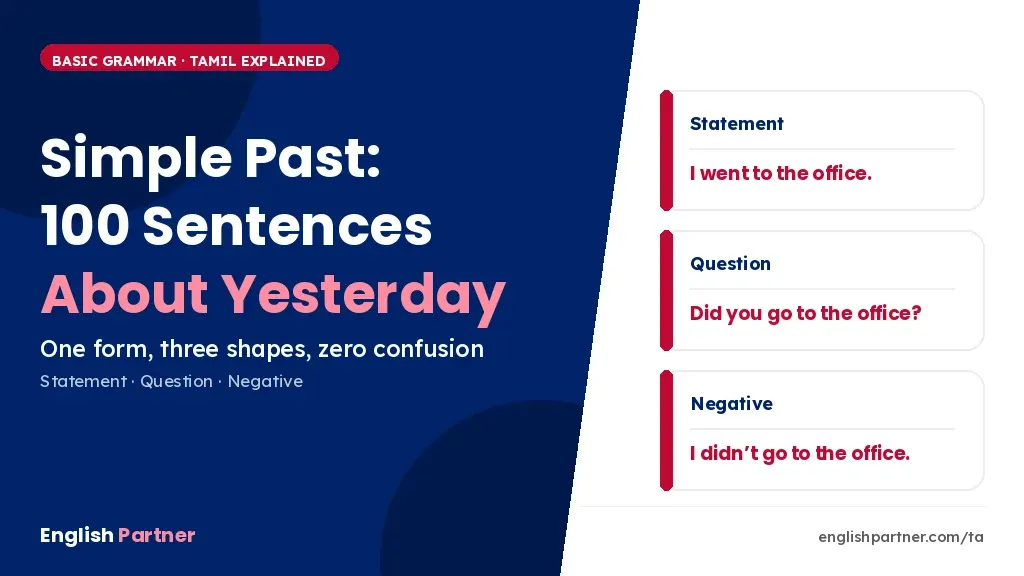
2. Simple Past – anything finished. I went to Chennai last week. The meeting ended at five. I didn’t see your message.
3. Present Continuous – right now, and fixed plans. I am cooking, call you later. We are meeting the client on Friday.
4. Present Perfect – experience and results. I have finished the report. Have you eaten? I have never been to Delhi.
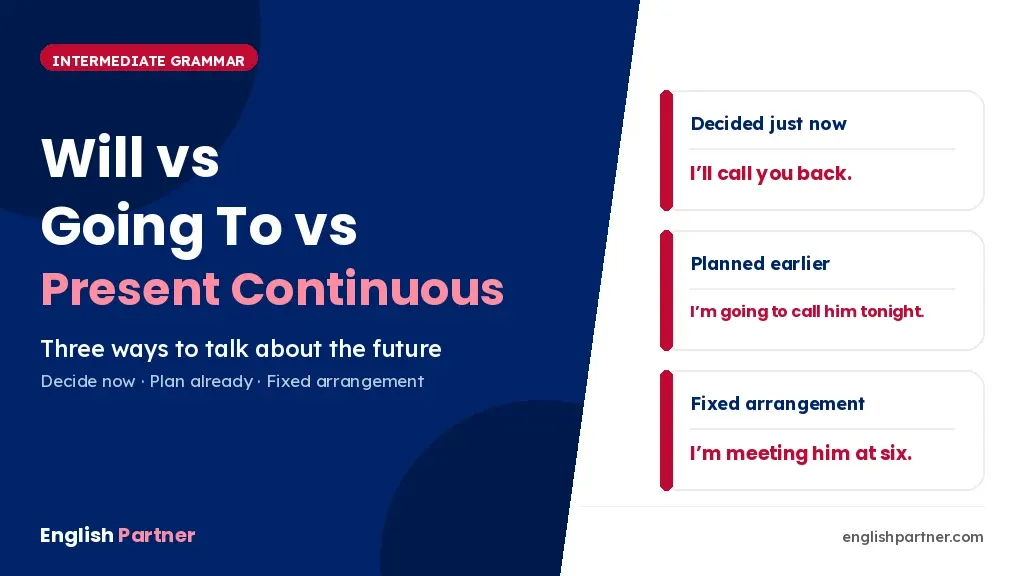
5. Will – promises and decisions. I will call you back. I’ll send it by evening.
If you can use these five correctly, you sound fluent. Our 100 Tamil to English everyday sentences are built almost entirely from them – a good place to practise.
3 tense mistakes Indian learners make (and the fix)
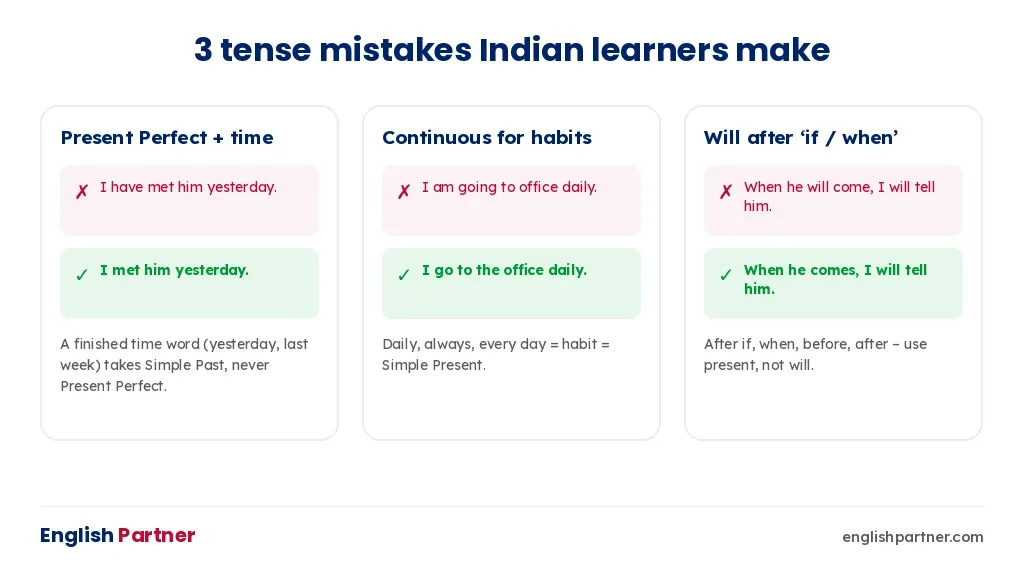
Mistake 1: Present Perfect with a finished time. “I have met him yesterday.” If you can say when – yesterday, last week, in 2020 – use Simple Past: “I met him yesterday.” Present Perfect is for when the time is not finished or not important.
Mistake 2: Continuous for habits and states. “I am going to office daily.” “I am knowing him.” Daily, always, every day = habit = Simple Present: “I go to the office daily.” And state verbs – know, like, want, have (own), understand – are not used in continuous at all: “I know him.”
Mistake 3: Will after if and when. “When he will come, I will tell him.” After if, when, before, after, until, English uses the present even for the future: “When he comes, I will tell him.” One will per sentence, in the main part.
These three patterns come partly from how Tamil, Telugu and Hindi handle time, which is why trainers who speak your language can explain them faster than a rulebook can.
How to practise tenses for speaking (not exams)
Every morning, three sets of ten sentences, out loud.
Yesterday (Simple Past): I woke up at six. I had idli. I took the bus…
Every day (Simple Present): I wake up at six. I have idli. I take the bus…
Today / tomorrow (Continuous + will): I am going to the office now. I will call my mother tonight…
Same ten actions, three tenses. Ten minutes. After two weeks your mouth chooses the tense before your brain checks the chart – which is the whole goal.
When self-practice is not enough
A chart tells you the rule. It cannot hear you say “I have met him yesterday” for the fortieth time and stop you. That is where daily practice with a trainer changes the speed of progress.
Our Basic level covers Simple Present, Past and Continuous through daily WhatsApp and live speaking practice, and Intermediate takes you through Perfect and Future forms – always explained in your mother tongue first. Learners in the city can join our spoken English classes in Coimbatore in person. The British Council makes the same point: tense accuracy comes from speaking practice with feedback, not from memorising tables.
Final thoughts and your next step
Twelve tenses, three patterns, five that matter. Save the chart, but spend your time on the five. Ten sentences in three tenses every morning, out loud, and the chart becomes something you no longer need to look at.
Not sure which level to start from? Send “Hi” on WhatsApp for a free five-minute level test in your language, and a trainer will tell you exactly which tenses to work on first.
Frequently asked questions
How many tenses are there in English?
Twelve, if you count all combinations of three times (present, past, future) and four aspects (simple, continuous, perfect, perfect continuous). In daily speaking, five of them do almost all the work.
Which tenses should a beginner learn first?
Simple Present, Simple Past and Present Continuous. Add Present Perfect and “will” next. With those five you can hold most everyday conversations.
What is the easiest way to remember the tenses formula?
Learn the three helper patterns: continuous = be + V-ing, perfect = have + V3, future = will + verb. Every one of the twelve tenses is a combination of these.
What is the difference between Simple Past and Present Perfect?
Simple Past has a finished time (“I met him yesterday”). Present Perfect has no time or an unfinished time (“I have met him”, “I have worked here since 2022”). If you can say when, use Simple Past.
Is “I am having a car” correct?
No. Having, liking, knowing, wanting and similar “state” verbs are not used in continuous tenses. Say “I have a car.”
Do Indians overuse the continuous tense?
Yes, it is one of the most common patterns – “I am going to office daily”, “I am knowing him”. Habits and states take Simple Present: “I go to the office daily”, “I know him”.
How can I practise tenses for speaking, not just exams?
Describe your day in three tenses every morning: what you did yesterday (past), what you do every day (present), what you will do today (future). Out loud, ten sentences each.
Which English Partner course covers tenses?
Basic covers Simple Present, Past and Continuous with daily speaking practice. Intermediate covers Perfect and Future forms. Both are taught in your mother tongue first.