Will vs Going To vs Present Continuous: Three Ways to Talk About the Future
 Vishaleni
Content Writer
Published
Time to read
8 minutes
Vishaleni
Content Writer
Published
Time to read
8 minutes
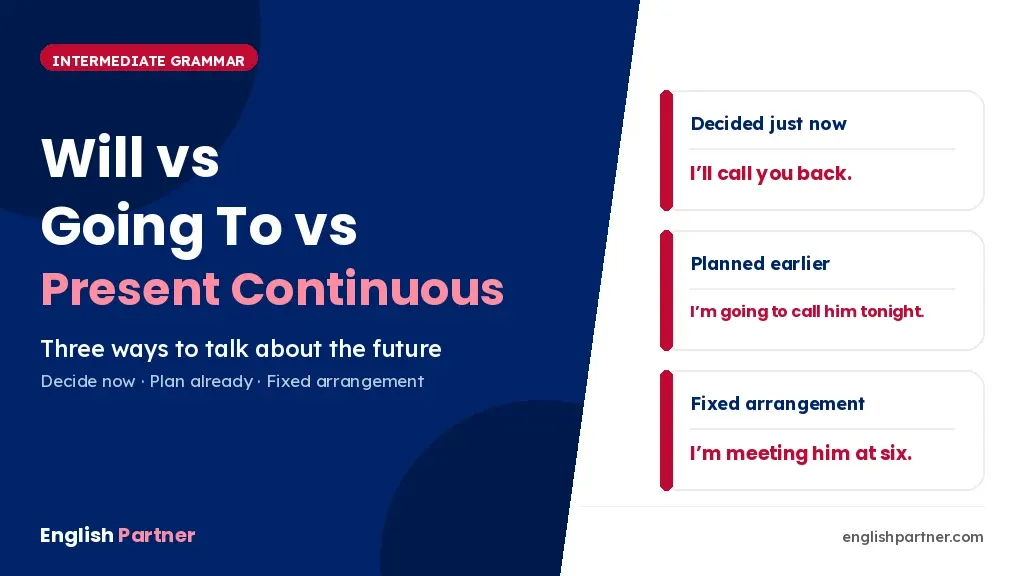
Quick answer: Ask one question – when did you decide? Deciding as you speak takes will (I’ll get it). An intention you already had takes going to (I’m going to start gym). An arrangement already fixed takes present continuous (I’m meeting him at four). Everything below is that one question applied to real sentences.
Why three forms for one future
Tamil, Telugu and Hindi manage the future with one form. English has three, and school usually taught only one – will. That is why so many learners say “I will go to Chennai next week” for a trip booked a month ago, and sound, to an English ear, like they just thought of it.
The three forms are not about grammar points. They tell the listener how settled the plan is. Getting that right is the difference between sounding fluent and sounding translated – which is why trainers at English Partner teach this as a speaking habit, not a rule to memorise.
Three forms, three moments
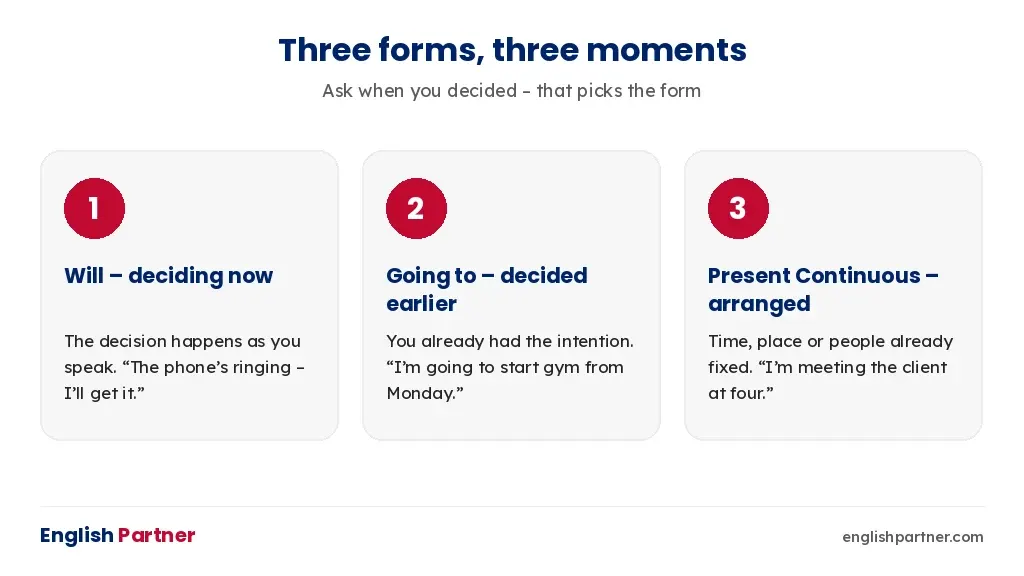
Will – you are deciding right now. The decision happens in the moment of speaking. The phone’s ringing – I’ll get it. You look tired, I’ll drive. Don’t worry, I’ll handle it.
Going to – you decided earlier. The intention already existed before this conversation. I’m going to start gym from Monday. We’re going to buy a new fridge this month.
Present continuous – it is already arranged. Time, place or people are fixed, often in your calendar. I’m meeting the client at four. We’re flying on Friday. She’s joining us for dinner.
Notice the pattern: as you move down the list, the plan gets more settled. Will is the loosest, present continuous the firmest.
Same situation, different form
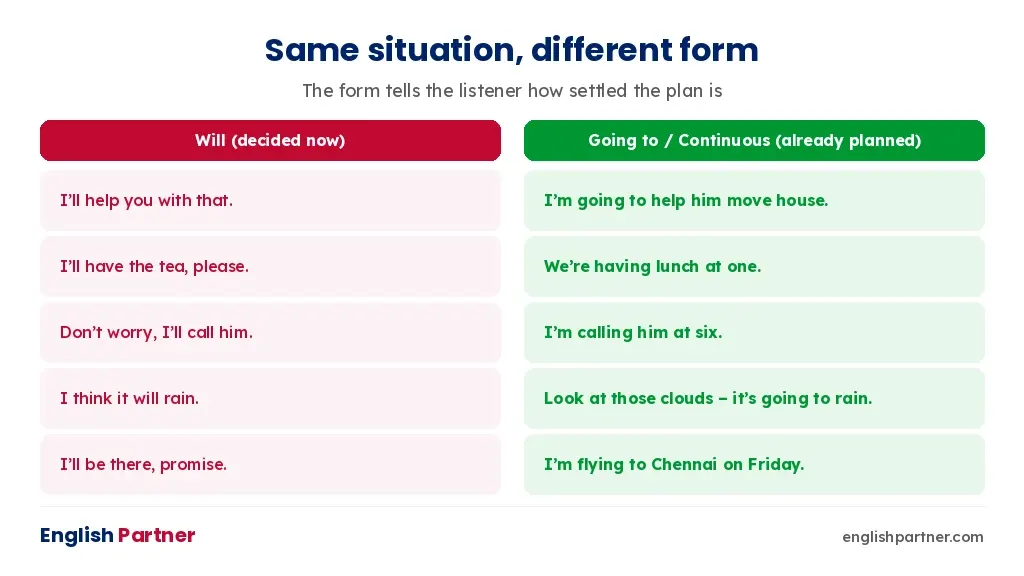
| Will (deciding now) | Going to / Continuous (already planned) | What changes |
|---|---|---|
| I’ll help you with that. | I’m going to help him move house. | First: offered this second. Second: agreed earlier. |
| I’ll have the tea, please. | We’re having lunch at one. | First: ordering now. Second: already booked. |
| Don’t worry, I’ll call him. | I’m calling him at six. | Second one has a time – so it is an arrangement. |
| I think it will rain. | Look at those clouds – it’s going to rain. | First: opinion. Second: evidence in front of you. |
| I’ll be there, promise. | I’m flying to Chennai on Friday. | First: a promise. Second: a ticket. |
| I’ll ask my manager. | I’m going to ask for a raise. | Second one has been on your mind for weeks. |
Read each pair aloud. You can hear the difference even before you can explain it – and that is exactly the goal.
Signal words that pick the form
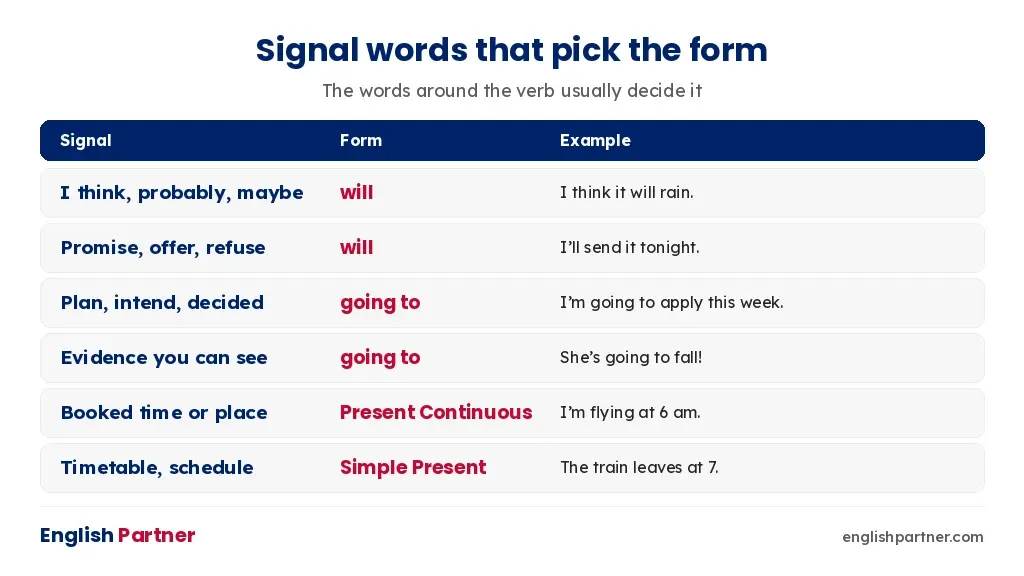
| Signal in the sentence | Form | Example |
|---|---|---|
| I think, probably, maybe, I’m sure | will | I think it will rain tomorrow. |
| Promises, offers, refusals | will | I’ll send it tonight. I won’t tell anyone. |
| Plan, intend, decided | going to | I’m going to apply this week. |
| Evidence you can see right now | going to | She’s going to fall! |
| Booked time, place or people | present continuous | I’m flying at 6 am. |
| Timetable or schedule | simple present | The train leaves at seven. |
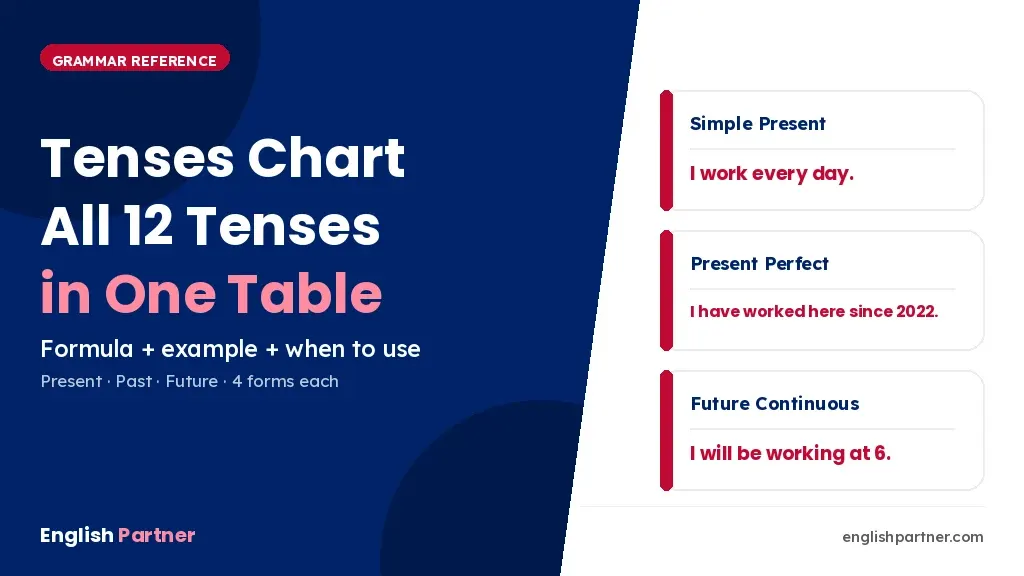
That last row surprises people. Timetables – trains, flights, office hours, class times – take the present tense in English, not a future form. “The shop opens at nine.” Our tenses chart shows where each of these sits in the full system.
Forming each one
| Will | Going to | Present continuous | |
|---|---|---|---|
| Statement | I will call. / I’ll call. | I am going to call. | I am calling at six. |
| Negative | I won’t call. | I’m not going to call. | I’m not calling today. |
| Question | Will you call? | Are you going to call? | Are you calling tomorrow? |
| Short answer | Yes, I will. | Yes, I am. | Yes, I am. |
In speech, will almost always becomes ’ll – I’ll, we’ll, he’ll. Saying the full “I will” every time is one of the small things that makes English sound stiff. And after will, the verb stays in its base form: I will go, never I will went. If verb forms still trip you up, our V1 V2 V3 guide settles it.
3 future-tense mistakes trainers hear
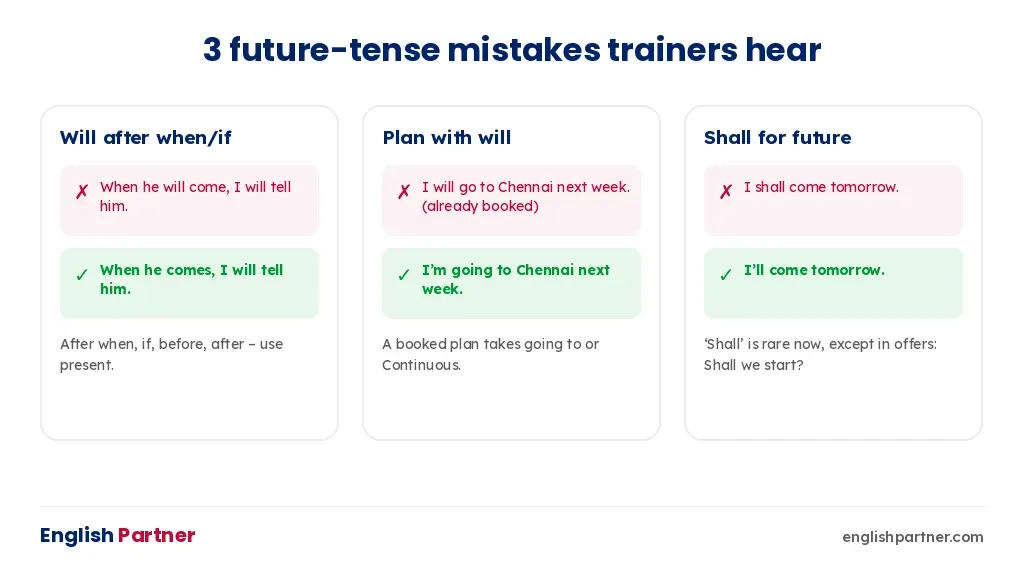
Mistake 1: “When he will come, I will tell him.” After when, if, before, after, until, as soon as, English uses the present even for future meaning: “When he comes, I will tell him.” One will per sentence, in the main part. This is the single most common future error among Indian learners.
Mistake 2: Using will for a settled plan. “I will go to Chennai next week” when the ticket is already booked. Say “I’m going to Chennai next week” – the arrangement is fixed, so the continuous fits.
Mistake 3: “I shall come tomorrow.” Shall is now rare in statements and sounds like a textbook from 1970. Use “I’ll come tomorrow.” Keep shall for offers and suggestions: “Shall we start?” “Shall I help you?”
A fourth, smaller one: “I am going to office tomorrow” needs the article – “to the office.”
Your 5-day speaking plan
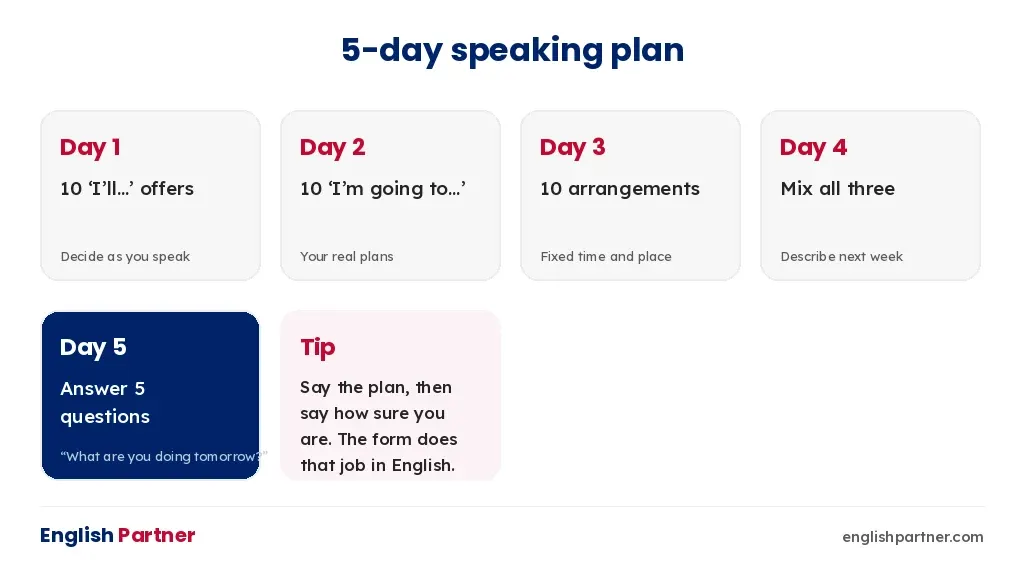
Day 1: Ten offers with I’ll… – decide as you speak. I’ll get it. I’ll call back. I’ll bring it tomorrow.
Day 2: Ten real plans with I’m going to… – things you have actually decided.
Day 3: Ten arrangements in present continuous, each with a time. I’m meeting Ravi at five.
Day 4: Describe next week using all three, out loud, in one go.
Day 5: Answer five questions: What are you doing tomorrow? What will you do if it rains? What are you going to do this month?
Ten minutes a day. By Day 5 the form arrives before you think about it, which is what fluency actually is.
When self-practice is not enough
You can learn this rule in ten minutes. What you cannot do alone is notice that you said “When he will come” in a client call – because it sounds completely fine inside your own head.
Our Intermediate level works on exactly this: future and perfect forms, through daily speaking practice on WhatsApp and live calls, with a trainer who explains the rule in your mother tongue and catches the slips as they happen. If simple present and past still feel shaky, start with Basic instead. Learners in the city can join our spoken English classes in Coimbatore in person. As Cambridge English notes, tense accuracy improves fastest when practice comes with feedback.
Final thoughts and your next step
One question: when did you decide? Just now – will. Earlier – going to. Already fixed – present continuous. Timetables stay in the present.
Try Day 1 tonight: ten offers with I’ll. Then pair this with our present perfect vs simple past guide and you will have the past and the future both covered.
Not sure which level to start from? Send “Hi” on WhatsApp for a free five-minute level test in your language.
Frequently asked questions
What is the difference between will and going to?
Will is for a decision made as you speak: “The phone’s ringing – I’ll get it.” Going to is for an intention you already had: “I’m going to start gym from Monday.” Same future, different moment of deciding.
When do I use present continuous for the future?
When the arrangement is already fixed – time, place or people are settled. “I’m meeting the client at four.” “We’re flying on Friday.” If it is in your calendar, present continuous is the natural choice.
Is “I will go to Chennai next week” wrong?
Not grammatically, but it sounds like you decided a second ago. If the trip is already planned, say “I’m going to Chennai next week” or “I’m going to travel to Chennai next week.”
Why is “When he will come, I will tell him” wrong?
After when, if, before, after and until, English uses the present even for future meaning: “When he comes, I will tell him.” One will per sentence, in the main part.
Should I use shall or will?
Use will. Shall now sounds formal or old-fashioned in statements. It survives mainly in offers and suggestions: “Shall we start?” “Shall I help you?”
How do I talk about a timetable in the future?
Use the simple present: “The train leaves at seven.” “The office opens at nine.” Fixed schedules take present tense, not will.
What is the difference between “it will rain” and “it’s going to rain”?
“It will rain” is a prediction from opinion or knowledge. “It’s going to rain” is a prediction from evidence you can see right now – dark clouds, a dropping sky.
Which English Partner course covers future tenses?
Intermediate. It covers the future and perfect forms through daily speaking practice, explained in your mother tongue first.