Past Continuous vs Simple Past: “I Was Eating” or “I Ate”?
 Vishaleni
Content Writer
Published
Time to read
8 minutes
Vishaleni
Content Writer
Published
Time to read
8 minutes
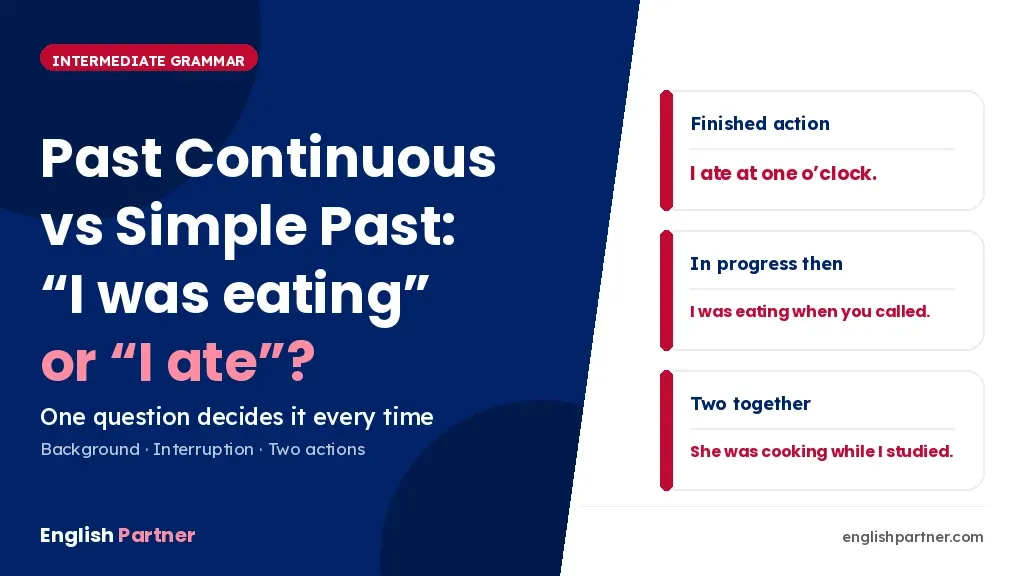
Quick answer: Ask one question – was the action finished, or still running at that moment? Finished takes simple past (I ate at one). Still running takes past continuous (I was eating when you called). And the short action that interrupts is always simple past. Example pairs, signal words and the when/while rules are below.
Why this pair confuses Indian learners
Tamil, Telugu and Hindi all manage the past comfortably with one main form. English splits it, and school usually taught the two tenses in separate chapters months apart – so learners know both forms but not which one belongs where.
The result is the sentence trainers at English Partner hear in every Intermediate batch: “Yesterday I was watching the full match.” Grammatically formed, but it tells the listener the match was interrupted. The speaker meant they watched the whole thing.
That is what this tense pair actually does: it tells the listener how the action sat in time. Once you hear that, choosing becomes automatic.
The one-question test
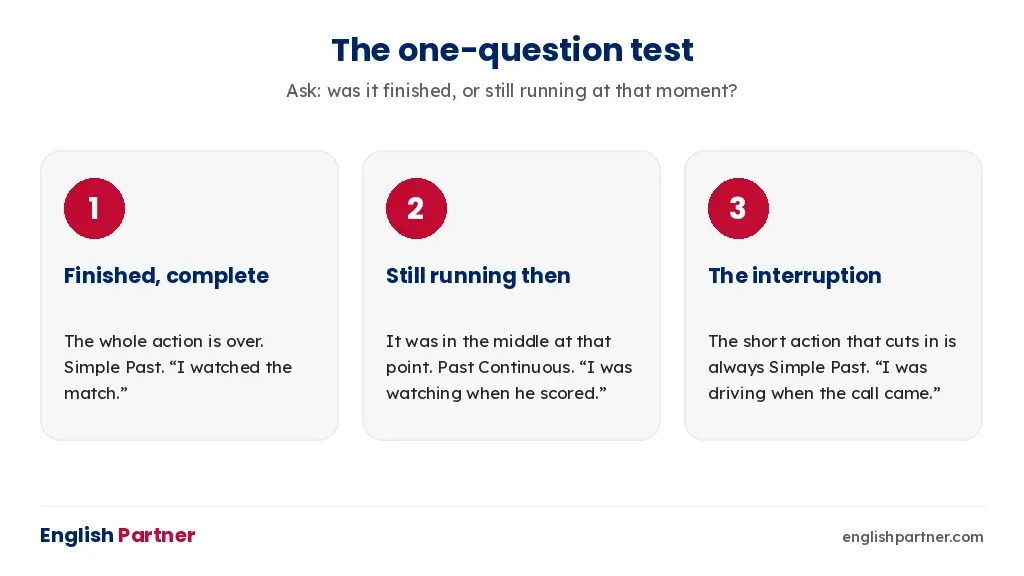
Finished and complete → simple past. The whole action is over, start to end. I watched the match. She cooked dinner. We finished at six.
Still running at that moment → past continuous. You are pointing at the middle of it. I was watching when he scored. She was cooking at eight. We were still working at six.
The interruption → always simple past. The short action that cuts in never takes the continuous. I was driving when the phone rang.
Notice how the second and third work together. Most real sentences use both tenses at once – a long background action and a short one that lands inside it.
Forming the past continuous
| Simple Past | Past Continuous | |
|---|---|---|
| Formula | V2 | was / were + V-ing |
| Statement | I worked. They came. | I was working. They were coming. |
| Question | Did you work? | Were you working? |
| Negative | I didn’t work. | I wasn’t working. |
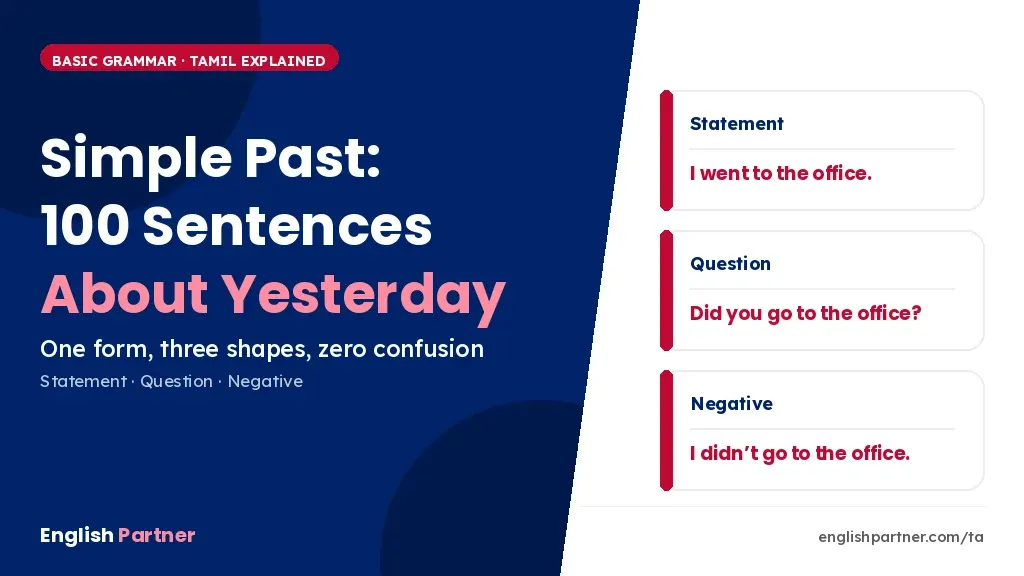
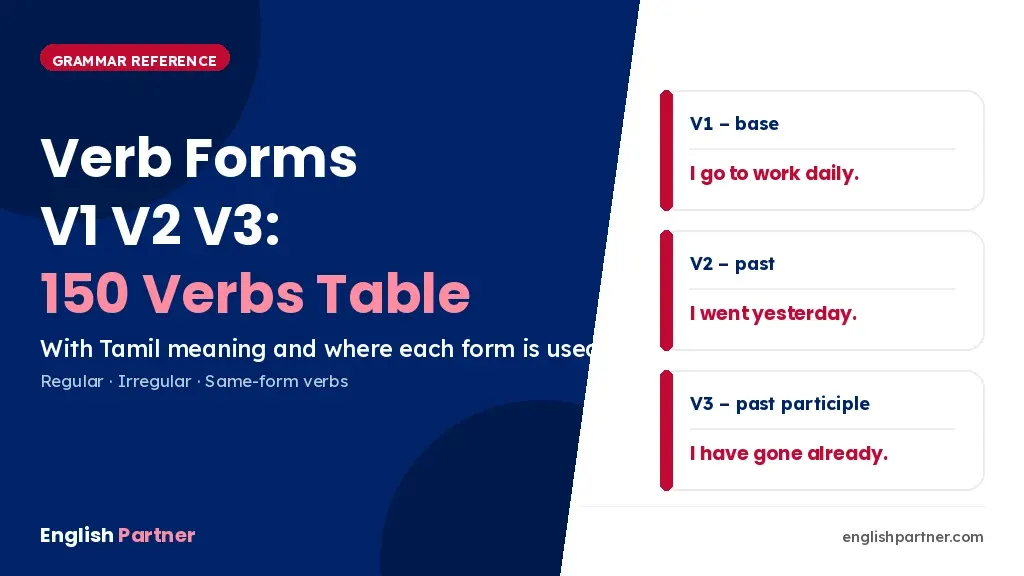
Was goes with I, he, she, it. Were goes with you, we, they. And notice the continuous never uses did – the question simply moves was/were to the front. If the simple past side still feels shaky, our simple past guide has 100 sentences, and the verb forms table covers the V2 forms.
Past continuous vs simple past: same verb, two tenses
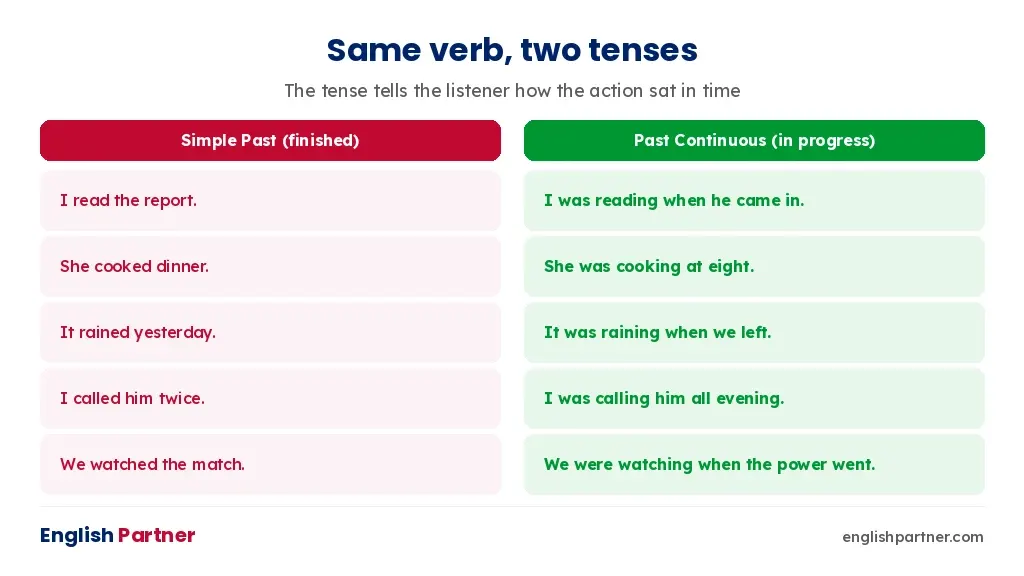
| Simple Past (finished) | Past Continuous (in progress) | What changes |
|---|---|---|
| I read the report. | I was reading when he came in. | First: finished it. Second: interrupted. |
| She cooked dinner. | She was cooking at eight. | Second one points at a moment, not the result. |
| It rained yesterday. | It was raining when we left. | Second one sets the scene for another event. |
| I called him twice. | I was calling him all evening. | Second suggests repeated effort, not a result. |
| We watched the match. | We were watching when the power went. | First: the whole match. Second: part of it. |
| He worked here in 2019. | He was working here when I joined. | Second uses his job as the background. |
Read each pair aloud. The difference is not about time words – it is about whether you are describing a completed event or standing inside one.
When and while: the two clause words
These two words do most of the work in real sentences, and they behave differently.
When usually introduces the short action, in simple past:
| Tamil | English |
|---|---|
| நான் ஓட்டிட்டு இருந்தப்போ ஃபோன் வந்துச்சு. | I was driving when the phone rang. |
| நான் சமைச்சிட்டு இருந்தப்போ அவரு வந்தாரு. | I was cooking when he came. |
| நாங்க கிளம்பும்போது மழை பெஞ்சுது. | We were leaving when it started to rain. |
| நான் படிச்சிட்டு இருந்தப்போ கரண்ட் போச்சு. | I was studying when the power went. |
While usually introduces the long action, in past continuous:
| Tamil | English |
|---|---|
| நான் ஓட்டிட்டு இருந்தப்போ ஃபோன் அடிச்சுது. | While I was driving, the phone rang. |
| அவள் சமைச்சிட்டு இருந்தா, நான் படிச்சிட்டு இருந்தேன். | While she was cooking, I was studying. |
| நான் காத்திட்டு இருந்தப்போ மெசேஜ் படிச்சேன். | While I was waiting, I read my messages. |
| அவங்க பேசிட்டு இருந்தாங்க, நான் நோட்ஸ் எடுத்தேன். | While they were talking, I took notes. |
Two continuous actions running together is the one case where both halves take the continuous: “She was cooking while I was studying.” Both were in the middle, so neither is finished.
Signal words that pick the tense
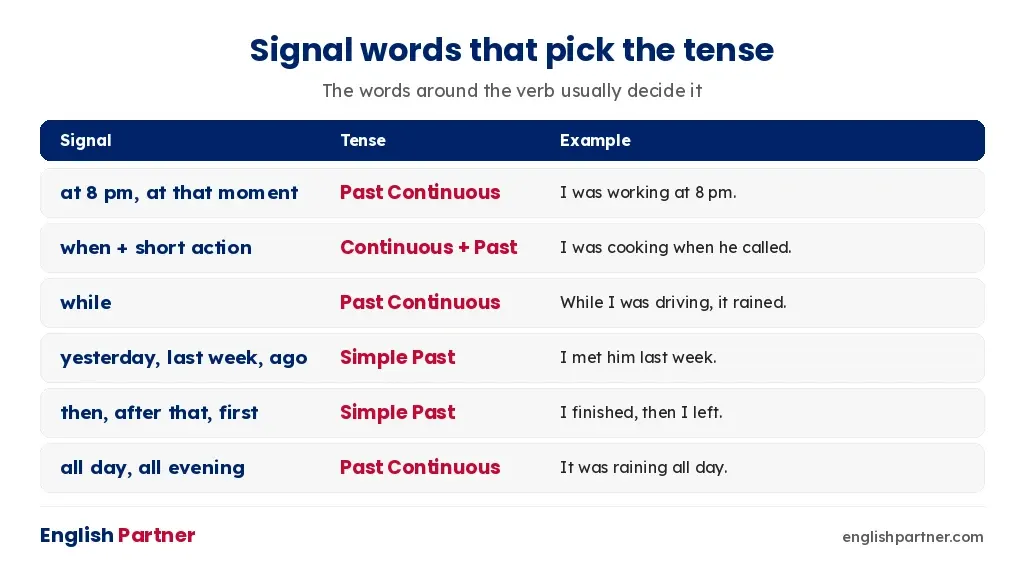
| Signal in the sentence | Tense | Example |
|---|---|---|
| at 8 pm, at that moment, at the time | Past Continuous | I was working at 8 pm. |
| when + a short action | Continuous + Simple Past | I was cooking when he called. |
| while | Past Continuous | While I was driving, it rained. |
| all day, all evening, the whole time | Past Continuous | It was raining all day. |
| yesterday, last week, two days ago | Simple Past | I met him last week. |
| then, after that, first, finally | Simple Past | I finished, then I left. |
The last row matters for storytelling. When you list events in order – first this, then that – every step is a completed action, so the whole sequence stays in the simple past. The continuous only appears when you stop to describe the scene.
Telling a story with both tenses
Here is how the two work together in a real paragraph. The continuous sets the scene; the simple past moves the story forward.
“Yesterday evening I was working on the report when my manager called. It was raining outside, and the internet was acting up. I told him I would finish by nine. While I was typing the last page, the power went. I saved the file, closed the laptop and went home.”
Four continuous verbs – all background. Five simple past verbs – all events. That is the natural rhythm of storytelling in English, and copying it is the fastest way to sound fluent when you describe your day.
3 mistakes trainers hear at Intermediate
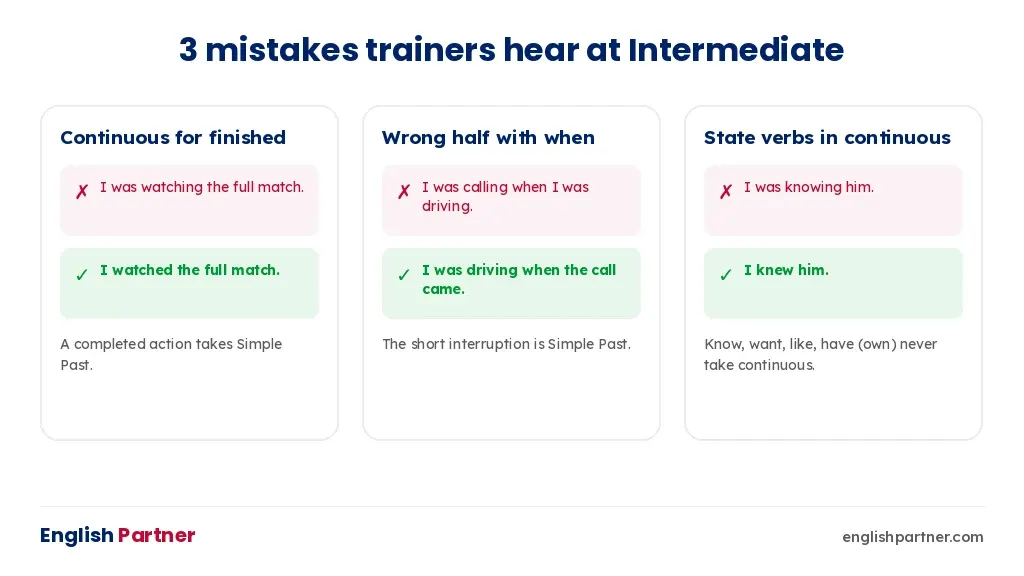
Mistake 1: continuous for a completed action. “I was watching the full match.” The word full tells us it finished, so it takes simple past: “I watched the full match.”
Mistake 2: the wrong half with “when”. “I was calling when I was driving.” Both halves cannot be the background. The short action takes simple past: “I was driving when the call came.”
Mistake 3: state verbs in continuous. “I was knowing him.” Know, want, like, need, understand, believe and have (meaning own) never take continuous forms: “I knew him.” This is the same rule behind “I am having a car” being wrong – our have, has, had guide covers that side.
Your 3-day practice plan
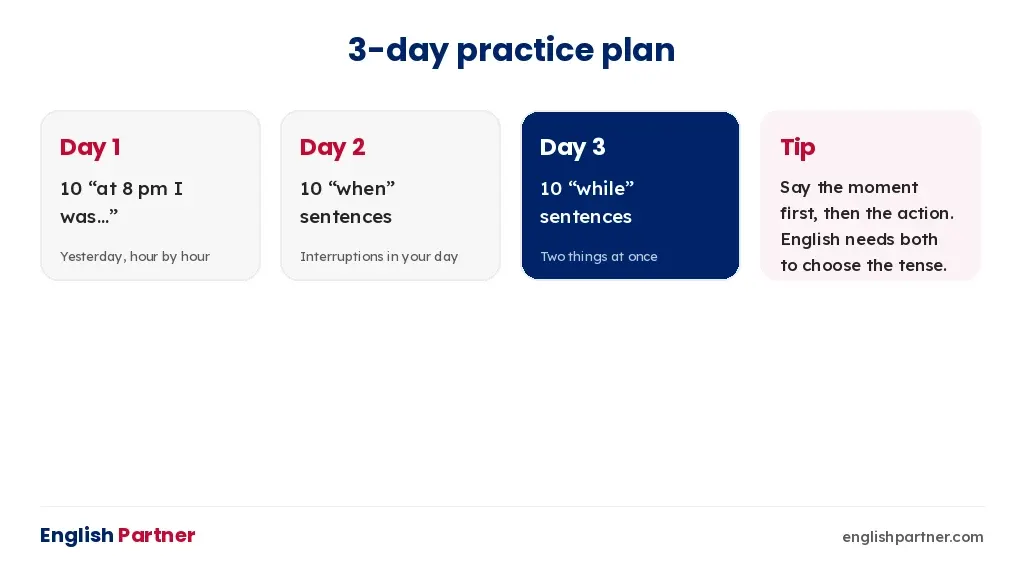
Day 1: Ten sentences starting “At 8 pm yesterday I was…” – walk through your day hour by hour.
Day 2: Ten when sentences – real interruptions from your week. I was eating when my sister called.
Day 3: Ten while sentences – two things happening together. While I was cooking, my son was studying.
Then tell yesterday’s story out loud in one go, mixing both tenses the way the paragraph above does. Thirty sentences over three days, and the choice stops being a decision.
When self-practice is not enough
This is a tense pair you can understand in ten minutes and still get wrong in conversation for years – because both forms sound acceptable inside your own head, and nobody corrects adults mid-sentence.
Our Intermediate level works on exactly this: continuous, perfect and future forms, through daily speaking practice on WhatsApp and live calls, with a trainer who explains the rule in your mother tongue and catches the slips as they happen. If the simple past itself still feels uncertain, start with Basic. Learners in the city can join our spoken English classes in Coimbatore in person. As Cambridge English notes, tense accuracy improves fastest when practice comes with feedback.
Final thoughts and your next step
One question: finished, or still running? Finished takes the simple past. Still running takes the continuous. The short action that interrupts is always simple past, and state verbs never take the continuous at all.
Try Day 1 tonight – ten sentences about where you were and what you were doing at 8 pm. Then pair this with our present perfect vs simple past guide and the tenses chart, and the whole past system fits together.
Not sure which level to start from? Send “Hi” on WhatsApp for a free five-minute level test in your language.
Frequently asked questions
What is the difference between past continuous and simple past?
Simple past is for a finished action: “I ate at one.” Past continuous is for an action still running at a past moment: “I was eating when you called.” Ask whether the action was complete or in the middle at that point.
How do I form the past continuous?
Was or were plus the -ing form: I was working, they were waiting. Use was for I, he, she, it; were for you, we, they.
How do when and while work together?
The long, background action takes past continuous and the short action that interrupts takes simple past: “I was driving when the phone rang.” While usually introduces the longer action: “While I was driving, the phone rang.”
Is “I was watching the full match” correct?
No. The full match is a completed action, so it takes simple past: “I watched the full match.” Use the continuous only for the middle of it: “I was watching when he scored.”
Why is “I was knowing him” wrong?
Know is a state verb, and state verbs do not take continuous forms. The same applies to want, like, need, understand and have when it means own. Say “I knew him.”
Can I use past continuous for two actions at the same time?
Yes, with while: “She was cooking while I was studying.” Both actions were running together, so both take the continuous.
Does past continuous always need a time or an event?
Almost always. The continuous describes a moment, so the sentence needs something to fix it — a clock time, a “when” clause, or a period like “all evening”.
Which English Partner course covers this?
Intermediate. It covers the continuous, perfect and future forms through daily speaking practice, explained in your mother tongue first.