Present Perfect vs Simple Past: “I Have Eaten” or “I Ate”? (One Question Decides It)
 Vishaleni
Content Writer
Published
Time to read
9 minutes
Vishaleni
Content Writer
Published
Time to read
9 minutes
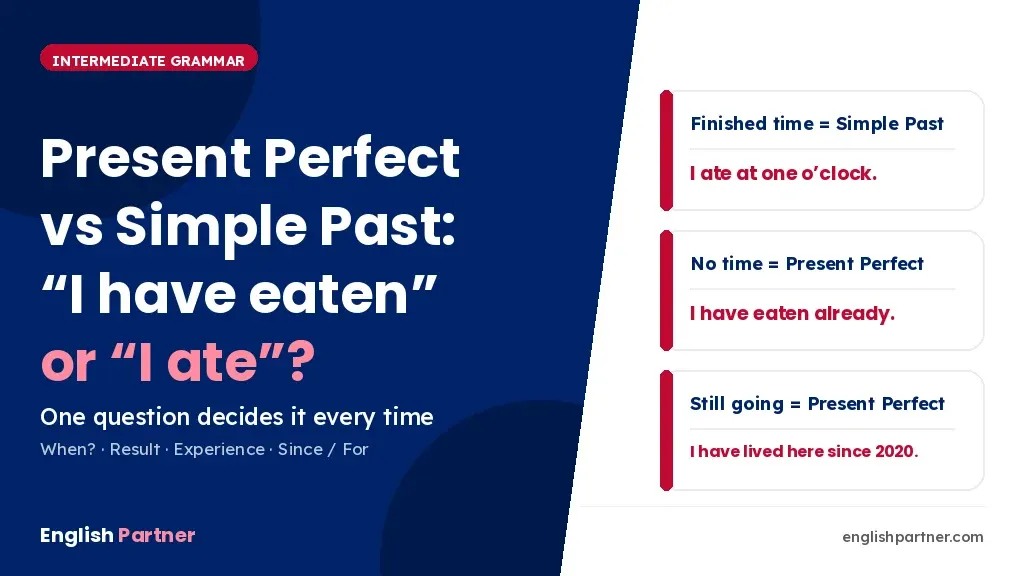
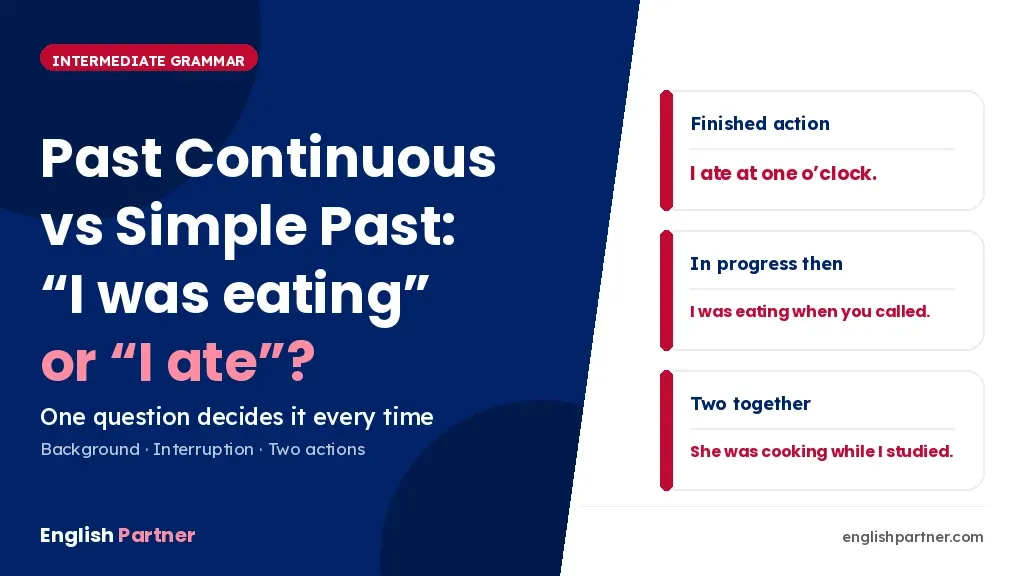
Quick answer: Ask one question – can I say when it happened? If yes (yesterday, at five, in 2020), use Simple Past: I ate at one. If no, or if the situation is still running (since, for, today, ever, yet), use Present Perfect: I have eaten. I have lived here since 2020. That single question handles almost every case. The pairs, the time-word cheat sheet and the mistakes are below.
Why this pair confuses so many learners
Present Perfect vs Simple Past is the question Intermediate learners at English Partner ask more than any other. And the confusion is fair: both tenses talk about the past, both often translate to the same Tamil, Telugu or Hindi sentence, and school taught them as two separate lists of rules.
Here is what school did not say clearly enough: the difference is not really about the action. It is about the time. One tense points at a finished moment; the other deliberately does not.
The one-question test
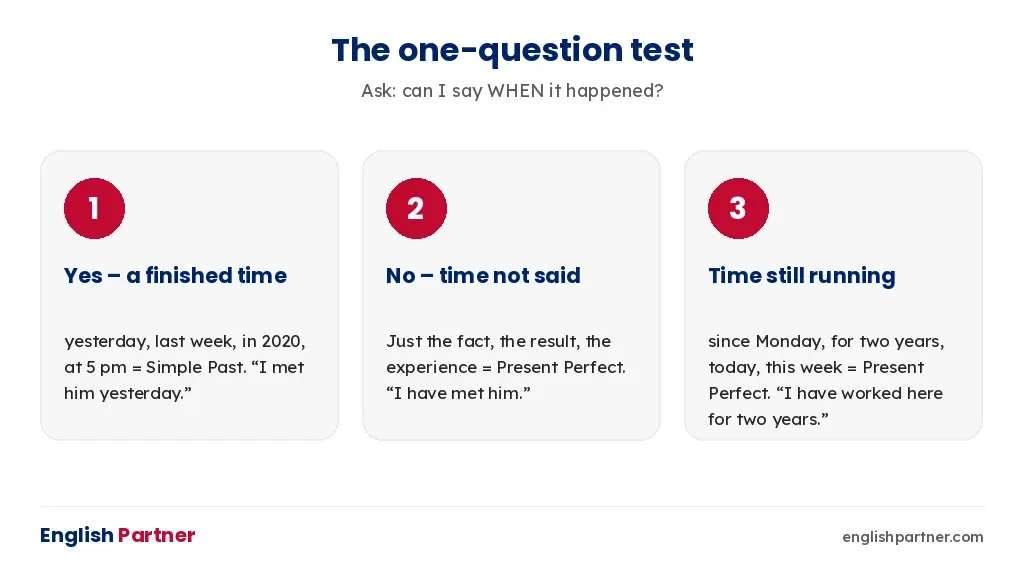
Before you choose the tense, ask: Can I say when?
Yes, and that time is over. Yesterday, last week, at five, in 2020, two days ago. → Simple Past. I met him yesterday. She called at five. We moved here in 2020.
No, I’m not saying when. The point is the fact, the result or the experience – not the time. → Present Perfect. I have met him. She has called. Have you eaten?
The time is still running. Since Monday, for two years, today, this week, so far. → Present Perfect. I have worked here for two years. I have called her twice today.
Notice that the third case is really the second one in disguise: the time is not finished, so you cannot point at it.
Same action, two tenses
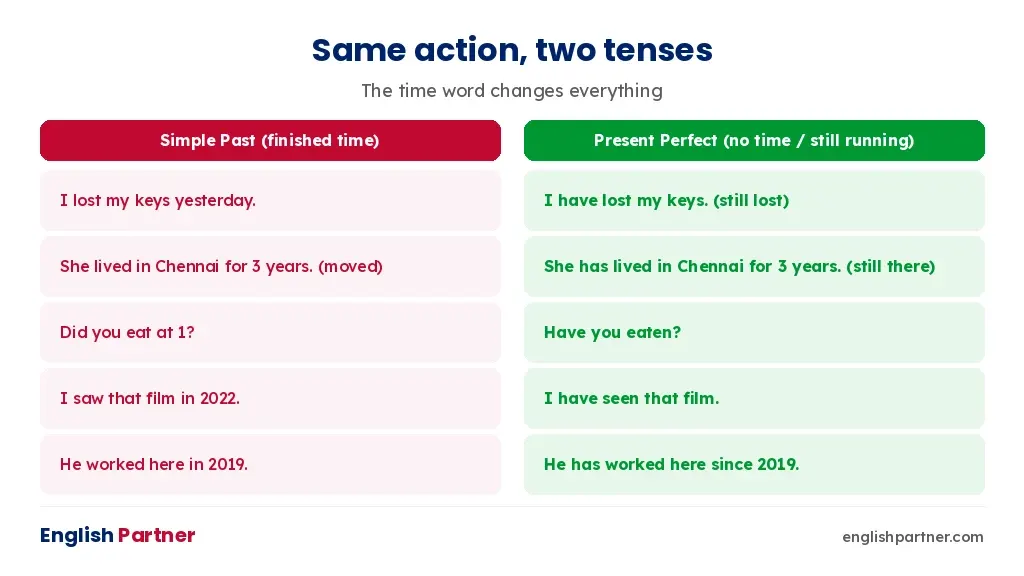
Read each pair aloud and feel the difference.
| Simple Past (time finished) | Present Perfect (no time / still running) | What changes |
|---|---|---|
| I lost my keys yesterday. | I have lost my keys. | Second one: they are still lost, and that is the point. |
| She lived in Chennai for three years. | She has lived in Chennai for three years. | First: she moved away. Second: she is still there. |
| Did you eat at one? | Have you eaten? | First asks about a time. Second asks about hunger now. |
| I saw that film in 2022. | I have seen that film. | Second: experience, no date needed. |
| He worked here in 2019. | He has worked here since 2019. | First: over. Second: still working. |
| I finished the report at six. | I have finished the report. | Second: it is done – that is the news. |
| We met in college. | We have met before. | First: where and when. Second: just the fact. |
| Amma cooked biryani on Sunday. | Amma has cooked biryani. | Second: it is ready now. |
The time-word cheat sheet
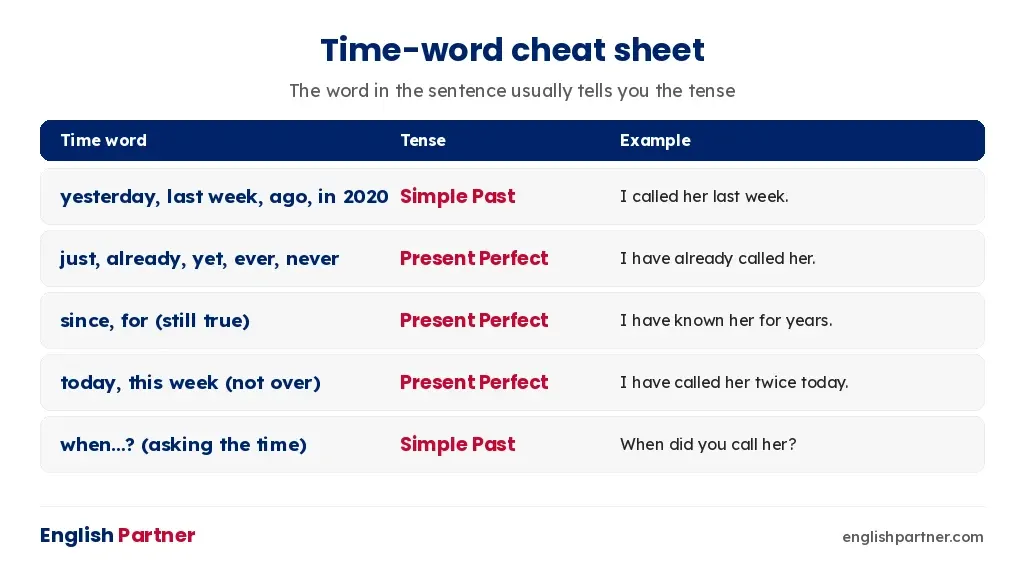
Most sentences contain a word that tells you the tense before you even think about it.
| Words that point to a finished time → Simple Past | Words that leave the time open → Present Perfect |
|---|---|
| yesterday, last night, last week, last year | just, already, yet |
| two days ago, a month ago | ever, never, before |
| in 2020, in March, on Monday | since (a starting point), for (a length, still true) |
| at five, this morning (if morning is over) | today, this week, this year (still going) |
| when…? (asking for the time) | so far, up to now, recently, lately |
Two words deserve their own note. Since marks where something started: since 2020, since Monday. For marks how long: for five years, for two hours. Both take Present Perfect when the situation is still true. Our existing post on the differences between since and for goes deeper.
Forming the two tenses
| Simple Past | Present Perfect | |
|---|---|---|
| Formula | V2 | have/has + V3 |
| Statement | I ate. She went. | I have eaten. She has gone. |
| Question | Did you eat? Did she go? | Have you eaten? Has she gone? |
| Negative | I didn’t eat. She didn’t go. | I haven’t eaten. She hasn’t gone. |
If have/has is still shaky, our have, has, had guide settles it, and the tenses chart shows where both of these sit among the twelve.
3 mistakes trainers hear at Intermediate
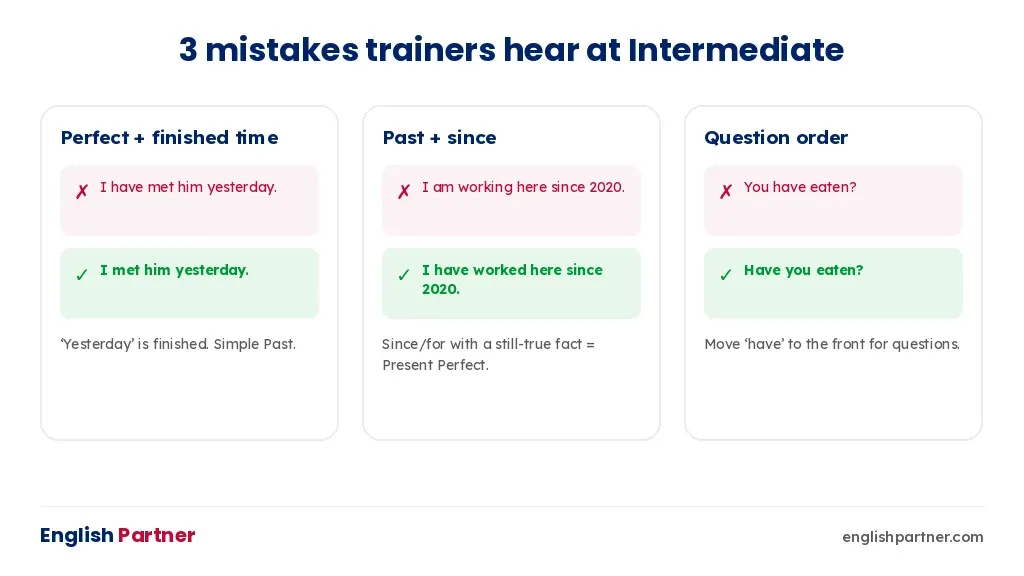
Mistake 1: Present Perfect with a finished time. “I have met him yesterday.” The moment you say yesterday, the time is finished, and Present Perfect is no longer allowed. “I met him yesterday.” This is the most common tense error among Indian learners – it is on our 15 mistakes Tamil speakers make list too.
Mistake 2: Present Continuous with since / for. “I am working here since 2020.” Since and for, with something still true, take Present Perfect: “I have worked here since 2020” (or have been working, if you want to stress that it is ongoing).
Mistake 3: Statement order in questions. “You have eaten?” People will understand you, but it sounds unsure. Move have to the front: “Have you eaten?”
A note on American English
You will hear Americans say “I already ate” and “Did you eat yet?” – Simple Past where British and Indian English use Present Perfect. Both are understood everywhere. If you are preparing for IELTS or working with UK or Indian companies, stick with Present Perfect for already, yet, just; if your team is American, either is fine.
How to practise it for speaking
Each evening, two short lists, out loud:
Five things with a time (Simple Past): I woke up at six. I called Amma at eight. I had lunch at one…
Five things with no time (Present Perfect): I have finished my work. I have drunk three coffees today. I haven’t called Ravi yet…
Ten sentences, three minutes. After two weeks, the one-question test runs in your head without you asking it.
When self-practice is not enough
You can learn the rule from this page. What you cannot do alone is notice that you said “I have seen him yesterday” in a meeting – nobody corrects adults, so the habit stays for years.
Our Intermediate level works on exactly this: perfect and future tenses, through daily speaking practice on WhatsApp and live calls, with a trainer who explains the rule in your mother tongue and catches the slips as they happen. Learners in the city can join our spoken English classes in Coimbatore in person. As Cambridge English notes in its guidance for learners, tense accuracy improves fastest when practice comes with feedback.
Final thoughts and your next step
One question: can I say when? Yes and it is over – Simple Past. No, or still running – Present Perfect. Everything else on this page is just that question applied to real sentences.
Try the two lists tonight. And if you would like a trainer to listen and tell you which tense slips you make without knowing, send “Hi” on WhatsApp for a free level test in your language.
Frequently asked questions
What is the difference between Present Perfect and Simple Past?
Simple Past is for a finished action at a finished time: “I ate at one.” Present Perfect is for an action with no stated time, a result that matters now, or something that started in the past and is still true: “I have eaten”, “I have lived here since 2020.”
Is “I have eaten” or “I ate” correct?
Both, in different situations. “I ate at one o’clock” (time given) is Simple Past. “I have eaten” (no time, the point is that you are not hungry now) is Present Perfect.
Can I use Present Perfect with “yesterday”?
No. Yesterday, last week, in 2020, two days ago – any finished time – takes Simple Past. “I have met him yesterday” is one of the most common mistakes among Indian learners; the correct form is “I met him yesterday.”
What is the rule for since and for?
Both go with Present Perfect when the situation is still true: “I have worked here since 2020 / for five years.” Since marks the starting point; for marks the length. If the situation is over, use Simple Past: “I worked there for five years” (not anymore).
How do I ask a question in Present Perfect?
Move have/has to the front: “Have you eaten?” “Has she called?” Keep the verb in V3.
Do Americans use Simple Past where British English uses Present Perfect?
Yes, often. American English accepts “I already ate” and “Did you eat yet?” Both forms are understood everywhere; Indian English generally follows the British pattern.
How can I practise this for speaking?
Each evening, say five things you did at a specific time today (Simple Past) and five things you have done with no time (Present Perfect): “I called Amma at six” / “I have finished my work.”
Which English Partner course covers Present Perfect?
Intermediate. It covers the perfect and future tenses through daily speaking practice, explained in your mother tongue first.