12 Differences Between "Since" and "For": A Simple Guide for English Learners
 Vishaleni
Content Writer
Last Updated
Time to read
6 minutes
Vishaleni
Content Writer
Last Updated
Time to read
6 minutes

Why "Since" and "For" Confuse So Many Learners
In many Indian languages like Tamil, Hindi, and Telugu, one word can often cover both meanings. So when learners switch to English, they naturally mix up “since” and “for.” This is a very common and completely normal mistake. With a little practice, you can fix it quickly and speak more naturally.
Quick Overview: Since vs For
Before we go into the 12 differences, here is a simple chart to help you see the main idea at a glance.
| Point | Since | For |
|---|---|---|
| Refers to | A starting point in time | A length of time |
| Answers | Since when? | How long? |
| Example | Since 2020 | For 5 years |
| Common tense | Present perfect | Present perfect & past simple |
This table gives you the foundation. Now let us break it down step by step.
The 12 Differences Between "Since" and "For"
1. “Since” Points to a Starting Time
We use “since” to show when something started. It marks a point in the past.
For example: I have lived in Bangalore since 2019.
Here, 2019 is the exact starting point of the action.
2. “For” Shows a Length of Time
We use “for” to show how long something lasts. It refers to a period, not a point.
For example: I have lived in Bangalore for six years.
Here, “six years” is the total duration.
3. “Since” Answers “Since When?”
When someone asks “Since when?”, the answer uses “since.”
For example: She has been studying since morning.
This tells us the moment the studying began.
4. “For” Answers “How Long?”
When someone asks “How long?”, the answer uses “for.”
For example: She has been studying for three hours.
This tells us the total time spent studying.
5. “Since” Needs a Specific Date or Time
“Since” is always followed by a fixed point — a date, day, year, or event.
Examples include since Monday, since 5 o’clock, since 2015, since I was a child.
Each one is a clear moment in time.
6. “For” Needs a Number or General Duration
“For” is followed by a quantity of time, like hours, days, weeks, or years.
Examples include for two hours, for ten days, for a long time, for ages.
Each one tells us the length, not the start.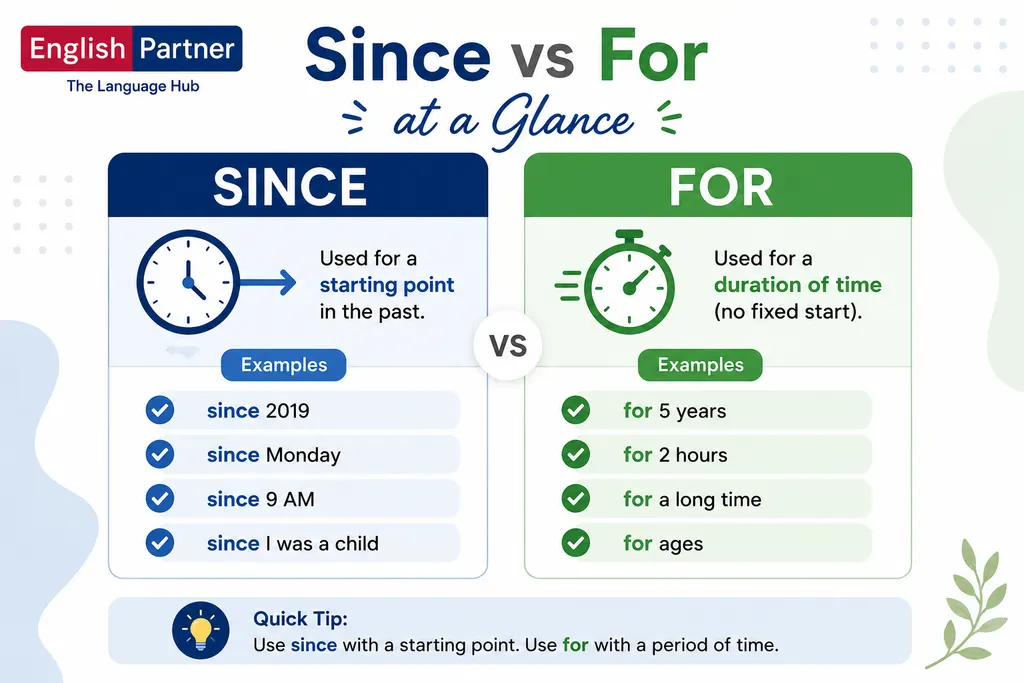
7. “Since” Usually Uses the Present Perfect Tense
“Since” works best with the present perfect tense (has/have + verb). This shows an action that started in the past and continues now.
For example: We have known each other since college.
The friendship started in college and still continues.
8. “For” Can Be Used With More Tenses
“For” is more flexible. It works with present perfect, past simple, and even future tenses.
For example:
She lived in Chennai for ten years. (past simple)
I will stay here for a week. (future)
9. “Since” Can Follow With a Full Clause
Sometimes “since” is followed by a complete event, not just a date.
For example: I have felt happier since I joined the spoken english class.
Here, “I joined the class” is the starting point.
10. “For” Cannot Replace “Since” With Specific Times
This is a common error. We never say “since two hours.” The correct word is “for.”
For example:
✅ We have been waiting for two hours.
❌ We have been waiting since two hours.
11. “Since” Often Pairs With “Ever”
We sometimes use “ever since” to add emphasis to a starting point.
For example: He has been nervous about speaking English ever since school.
This stresses that the feeling started long ago and continues.
12. “For” Can Sometimes Be Left Out
In casual speech, “for” can sometimes be dropped, but “since” cannot.
For example: They have been married (for) ten years.
Both versions are correct. But you cannot remove “since” the same way.
A Simple Trick to Remember the Difference
Here is a simple routine you can follow at home.
Step 1: Write five sentences about your own life using “since.”
Example: I have worked here since 2022.
Step 2: Write five sentences using “for.”
Example: I have worked here for three years.
Step 3: Read them aloud daily for one week.
Step 4: Ask a friend or trainer to check them.
This kind of daily practice helps the rules become natural over time.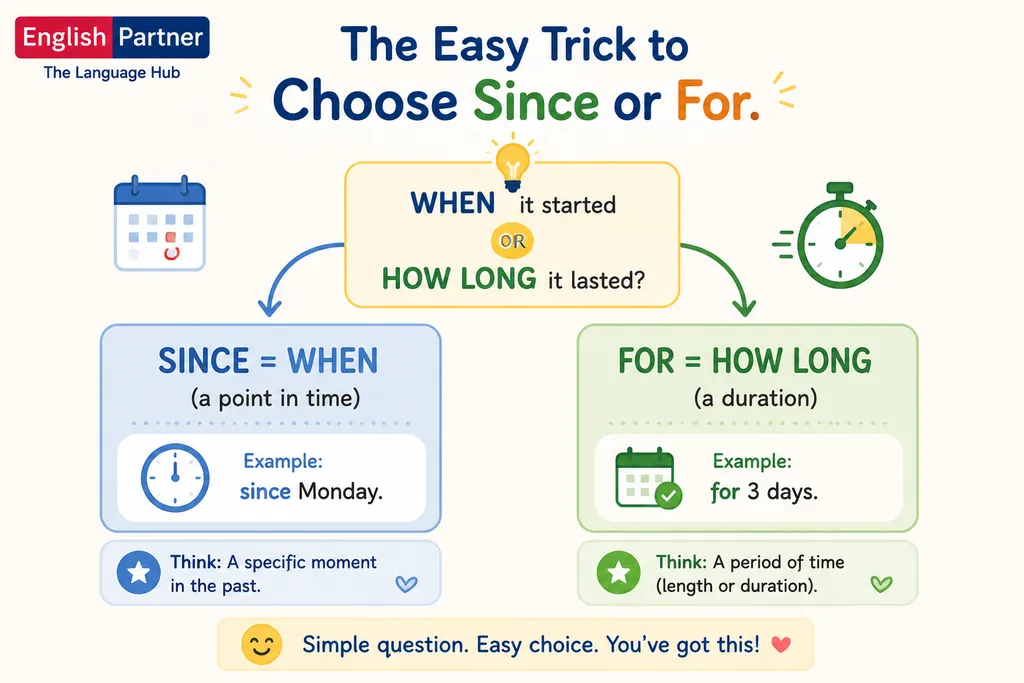
Common Mistakes Learners Make
Even confident speakers sometimes slip up. Here are the most frequent errors we notice in our classes.
- Saying “since five years” instead of “for five years”
- Using past simple with “since” instead of present perfect
- Forgetting that “for” needs a duration, not a date
According to Cambridge Dictionary, the key rule is simple: for refers to periods of time, while since refers to a point in time. Keeping this in mind will save you from most mistakes.
You can also explore more examples on the British Council LearnEnglish website, which is a trusted authority for grammar learners worldwide.
When Self-Study Is Not Enough
Reading rules is a great start. But speaking naturally is a different skill. Many learners understand the difference between “since” and “for” on paper, yet still hesitate while talking. This is completely normal. If you find yourself freezing during conversations or interviews, guided practice can help. A structured spoken english course gives you the chance to practise with real feedback and slowly build confidence. Results may vary from person to person, and steady daily practice always matters most.
Final Thoughts
The difference between “since” and “for” comes down to one idea — a starting point versus a length of time. Once you remember that, the confusion fades away. Keep practising with your own real-life examples. Small daily efforts add up faster than you think.
Ready to Speak English With More Confidence?
If you often feel unsure about grammar like “since” and “for” while speaking, you are not alone — and you do not have to figure it out by yourself.
At English Partner, we help learners across Bangalore, Chennai, and Hyderabad build real speaking confidence through guided, friendly practice.
👉 Take a quick assessment on EnglishPartner.com to find out which course suits your current level and goals. Let us help you take the next confident step in your English journey.
Frequently asked questions
What is the simplest difference between "since" and "for"?
"Since" tells you when something started, and "for" tells you how long it lasted. That single idea covers most situations.
Can I use "for" with a specific date?
No. With a date or fixed time, you must use "since." Use "for" only with a length of time like hours or years.
Is it correct to say "since two hours"?
No, this is a common mistake. The correct form is "for two hours" because two hours is a duration, not a starting point.
Which tense should I use with "since"?
"Since" usually goes with the present perfect tense, such as "I have lived here since 2020."
Can "for" be used in past and future sentences?
Yes. "For" is flexible and works in past, present, and future. For example, "I will stay for a week."
Why do Tamil, Hindi, and Telugu speakers confuse these words?
Many Indian languages use one word for both meanings. So switching to English naturally causes mix-ups, which improve with practice.
How long does it take to master "since" and "for"?
With regular daily practice, most learners feel comfortable within a few weeks. The exact time depends on your effort and consistency.
Can I drop the word "for" in a sentence?
Sometimes, yes. You can say "They have been married ten years." But you cannot drop "since" the same way.