How to Learn English in Telugu: A Step-by-Step Plan for Beginners
 Dhinesh Kumar
Content Writer
Published
Time to read
10 minutes
Dhinesh Kumar
Content Writer
Published
Time to read
10 minutes
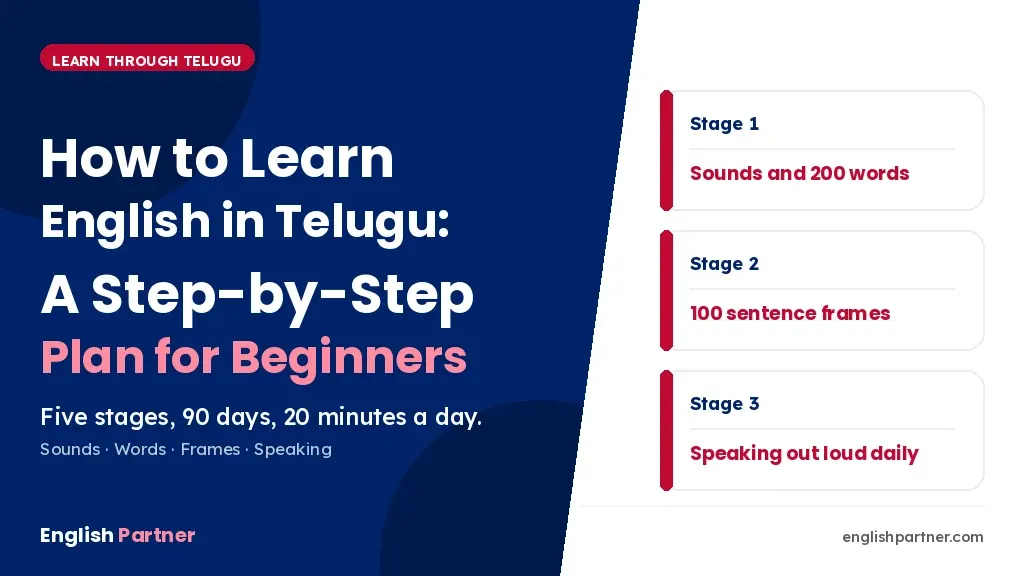
Quick answer: Learn in five stages, in this order – 200 words with Telugu meaning, 100 sentence frames, 20 minutes of speaking aloud daily, listening, then real conversation. Most beginners stall because they study grammar for months and never reach stage three. The 90-day plan is below.
Telugu is not the obstacle
A lot of advice tells Telugu speakers to “think only in English” from day one. For an adult beginner that is bad advice, and it is the reason many people quit in the first fortnight.
Here is what actually happens. A rule explained in Telugu – why English needs was when Telugu puts the past inside the verb – takes about two minutes to land. The same rule taught in English-only takes three or four sessions and still feels slippery.
So Telugu is the fastest route into the rule. What you remove later is something much narrower: the habit of building a full Telugu sentence and converting it while someone waits for your answer. Understanding in Telugu is fine. Learning in Telugu is fine. Only live conversion costs you time.
That distinction matters because it tells you what kind of practice to do – explanation in Telugu, practice in English. Most learners have had the opposite: English explanations they half-followed, and almost no speaking practice at all.
How to learn English in Telugu: the 5-stage path
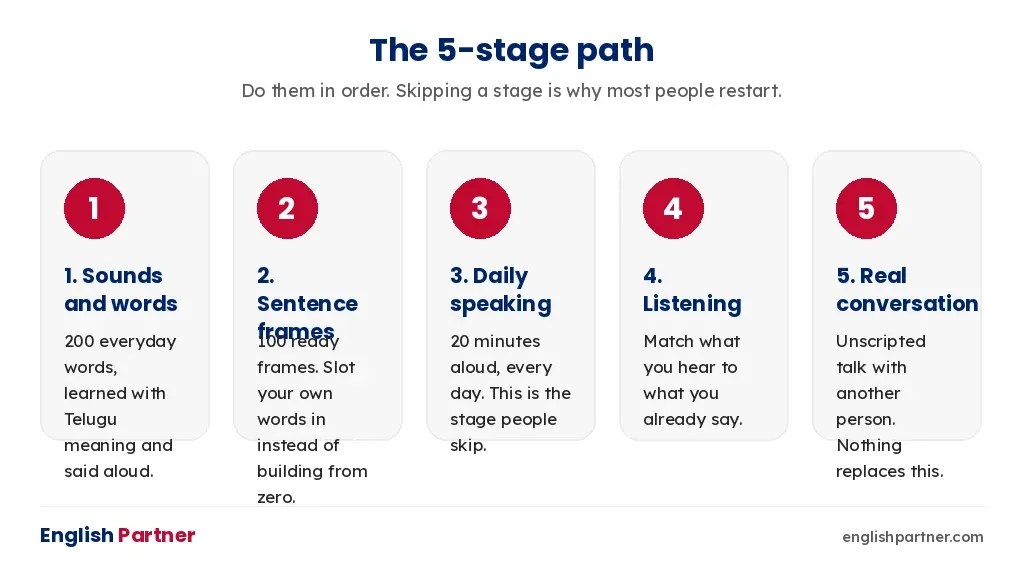
Stage 1 – sounds and 200 words. Everyday words only, each learned with its Telugu meaning and said aloud. Not 2,000 words. Two hundred, properly, with the right pronunciation.
Stage 2 – 100 sentence frames. A frame is a ready-made shape you slot words into: “Could you please ___?”, “I am looking for ___.” Frames matter more than vocabulary because they remove the assembly step.
Stage 3 – daily speaking, 20 minutes. This is the stage almost everyone skips, and it is the one that produces fluency. Aloud, every day, mistakes included.
Stage 4 – listening. Only after you can say something does hearing it make sense. Listening first and speaking later is the wrong order for adults.
Stage 5 – real conversation. Unscripted talk with another person. Nothing in stages 1 to 4 replaces this, and no amount of extra study substitutes for it.
The 90-day plan
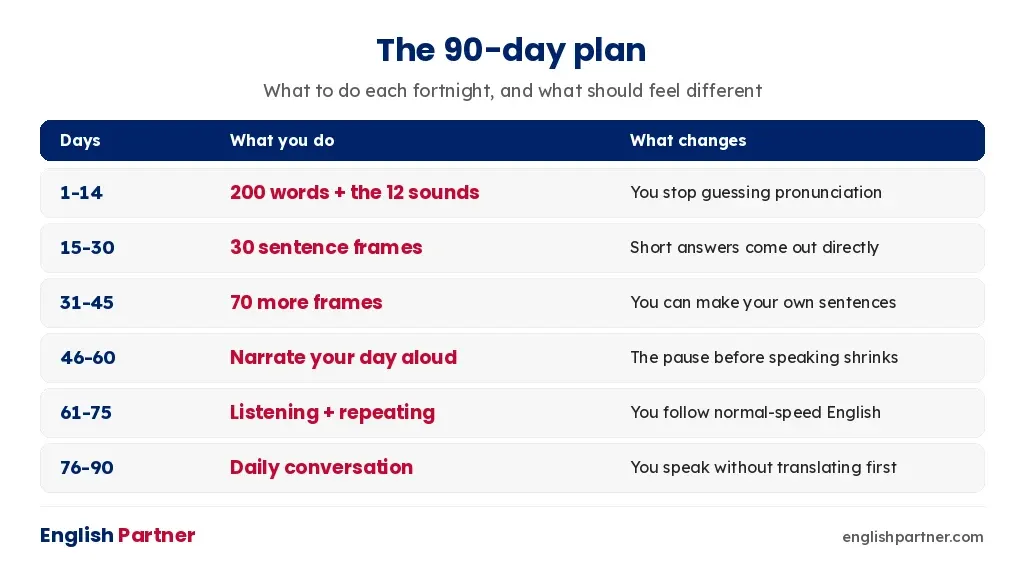
Read the right-hand column carefully. Knowing what should feel different by day 30 is what stops you concluding it is not working.
Days 46 to 60 are the ones to watch. That is where the pause before speaking shrinks noticeably – and it is also where many learners feel they have gone backwards, because they have started attempting longer sentences. That dip is progress, not failure.
Stage 1: words that earn their place
Start with words you will use today, with the Telugu meaning beside each one. Say every word aloud – silent reading does almost nothing for speech.
| English | Telugu |
|---|---|
| tomorrow | రేపు |
| yesterday | నిన్న |
| now | ఇప్పుడు |
| later | తరువాత |
| daily | రోజూ |
| enough | సరిపోతుంది |
| almost | దాదాపు |
| maybe | కావచ్చు |
| already | ఇప్పటికే |
| still | ఇంకా |
Notice these are not nouns. Beginners usually learn objects – table, chair, bus – and then cannot build a sentence, because sentences are held together by time and quantity words like the ones above.
Stage 2: the frames that do most of the work
Store these whole. Do not break them into words, and do not look for the Telugu equivalent of each part – only of the complete frame.
| English frame | Telugu |
|---|---|
| Could you please send me… | దయచేసి పంపగలరా… |
| I am looking for… | నేను … వెతుకుతున్నాను |
| I am not sure about that. | నాకు సరిగ్గా తెలియదు. |
| Let me check and tell you. | చూసి చెప్తాను. |
| Could you say that again? | మళ్ళీ చెప్పగలరా? |
| I did not quite understand. | నాకు అర్థం కాలేదు. |
| Give me a second. | ఒక్క నిమిషం. |
| That works for me. | అది నాకు సరిపోతుంది. |
| Can we talk later? | తరువాత మాట్లాడుదామా? |
| Thank you so much. | చాలా ధన్యవాదాలు. |
Ten frames, said aloud five times each, and they start arriving before the Telugu does. That is the entire mechanism behind speaking without translating – and it is why frames beat vocabulary lists.
Once these are comfortable, our Telugu to English sentences guide has a longer set to work through.
Stage 3: your 20 minutes a day
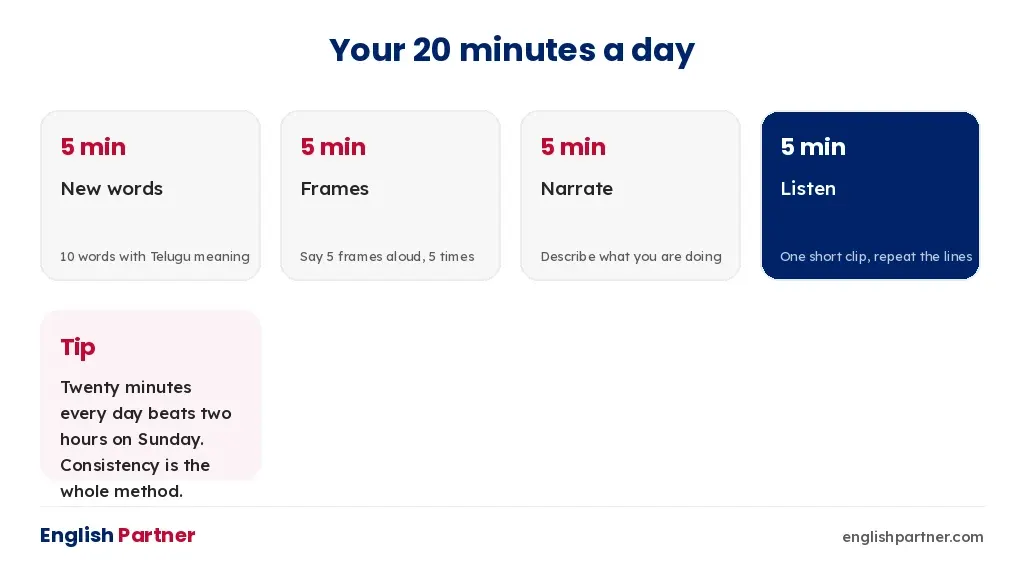
Four blocks of five minutes. The narration block is the one that does the heavy lifting – describing what you are doing as you do it, out loud, in English.
“I am making coffee. I am checking my phone. I am about to leave.” Nobody has to hear it. The point is that your mouth produces English without a translation step, because the thing you are describing is in front of you.
Twenty minutes daily beats two hours on Sunday, and that is not a motivational line – speech is a motor habit, and motor habits need frequency rather than duration.
3 mistakes Telugu speakers make while self-learning
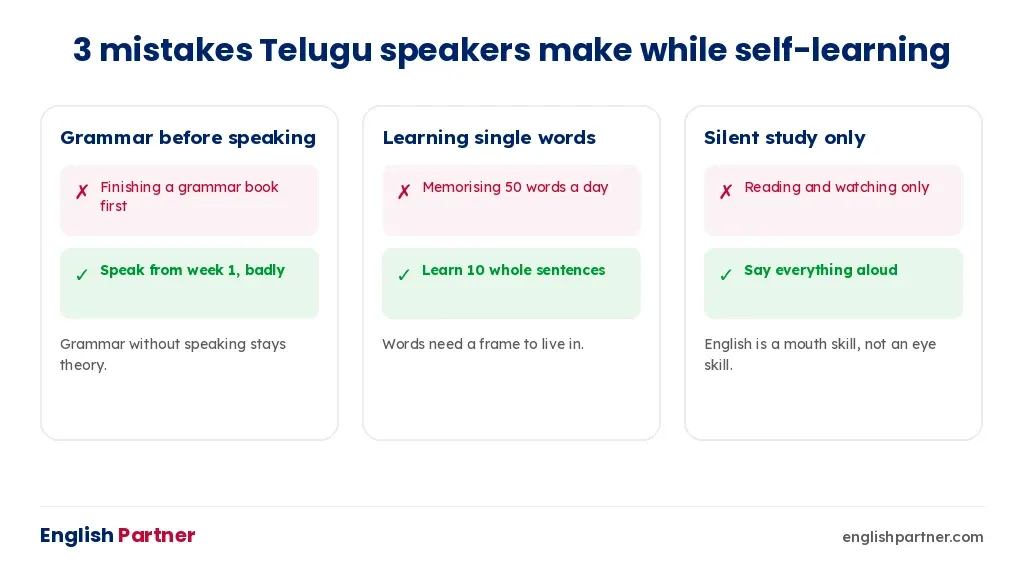
Mistake 1 – grammar before speaking. Finishing a grammar book first feels responsible and produces almost no spoken ability. Speak from week one, badly, and let the grammar settle through use.
Mistake 2 – learning single words. Fifty words a day is impressive and unusable. Ten whole sentences is slower on paper and far more useful in conversation, because a word needs a frame before you can say it.
Mistake 3 – silent study only. Reading, watching and scrolling build understanding, not speech. English is a mouth skill. If your tongue has not practised it, it will not come out under pressure.
There is also a specific first-language pattern worth knowing about – the handful of mistakes that come straight from Telugu sentence structure. Our guide to the English mistakes Telugu speakers make covers those with the fix for each. The British Council makes the same broader point about adult learners: regular spoken output matters more than more input.
Self-study and trainer-led: an honest comparison
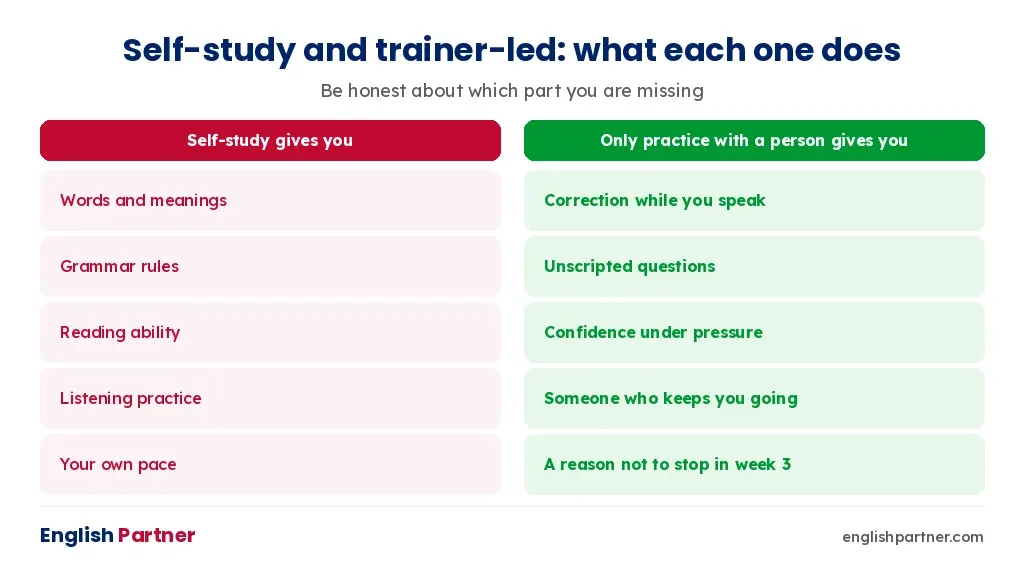
Stages 1, 2 and 4 work perfectly well alone, free, at home. Words, frames, reading and listening need nobody.
Stages 3 and 5 are where self-study hits a ceiling, and it is worth being clear about why. Alone, nobody tells you that your frame is slightly off. Nobody asks you something you did not prepare for. And nobody keeps you talking past the point where it gets uncomfortable – which is exactly where learning happens.
That is also why week three is the common quitting point. The early progress has flattened, the pause has come back because you are attempting harder sentences, and there is no one to tell you that this is normal.
So the honest answer is: start free. If you are still stuck at the same place after a month of real daily practice, the missing piece is a person, not more material.
Where to go when you want a trainer
If you decide you want someone on the other end, our spoken English course through Telugu is built around exactly the gap above – trainers who explain the rule and the correction in Telugu, with daily WhatsApp speaking practice and live calls so stages 3 and 5 actually happen.
Learners in Telangana and Andhra can also join locally through our spoken English classes in Hyderabad, Vijayawada or Vizag.
Final thoughts and your next step
Five stages, in order. Two hundred words, a hundred frames, twenty minutes aloud every day, then listening, then real conversation. Telugu stays – as the way you understand the rule, not as the sentence you convert mid-conversation.
Tonight, do one thing: take the first ten frames above and say each one aloud five times. That is Stage 2 started, and it takes under ten minutes.
Not sure which stage you are at? Send “Hi” on WhatsApp for a free five-minute level test in Telugu.
Frequently asked questions
How can I learn English in Telugu as a complete beginner?
Follow five stages in order: 200 everyday words with Telugu meaning, then 100 sentence frames, then 20 minutes of speaking aloud daily, then listening, then real conversation. Most beginners fail because they skip straight to grammar and never reach the speaking stage.
How long does it take to learn English through Telugu?
With 20 minutes of daily practice, most adults hold short English conversations in about 90 days. The first visible change – shorter pauses before you speak – usually comes in the third or fourth week.
Is it okay to learn English through Telugu instead of English only?
Yes, and for most adults it is faster. A rule explained in Telugu takes two minutes to understand; the same rule in English-only takes several sessions. Use Telugu to understand, then practise the sentence in English.
What should I learn first – grammar or speaking?
Speaking. Grammar studied without speaking stays theory and does not transfer to conversation. Start saying imperfect sentences from week one and let the grammar correct itself through use.
How many English words do I need to speak everyday English?
Around 800 to 1,000 words cover most daily conversation. More useful than the count is learning them inside whole sentences, because single words need a frame to sit in before you can use them.
Can I learn English in Telugu for free at home?
Yes, for the first two stages – words, frames, reading and listening all work alone. What self-study cannot give you is correction while you speak and unscripted conversation, which is where most learners stall around week three.
What is the best 20-minute daily routine?
Five minutes of new words, five minutes saying sentence frames aloud, five minutes narrating what you are doing, and five minutes of listening and repeating. Twenty minutes daily works better than two hours once a week.
Does English Partner teach in Telugu?
Yes. Trainers explain grammar and corrections in Telugu while pushing you to practise in English, through WhatsApp classes and live calls with 24/7 personal trainer support.