Why Adults Give Up on English in Week 3 — and What Actually Works
 Dhinesh Kumar
Content Writer
Published
Time to read
9 minutes
Quick answer: Four reasons, and ability is not one of them. Wrong level, invisible progress, sessions too long, and nobody correcting you. Each has a fix that costs nothing, and the dip arrives on a predictable schedule.
Why adults give up on English: the shape of it
If you have started learning English before and stopped, you are in a very large group, and the way it happened was probably close to this:
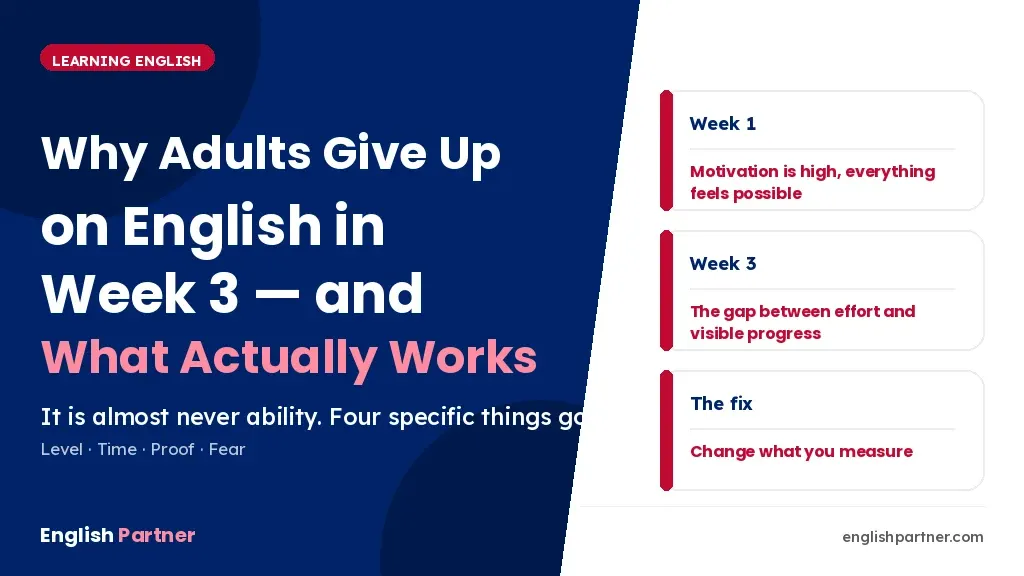
Week 1. Motivation is high. You study an hour a day, you understand the lessons, it feels like this time will be different.
Week 2. Still going. One or two days missed. You tell yourself you will make them up.
Week 3. The missed days did not get made up. You look back and cannot point to anything you can do now that you could not do three weeks ago. You still cannot speak.
Week 4. It quietly stops. Nothing dramatic — you just do not open it again.
That is not a personal failing. It is a predictable pattern with four causes, and once you can see them they stop being mysterious.
Reason 1: you were placed in the wrong level
This is the biggest one and the least talked about.
Most people choose their own level, and almost everyone chooses too high — partly out of pride, partly because they confuse understanding English with being able to produce it. You read English every day, so starting at a beginner level feels insulting.
Then the course moves at a pace you cannot speak at. Every session leaves you slightly behind. By week three the gap is wide enough that showing up feels bad, and stopping feels like relief.
The fix: start lower than feels right. A level that is slightly too easy for two weeks costs you two weeks. A level that is too hard costs you the whole attempt — and usually two years before you try again.
Reason 2: progress in speaking is invisible
You can feel vocabulary growing. You can see a completed chapter. You cannot feel fluency arriving — it happens too gradually, and your own ear adjusts as you improve, which hides the change from you.
So at week three you take stock and find no evidence. Not because there is none, but because you have no way to see it.
The fix: record sixty seconds on day one. Talk about your day, badly. Save it and do not listen to it. Record again every week.
When the week-three dip arrives — and it will — listen to the day-one recording. That is the entire intervention, and it works on almost everyone, because the difference is audible even when it is not yet noticeable.
Reason 3: the session was too long
An hour a day sounds serious, and that is the problem. An hour requires a clear slot, a quiet place and energy you may not have after a working day.
So it gets postponed to the weekend, and weekend plans get filled, and a missed Sunday takes the whole week with it.
The fix: twenty minutes, daily, at the same time. Three reasons it works better:
- It fits. Twenty minutes exists in almost every day, even bad ones.
- Frequency beats duration. Language is built by repeated exposure, not by long sessions. Seven twenty-minute sessions beat one two-hour session comfortably.
- A missed day costs a day. Not a week. That alone decides whether you are still going in month two.
Reason 4: nobody was correcting you
You can read grammar alone. You cannot correct your own speaking, for the same reason you cannot hear your own accent — your brain plays you the sentence you intended, not the one you produced.
Without correction, mistakes do not stay neutral. They harden. Six weeks of practising “he said me” makes it more automatic, not less.
And there is a second cost: you have no idea whether you are improving, which feeds straight back into reason 2.
The fix: one person who corrects you. A trainer, a colleague, anyone willing to say “you meant told, not said”. The number of people needed is one.
The two beliefs underneath all four
“Grammar first, speaking later.” This feels responsible and it is why people study for months and still cannot talk. Speaking is a muscle, and it does not wait politely while you finish the book. You can hold a full conversation with present tense and three hundred words — grammar tidies up what you are already saying.
“I'll start speaking when I'm ready.” Confidence does not come before speaking. It comes from having spoken badly a number of times and survived. Waiting to feel ready is waiting for an effect to arrive before its cause.
Both beliefs are reasonable, both are widely held, and both quietly guarantee the week-three quit.
The part nobody says out loud
There is a fifth reason, and it is the real one for many adults: there is nowhere safe to be bad at it.
At thirty-five, with a job and a family and people who respect you, speaking broken English in front of anyone is genuinely uncomfortable. That discomfort is not weakness — it is a reasonable response to a real social cost.
Two things help, and neither requires courage:
Practise alone, out loud. Narrate what you are doing while cooking or driving. In English, to nobody. It feels ridiculous for about two days and then it does not, and it gives your mouth the reps without any audience at all.
Choose an audience who has no stake. Your own children, a trainer who was hired for this, a shopkeeper you will never see again. The people whose opinion you care most about are the worst place to start, not the first.
What twenty minutes should actually contain
"Twenty minutes a day" is useless advice without a shape, and most people fill it with the easiest activity — reading — which is the one that improves speaking least.
| Minutes | What to do | Why |
|---|---|---|
| 5 | Say yesterday out loud, in English | Past tense, real content, no preparation |
| 5 | Read a short piece aloud | Builds pronunciation and pace together |
| 5 | Learn 4 words, used in your own sentences | Words in isolation do not survive |
| 5 | Record one minute and send it to someone | The correction loop, without which nothing sticks |
Notice that fifteen of the twenty minutes involve your mouth moving. If your study hour is silent, you are improving reading, and reading was never your problem.
When quitting is actually the right call
Worth saying, because not every stop is a failure.
If you started a course and the level is clearly wrong, stopping that course is correct — the mistake would be concluding you cannot learn English. If life genuinely has no twenty minutes in it this month, pausing deliberately and restarting on a named date is a decision, not a collapse.
The difference is whether you stop on purpose. A planned pause with a restart date is fine. A quiet fade where you simply stop opening it, and six months later believe you are someone who cannot learn English — that is the one worth preventing.
If you are pausing, write the restart date down somewhere, and keep the day-one recording. Both of those take a minute and both make the restart far more likely.
3 beliefs that cause the quit
If you want the research behind spaced, frequent practice rather than long sessions, the British Council publishes free guidance for adult learners.
A restart that survives week 3
The point of the plan is not intensity. It is that week three is marked on it in advance. The dip stops being evidence that you are failing and becomes a scheduled part of the thing — which is the difference between a dip and a quit.
When self-practice is not enough
You can fix three of the four reasons alone: start lower, shorten the session, record yourself. The fourth one you cannot. Nobody can correct their own speaking, and that is not a matter of effort.
That is what a trainer is for — catching the mistake in a real sentence, explaining it in your mother tongue, and making you say it again correctly before the habit sets. Learners can join our spoken English classes in Coimbatore, our spoken English classes in Chennai, or our spoken English classes in Pondicherry.
Final thoughts and your next step
You did not fail last time because you lacked ability. You were probably placed too high, measuring the wrong thing, attempting too much per session, and speaking to nobody who could correct you.
Today, record sixty seconds about your day, in English, badly. Save it somewhere you will not delete it. In four weeks that recording will be the only honest evidence you have — and on the day you need it, it will be the thing that keeps you going.