15 English Mistakes Telugu Speakers Make (and Why Telugu Grammar Causes Them)
 Vishaleni
Content Writer
Published
Time to read
9 minutes
Vishaleni
Content Writer
Published
Time to read
9 minutes
Quick answer: Most English mistakes Telugu speakers make are not random. They come from Telugu grammar – verb at the end, ఉంది for having, no articles, కదా – being translated word for word. Below are the 15 most common, grouped by the Telugu pattern behind them, with the one-line fix for each.
These are not “bad English”
Trainers at English Partner hear the same fifteen sentences in almost every Telugu batch. I am having a car. Myself Priya. She married with him. I passed out in 2024.
None of these come from carelessness. Every one of them is a perfectly good Telugu sentence wearing English words. The learner is doing exactly what a careful person does – translating accurately. The problem is that Telugu and English are built differently, and a word-for-word translation carries the Telugu structure across.
That is good news. If the mistakes come from a pattern, they can be fixed as a pattern – once you can see it. So this post is organised by the Telugu grammar behind each mistake, not as a random list.
The biggest pattern: word order
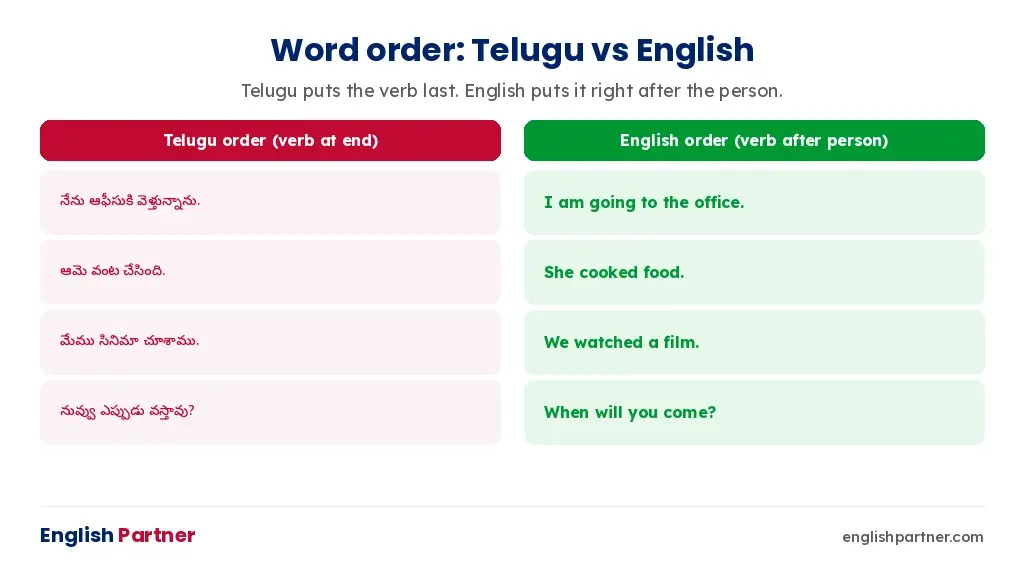
Telugu puts the verb at the end: నేను ఆఫీసుకి వెళ్తున్నాను. English puts it right after the person: I am going to the office.
This one difference is behind the feeling that English is “backwards.” It is not a mistake by itself, but it slows you down, because you build the sentence in Telugu order and then have to rearrange it. Getting used to person → verb → rest is the single biggest speed gain a Telugu learner can make.
Mistakes 1–3: the “having” family
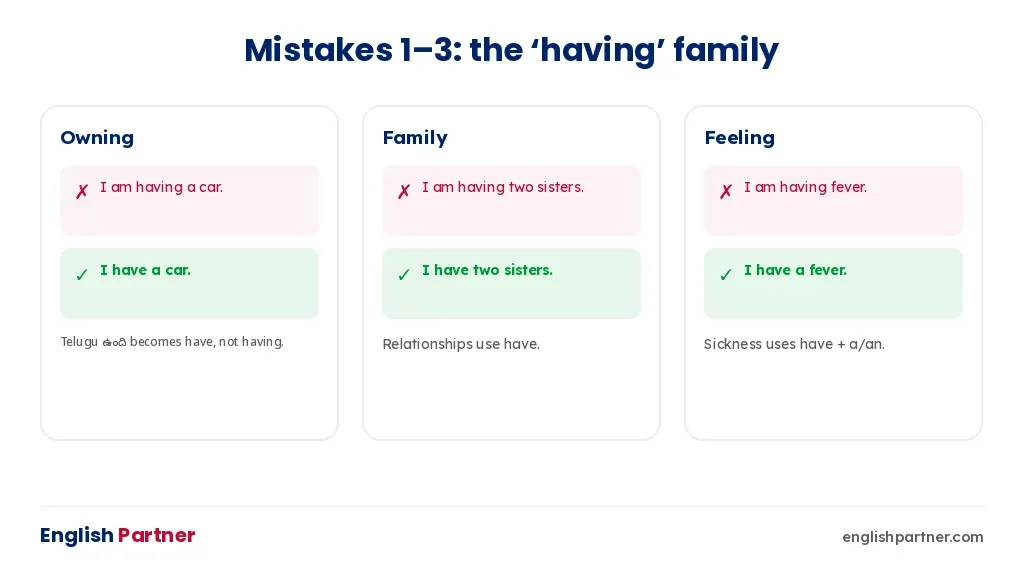
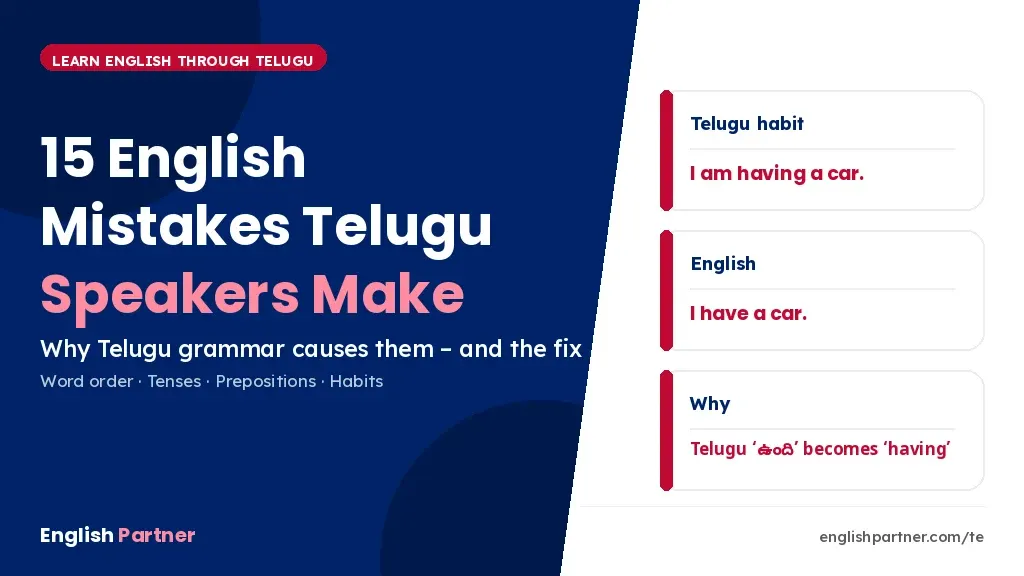
Telugu uses ఉంది (is / exists) for owning, family and feelings: నాకు కారు ఉంది. నాకు ఇద్దరు అక్కలు ఉన్నారు. నాకు జ్వరం ఉంది. So having feels like the natural translation. In English, having is only for eating and events.
| # | Telugu habit | English |
|---|---|---|
| 1 | I am having a car. | I have a car. |
| 2 | I am having two sisters. | I have two sisters. |
| 3 | I am having fever. | I have a fever. |
The full rule and 40 practice sentences are in our have, has, had guide.
Mistakes 4–6: Telugu words that don’t translate
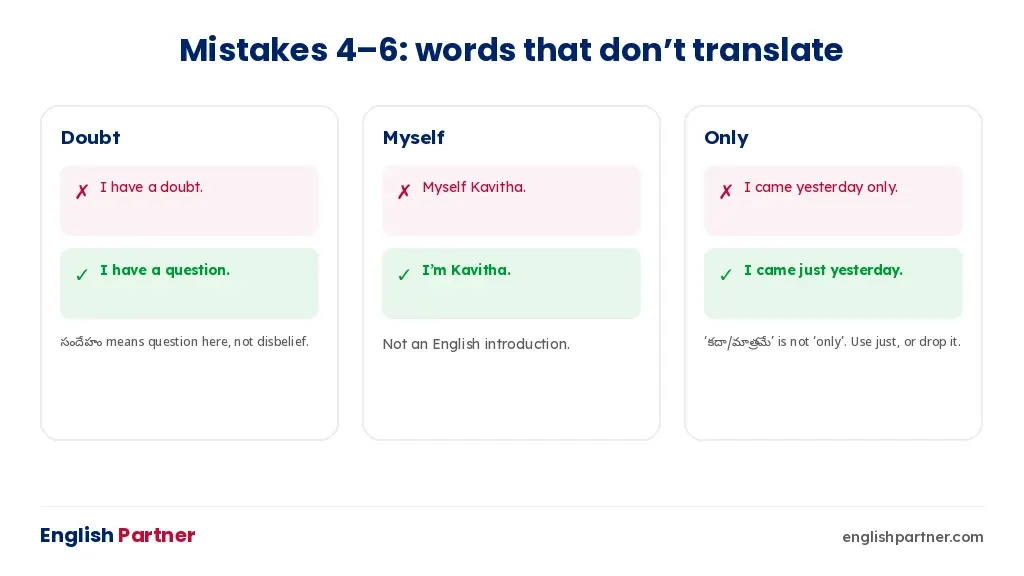
4. “I have a doubt.” సందేహం means both doubt and question in Telugu. In English, a doubt means you don’t believe something. When you want to ask: “I have a question.”
5. “Myself Kavitha.” There is no Telugu sentence behind this one – it is an Indian-English habit passed from person to person. It is still wrong, and interviewers notice it. “I’m Kavitha.”
6. “I came yesterday only.” Telugu మాత్రమే and the emphasis in నిన్ననే వచ్చాను get translated as only. But in English, only means “nothing else.” Use just, or drop it: “I came just yesterday.” Same with “Today itself” → “today.”
Mistakes 7–9: prepositions and articles
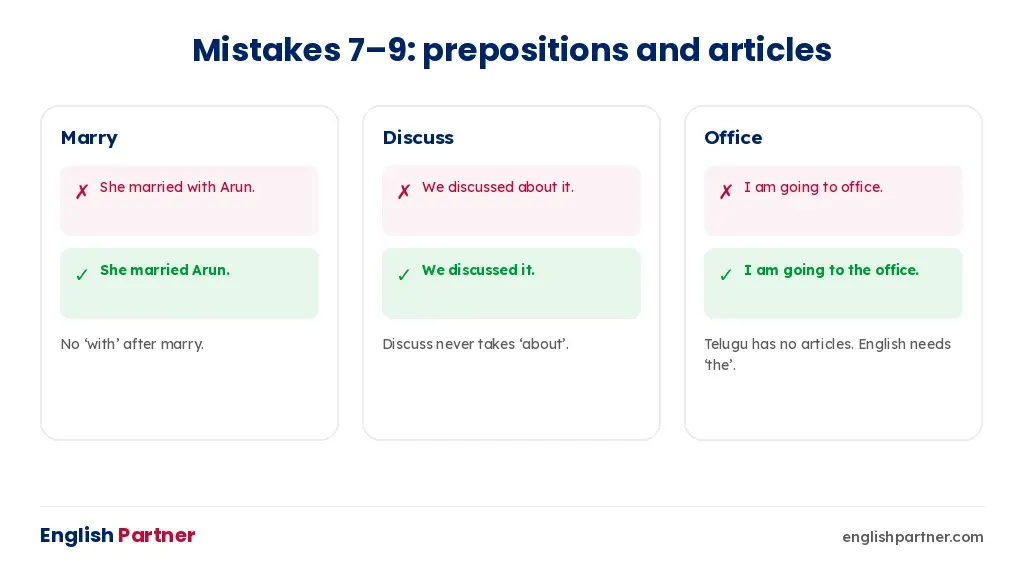
Telugu attaches meaning to the end of words (అతనితో, దాని గురించి), and learners look for an English word to carry that ending. Sometimes English has no word there at all.
| # | Telugu habit | English | Why |
|---|---|---|---|
| 7 | She married with Arun. | She married Arun. | -తో has no English word here. |
| 8 | We discussed about the plan. | We discussed the plan. | గురించి is already inside “discuss.” |
| 9 | I am going to office. | I am going to the office. | Telugu has no “the.” English needs it here. |
Number 9 is part of a bigger topic – Telugu has no articles at all – which our a, an and the guide covers in full.
Mistakes 10–12: tense habits
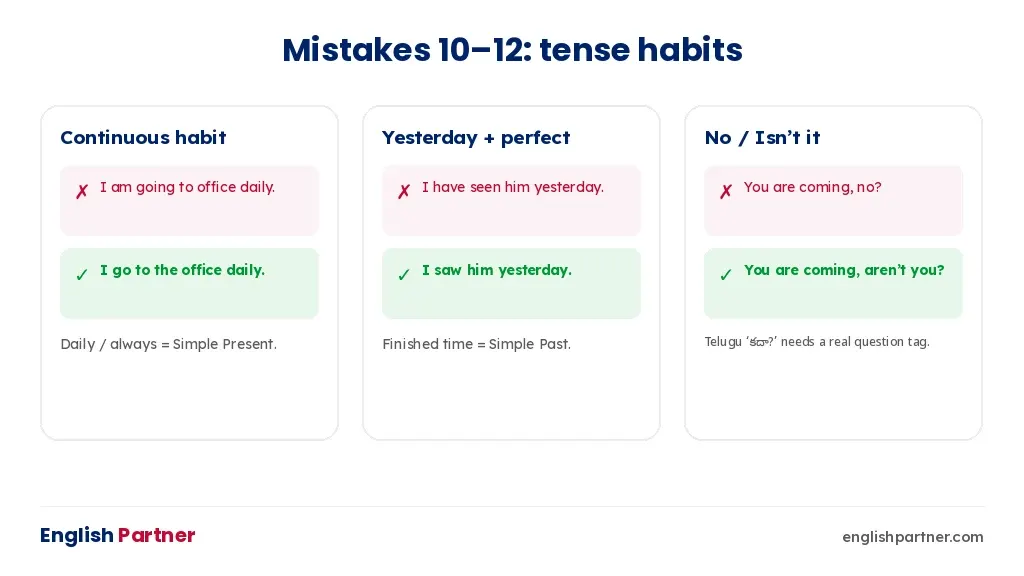
10. “I am going to office daily.” Telugu uses one present form (వెళ్తున్నాను) for both “right now” and “every day.” English splits them. Habits take Simple Present: “I go to the office daily.”
11. “I have seen him yesterday.” If there is a finished time – yesterday, last week – English uses Simple Past: “I saw him yesterday.” Present Perfect is for no time or unfinished time. Our tenses chart and the present perfect vs simple past guide lay this out.
12. “You are coming, no?” Telugu ends questions with కదా? and learners translate it as no? English uses a matching question tag: “You are coming, aren’t you?” In casual speech, “right?” is also fine.
Mistakes 13–15: small words, big difference
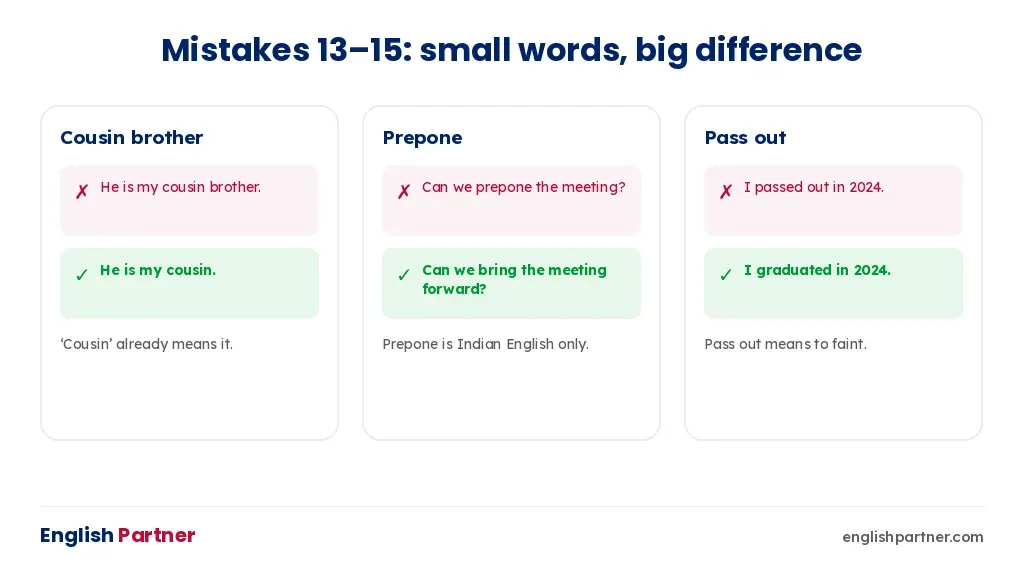
13. “He is my cousin brother.” Telugu has separate words for every relation, so cousin alone feels incomplete. In English, cousin already covers it: “He is my cousin.”
14. “Can we prepone the meeting?” Everyone in India understands this, and almost nobody outside India does. On an international call, say “Can we bring the meeting forward?”
15. “I passed out in 2024.” In standard English, pass out means to faint. Say “I graduated in 2024” or “I completed my degree in 2024.” This one matters most in interviews and on LinkedIn.
The full list in one place
| # | Say this | Not this |
|---|---|---|
| 1 | I have a car. | I am having a car. |
| 2 | I have two sisters. | I am having two sisters. |
| 3 | I have a fever. | I am having fever. |
| 4 | I have a question. | I have a doubt. |
| 5 | I’m Kavitha. | Myself Kavitha. |
| 6 | I came just yesterday. | I came yesterday only. |
| 7 | She married Arun. | She married with Arun. |
| 8 | We discussed it. | We discussed about it. |
| 9 | I am going to the office. | I am going to office. |
| 10 | I go to the office daily. | I am going to office daily. |
| 11 | I saw him yesterday. | I have seen him yesterday. |
| 12 | You are coming, aren’t you? | You are coming, no? |
| 13 | He is my cousin. | He is my cousin brother. |
| 14 | Bring the meeting forward. | Prepone the meeting. |
| 15 | I graduated in 2024. | I passed out in 2024. |
How to actually stop making them
Reading this list once will not change what comes out of your mouth tomorrow. Three things will:
Pick three, not fifteen. Choose the three you say most – for most learners it is 1, 4 and 10 – and work on only those for a week.
Say the correct version twenty times a day. Out loud. I have a car. I have a question. I go to the office daily. You are replacing a habit, and habits are replaced by repetition, not by understanding.
Get someone to catch you. The reason these mistakes survive for years is that nobody corrects adults. A friend, a colleague, or a trainer who says “have, not having” every time – gently – is worth more than any list. Research shared by the British Council on first-language interference says the same: errors that come from your mother tongue fade fastest with corrective feedback, not with more rules.
When self-practice is not enough
Every mistake on this page comes from a Telugu pattern, which means the fastest way to fix it is with someone who can see both languages at once. A trainer who speaks Telugu does not just say “that’s wrong” – they say “Telugu does X here, English does Y,” and the correction sticks.
That is how our spoken English classes in Telugu work, from the Basic level onwards: each pattern explained in Telugu, then practised in English every day on WhatsApp and live calls until the correct form is the automatic one. Starting from zero? Pre-Basic comes first. Learners in Andhra can visit our Vijayawada centre, and our head office runs spoken English classes in Coimbatore.
Final thoughts and your next step
You do not speak bad English. You speak accurate Telugu in English words. Now that you can see the fifteen places where the two languages part ways, you can fix them one pattern at a time.
Start with the having family tonight, then move on to our 50 Telugu to English everyday sentences, which are written to avoid every mistake on this page. And if you want a Telugu trainer to catch the ones you cannot hear yourself, send “Hi” on WhatsApp for a free level test.
Frequently asked questions
Why do Telugu speakers make these particular English mistakes?
Because they translate Telugu grammar directly. Telugu puts the verb last, uses ఉంది for having, has no articles, and uses కదా and మాత్రమే in ways English does not. Each mistake here maps to one of those patterns.
Is “I am having a car” wrong?
Yes. In English, having is only for eating (“I am having lunch”) or events (“we are having a party”). For owning, relationships and feelings, use have: I have a car, I have two sisters, I have a fever.
Is “myself Kavitha” correct English?
No. It is one of the most recognised Indian-English mistakes, especially in interviews. Say “I’m Kavitha” or “My name is Kavitha.”
Why is “I have a doubt” a problem?
In English a doubt means you do not believe something. When you want to ask, say “I have a question.” Telugu సందేహం covers both meanings, which is why the mix-up happens.
Is “prepone” a real word?
It is used and understood across India, but it is not standard English and most people outside India will not know it. Say “bring forward” or “move earlier.”
Why do Telugu speakers put the verb at the end in English?
Telugu is a subject-object-verb language: నేను ఆఫీసుకి వెళ్తున్నాను. English is subject-verb-object: I am going to the office. Learners who translate word by word carry the Telugu order into English.
How long does it take to stop making these mistakes?
With daily speaking and someone correcting you, most of these fade in three to four weeks. Alone, they can last for years, because nobody corrects adults.
Which English Partner course helps with this?
Basic level on the Telugu track. Trainers explain each pattern in Telugu first, then you practise in English every day on WhatsApp until the correct form becomes the habit.