Daily Standup English for IT Teams: 60 Seconds, Three Parts
 Dhinesh Kumar
Content Writer
Published
Time to read
8 minutes
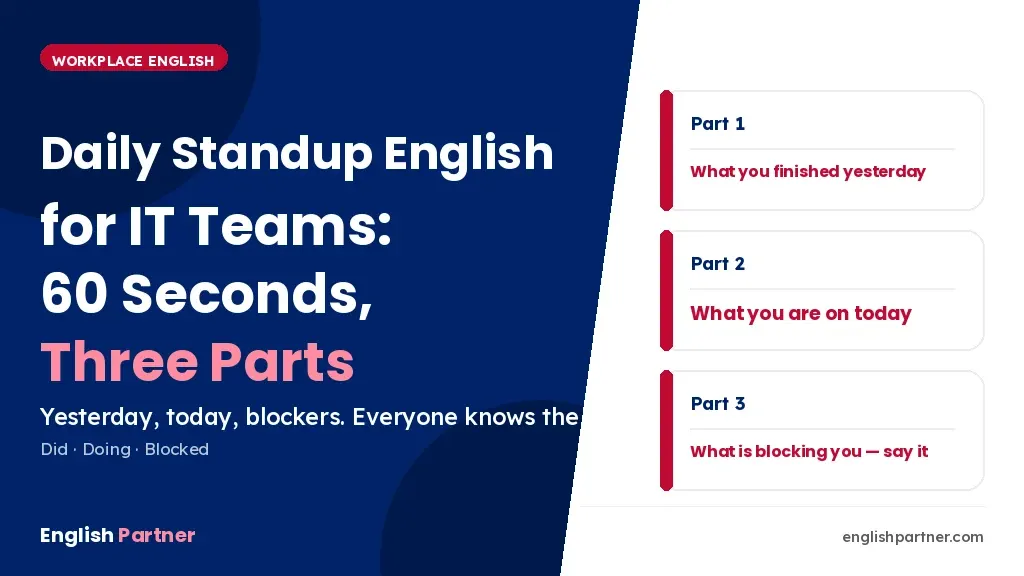
Quick answer: Three parts, sixty seconds. Yesterday in past simple — “I finished the login API.” Today in present continuous — “I'm working on the payment integration.” Blockers, named clearly — “I'm blocked on the staging credentials, I need DevOps access.”
Daily standup English: why one minute feels long
Everybody knows the standup format. Yesterday, today, blockers — it is written on the wall in half the offices in Coimbatore and Chennai.
And yet most updates come out as a vague sentence about “working on” something, no clear blocker, and a trailing pause while the person decides whether they have finished. Then the next person starts.
The reason is not knowledge of the project. It is that twelve people are listening, the window is about sixty seconds, and there is no time to assemble English while also deciding what to say. Preparation solves most of it, and one tense solves the rest.
Part 1: yesterday, in past simple
This is where the most marks are lost, and it is a grammar issue with a real cost.
“Yesterday I was working on the API” is grammatically fine and tells the team nothing. Was it finished? Half done? Blocked? Past continuous describes an activity. Your team needs an outcome.
- “I finished the login API and pushed it for review.”
- “I fixed the two bugs from Tuesday's testing.”
- “I completed the first half of the migration — the rest is today.”
- “I didn't get to the reporting module, the bug took the whole day.”
Notice the fourth one. Saying you did not finish something is a perfectly good standup update, and far better than a vague “working on it” that leaves everyone guessing.
The tense to use is past simple: finished, fixed, pushed, completed, reviewed, deployed, didn't get to.
Part 2: today, in present continuous
Short, and one or two items. A list of five things is not a plan.
- “Today I'm working on the payment integration.”
- “I'm going to start on the error handling once the API is merged.”
- “I'm continuing with the migration — should finish by evening.”
- “After the review comments come in, I'll pick those up.”
If you can attach a rough finish point, do. “Should have it done by tomorrow afternoon” is far more useful to a lead than the work item alone, and “should” rather than “will” keeps it honest.
Part 3: blockers, which is the part that matters
The whole reason the meeting exists, and the part most often skipped.
People hide blockers because raising one feels like admitting you could not solve something. In practice every experienced lead reads it the opposite way: a blocker named early is a person managing their work well.
Name what and who:
- “I'm blocked on the staging credentials — I need access from DevOps.”
- “I'm waiting on the client's confirmation on the field names.”
- “The test environment has been down since yesterday evening.”
- “I need fifteen minutes with Priya on the schema before I can continue.”
Compare with “There is some problem.” That sentence creates work rather than removing it — now someone has to ask three questions to find out what you meant.
And if you are not blocked, say it in four words and stop: “Nothing blocking me, thanks.”
The two sentences that keep a standup short
“Can we take this offline?” The moment two people start debugging in detail, this sentence rescues the other ten. It is not rude — it is the expected move, and saying it marks you as someone who respects the meeting.
“I'll follow up with you after the call.” The polite version when someone asks you something that needs more than a sentence. It ends the exchange without dismissing them.
A full update, as it actually sounds
Three sentences, roughly thirty seconds:
“Yesterday I finished the login API and pushed it for review. Today I'm on the payment integration — I should have the happy path done by evening. I'm blocked on the staging credentials, so I'll need DevOps access before I can test it end to end.”
That is the whole thing. Nothing complicated, no advanced vocabulary, and every person listening now knows exactly where you are and what you need.
Client calls and written updates
The same three parts work in a weekly client call, with one change in emphasis: clients care about progress against the plan rather than individual tasks.
- “We're on track for the 20th. Two of the four modules are done and in testing.”
- “We're slightly behind on the reporting piece — I'd put us at about three days late unless we drop the export feature.”
- “Nothing's blocking us from your side at the moment.”
For a written update on Slack or email, the same shape works and should be shorter, not longer:
“Done: login API (in review). In progress: payment integration, ETA tomorrow PM. Blocked: need staging credentials from DevOps.”
Three labels, three lines. It takes a minute to write and it is the format most leads prefer, because they can scan it.
The questions your lead asks back
A standup is rarely just your update. The follow-up is where people lose composure, usually because they switch into a long apology. Five questions come up constantly, and each has a short clean answer.
| They ask | What to say |
|---|---|
| Why did that take two days? | The schema had changed since the doc, so I had to redo the mapping. I've noted it for the others. |
| Will it be ready by Friday? | The core will. The export feature probably not — do you want it split? |
| Can you pick up Arun's ticket too? | I can, but then the integration slips to Monday. Which would you prefer? |
| Did you test it? | Unit tests yes, end to end not yet — that's what the staging access is for. |
| Is this still a blocker? | Yes, same as yesterday. I've pinged DevOps twice. |
Look at the third row. It does not refuse, and it does not accept blindly either — it hands the trade-off back with the cost attached. That one pattern will serve you for years.
The words IT teams use that textbooks do not
These come up in every standup and none of them appear in a grammar book.
- Pushed / merged — code sent to the repository, then combined into the main branch
- In review — waiting for a colleague to check it, not finished
- Happy path — the version where nothing goes wrong; usually built first
- Edge case — the unusual situation that breaks things
- Spike — time set aside to investigate rather than to build
- Hotfix — an urgent fix sent straight to production
- Regression — something that used to work and now does not
- Bandwidth — available time. "I don't have bandwidth this week" means you are full
- Circle back — return to this later
- Parked — deliberately paused, not forgotten
"I don't have bandwidth this week" is the most useful of these. It declines extra work without saying no, and every lead understands it immediately.
3 habits that make a standup drag
The second one is worth sitting with, because the instinct behind it is good — you want to solve your own problems. The arithmetic is simply against you. A blocker raised on day one costs someone an hour. The same blocker raised on day four has cost you three days of your own time as well.
For more on professional communication in English-speaking workplaces, the British Council publishes free business English material.
Your 5-day practice plan
Write tomorrow's update tonight, in three lines. Two minutes of preparation removes the entire problem of composing English while twelve people wait for you.
When self-practice is not enough
A prepared update holds until your lead asks “why did that take two days?” or “can you pick up Arun's ticket as well?” That follow-up is unrehearsable by definition, and it is where most people switch to a long apologetic explanation.
Live practice with a trainer builds the reply: real interruptions, real follow-up questions, and feedback in your mother tongue straight afterwards. Learners can join our spoken English classes in Coimbatore, our spoken English classes in Chennai, or our spoken English classes in Pondicherry.
Final thoughts and your next step
Finished things in past simple. Today's work in present continuous. Blockers named with what and who. Sixty seconds, and no thinking required at the moment you need it.
Tonight, write your three lines for tomorrow. Say them out loud once. That is the whole preparation, and it is the difference between an update people follow and one they wait out.