English for Nurses and Paramedical Students: Ward, Handover and Abroad
 Dhinesh Kumar
Content Writer
Published
Time to read
9 minutes
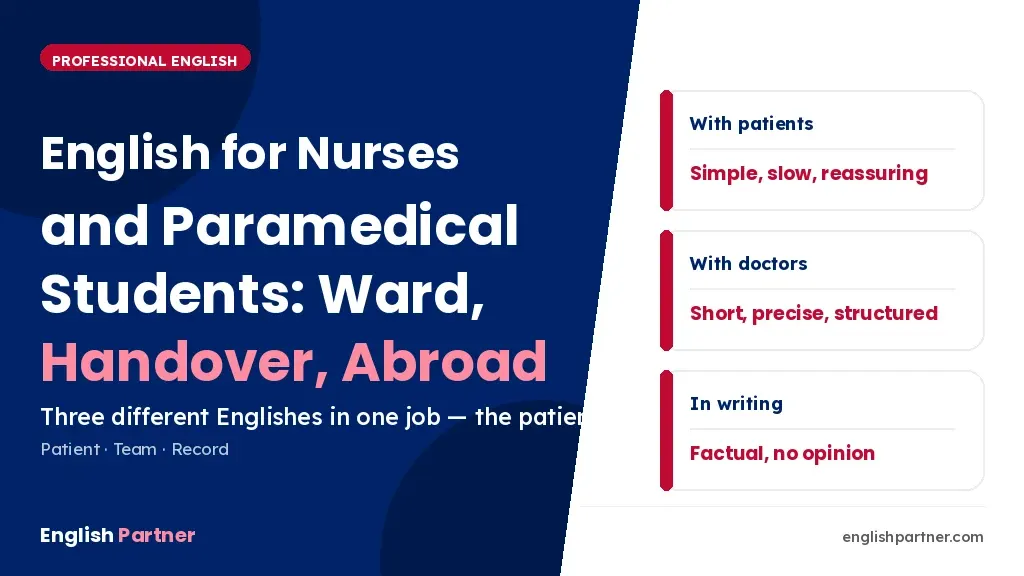
Quick answer: Nurses need three Englishes, not one. Simple and reassuring with patients (“this will sting a little”), short and structured with doctors (“bed 12, post-op day two, pain controlled”), and purely factual in writing (“patient reports pain 7/10 since 2am”).
English for nurses: three registers, one shift
Most English material for healthcare teaches medical vocabulary. That is rarely the actual gap — if you have trained in nursing, you already know the terms.
The gap is register: knowing which version of English a moment calls for. The same fact gets said three completely different ways depending on who is listening.
- To a colleague: “Patient is NPO from midnight.”
- To the patient: “Please don't eat or drink anything after midnight.”
- In the notes: “NPO from 00:00 per pre-op protocol. Patient informed.”
One fact, three forms. Using the wrong one is what causes a frightened patient, an irritated registrar or a weak note — and none of those is a vocabulary problem.
Register 1: with patients
Simple words, short sentences, and say what will happen before it happens. A patient who knows what is coming is a calmer patient, and that is a clinical outcome as much as a communication one.
Introducing yourself. “Good morning, I'm Priya, I'll be looking after you today.” Every shift, every patient.
Before anything you do. “I'm just going to check your blood pressure.” “I'm going to put a small tube in your hand.” Never start a procedure in silence.
Warning about pain. “This will sting a little — it'll be over quickly.” Say it honestly. “You won't feel anything” followed by pain costs you the patient's trust for the whole admission.
Asking about pain. Two questions, and both are needed: “On a scale of one to ten, how bad is it?” and “Is it a sharp pain or a dull ache?”
Checking they understood. “Does that make sense, or shall I explain again?” This is far better than “do you understand?”, which almost always gets a yes regardless of the truth.
The plain-English swaps worth memorising
More of the same pattern, because these come up constantly:
| To a colleague | To the patient |
|---|---|
| We need to take bloods | I'm going to take a small blood sample |
| You're on fluids | We're giving you water through the drip |
| Keep him nil by mouth | Nothing to eat or drink for now |
| We'll monitor his sats | We're checking the oxygen in your blood |
| Post-op day two | Two days since your operation |
| She's for discharge today | You'll be going home today |
| Analgesia PRN | Painkillers when you need them, just ask |
Say the right-hand column out loud until it is automatic. Under pressure the clinical term arrives first, and the plain version has to be close enough behind it to reach for.
Register 2: handover and talking to doctors
The opposite of patient English: short, dense and in a fixed order so nothing is forgotten and nothing has to be repeated.
Handover structure. Five parts:
- Who and where. “Bed 12, Mr Rajan, 58.”
- Diagnosis and day. “Post-op day two, lap chole.”
- What happened on your shift. “Stable overnight. Pain controlled on oral analgesia. Passed urine at 4am.”
- Current status. “Obs stable, last set at six.”
- What to watch. “Drain output was 40ml — worth keeping an eye on it.”
That whole handover is about twenty-five seconds. The fixed order is what makes it fast, and it also means you are never standing there deciding what to say next.
Raising a concern with a doctor. Same shape, compressed into four parts — what is happening, the background, what you observed, what you want:
“Doctor, bed 12 — his BP has dropped to 90 over 60 over the last hour. He's post-op day two, was stable until now. I'm concerned about bleeding. Could you come and see him?”
That last sentence matters. Say what you want to happen. A description without a request leaves the doctor to guess how worried you are.
Confirming an instruction. “Sorry, 5mg or 15mg?” Never guess a dose, never nod at an instruction you did not catch. In every hospital worth working in, confirming is expected and valued.
Register 3: the written record
Notes are legal documents. The rule is simple and absolute: facts and the patient's own words, never your impression.
- Not: “Patient seems very anxious.” → “Patient reports difficulty sleeping and asked twice about the surgery.”
- Not: “Looks much better today.” → “Sitting out of bed, ate half of breakfast, pain 3/10.”
- Not: “Family is being difficult.” → “Family requested a second explanation of the discharge plan.”
Two more habits: write the time with every entry, and record what you did as well as what you observed. “Pain 7/10 at 02:10. Analgesia given as prescribed. Reviewed at 03:00, pain 3/10.”
If you are planning to work abroad
Most countries require an English test for nursing registration — usually IELTS or OET. OET is healthcare-specific, with ward-based tasks rather than general topics, and many nurses find it a more natural fit. Requirements change, so always confirm the current standard with the regulator for the country you are applying to.
Beyond the exam, the real gap for most Indian nurses abroad is not speaking — it is listening:
- Speech at full speed, with no allowance made for you
- Accents you have not heard before, on the same ward
- Telephone handovers, where you lose lip-reading and context together
- Local terms that differ from your training — trolley, theatre, obs, meds round
Start listening practice early. It is the slowest of the four skills to build and the one most people leave until last.
The conversations nobody prepares you for
Ward phrases cover the routine. These four moments are the hard ones, and they are the ones new nurses report struggling with most in English.
A relative who is angry. Let them finish, acknowledge once, then say what you can do. "I understand, and I'm sorry you've been waiting. Let me find out where the doctor is and come straight back to you." Do not defend the ward and do not promise what you cannot deliver.
A patient who is frightened. Short sentences, slow pace, and do not fill the silence. "It's alright to feel worried. I'm going to stay here for a minute." Presence does more than explanation at that moment.
A patient who refuses something. Ask rather than push. "That's your decision. Can I ask what's worrying you about it?" Then record both the refusal and the reason in the notes.
When you have made a mistake. Report it immediately and plainly. "I gave the 8 o'clock dose at 9. I've recorded it and informed the doctor." No long explanation, no minimising. Every safe hospital depends on people being able to say that sentence.
Ward words that differ by country
If you are heading abroad, these differences cause more confusion than any clinical term.
| India / training | UK and many others |
|---|---|
| Operation theatre | Theatre, or OR in the US |
| Stretcher | Trolley |
| Medicine round | Meds round, drug round |
| Vitals | Obs (observations) |
| Attender / bystander | Relative, next of kin |
| Sister | Staff nurse, or Sister only for a senior grade |
| Dressing change | Wound care, dressing |
| Casualty | A&E, or ER in the US |
Bystander is the one worth unlearning early. In Indian hospitals it means the relative staying with the patient; elsewhere it means a passer-by, and using it in a handover will confuse the person listening.
3 habits that cause real problems
The third one is the one with consequences. Nodding at an instruction you did not fully catch feels respectful in the moment. Asking “sorry, 5mg or 15mg?” takes two seconds and is, without exaggeration, part of safe practice.
For healthcare-specific English practice material, the British Council publishes free resources and information on language tests used for professional registration.
Your 4-week plan
Practise the patient lines out loud with someone at home playing the patient. Register is the thing you are building, and you can only hear register when you speak it — reading the table silently does not develop it.
When self-practice is not enough
The phrases on this page you can learn this week. What you cannot practise alone is a patient asking something you did not expect, a relative who is upset, or a doctor cutting across your handover with a question.
Trainer-led practice builds exactly that — real interruptions, real-time replies, and feedback in your mother tongue straight afterwards so the correction lands. Learners can join our spoken English classes in Coimbatore, our spoken English classes in Chennai, or our spoken English classes in Pondicherry.
Final thoughts and your next step
Three registers: simple with patients, structured with the team, factual in writing. Knowing which one a moment needs is the skill — the vocabulary you already have.
This week, take the ten patient lines above and say each one out loud five times. Those ten sentences cover most of what you say to a patient in a shift, and they are the ones that decide whether that patient feels looked after.