Airport English for First-Time Flyers: Every Counter, Start to Finish
 Dhinesh Kumar
Content Writer
Published
Time to read
8 minutes
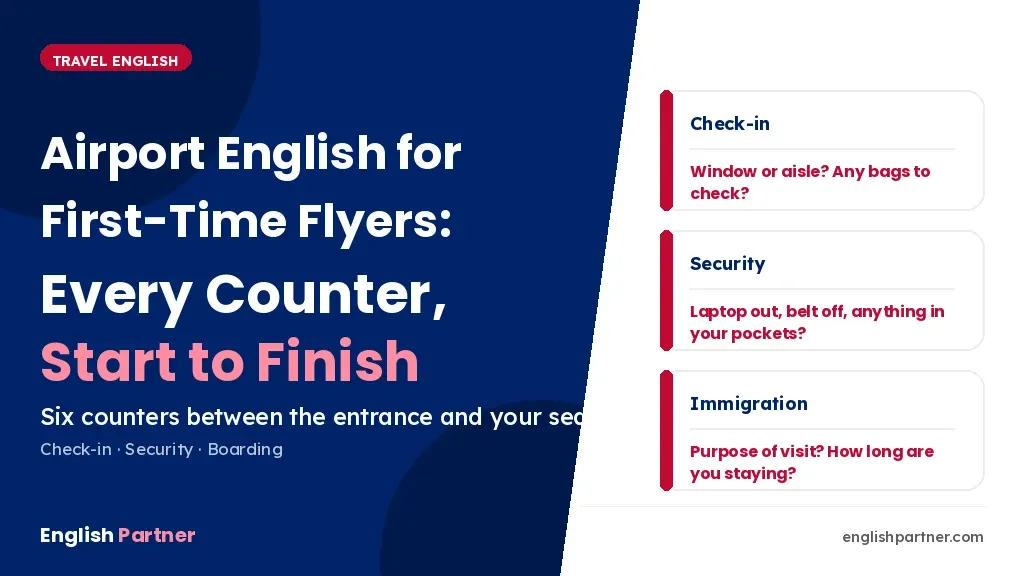
Quick answer: Six counters, and each asks about four questions. “Where are you flying today?” → “Dubai, on Emirates.” “How many bags?” → “Just one.” “Purpose of visit?” → “Visiting family.” The full set, with Tamil meanings, is below.
Airport English conversation: why it feels harder than it is
Flying for the first time is stressful for a reason that has nothing to do with English. You do not know the sequence. You do not know where to stand, what to take out of your bag, or who to ask.
So when a staff member asks a perfectly ordinary question, you are already half a step behind — and that gap gets read as an English problem when it is really a process problem.
Here is the useful fact: an airport is one of the most scripted environments you will ever speak English in. The same six counters, in the same order, asking the same questions, of every single passenger. Nobody is improvising. Learn the sequence and the English becomes about twenty short sentences.
Counter 1: entry and check-in
At the terminal entrance a guard checks your ticket and ID. Usually no conversation at all — just show both.
Then the check-in counter, which is the longest exchange of the whole airport and is still only four questions:
- “Where are you flying today?” → “Dubai, on Emirates.”
- “May I see your passport?” → “Here you go.”
- “How many bags are you checking in?” → “Just one.”
- “Window or aisle?” → “Aisle, please.”
Two more worth having ready. If your bag is close to the weight limit you may hear “Your bag is slightly overweight” — the reply is “Could I move some things to my hand luggage?” And if you are connecting onward: “Will my bag go straight through to Dubai?”
You walk away with a boarding pass. Two things to look at on it immediately: your gate number and your boarding time — which is earlier than the departure time printed on your ticket.
Counter 2: security
Almost no speaking here, which surprises people who were dreading it. You follow instructions.
What you will hear:
- “Please remove your laptop and keep it in a separate tray.”
- “Belt and watch off, please.”
- “Anything in your pockets?” → “No, nothing.”
- “Any liquids or power banks?” → “Just a power bank in my bag.”
Three rules that prevent the only real problems at this counter:
- Liquids: 100ml or less per container, all in one clear bag. A full water bottle will be taken. Empty it before, refill after.
- Power banks: hand luggage only, never in a checked bag. This is the most common item pulled out of bags.
- Watch the person in front. Whatever they take out, you take out. This is a completely legitimate strategy and everyone uses it.
Counter 3: immigration
For international flights. This is the one people worry about most, and the right approach is the opposite of what anxiety suggests: short answers.
- “What is the purpose of your visit?” → “I'm visiting family.” or “Tourism.” or “I'm going for work.”
- “How long are you staying?” → “Two weeks.”
- “Where will you be staying?” → “With my brother, in Deira.” or the hotel name.
- “Is this your first time travelling abroad?” → “Yes, it is.”
- “Do you have a return ticket?” → “Yes, on the 24th.”
Answer exactly what was asked and stop. A long story does not make you look more honest — it gives the officer more to follow up on, which lengthens the conversation you were hoping to shorten.
Have the return ticket and the address where you are staying ready on your phone. Being asked for them is routine, not a sign that anything is wrong.
The Tamil versions
| English | Tamil |
|---|---|
| I'm flying to Dubai. | நான் துபாய் போறேன். |
| Just one bag to check in. | ஒரு பேக் மட்டும் தான். |
| Could I get an aisle seat? | நடைவழி சீட் கிடைக்குமா? |
| I'm visiting family. | குடும்பத்தை பார்க்க போறேன். |
| Two weeks. | ரெண்டு வாரம். |
| Sorry, could you repeat that? | மன்னிக்கணும், திரும்ப சொல்றீங்களா? |
| Could you tell me where gate 14 is? | கேட் 14 எங்க இருக்குன்னு சொல்றீங்களா? |
| Is this the queue for Dubai? | துபாய்க்கு இதே கியூவா? |
Counter 4 to 6: gate, boarding and on board
Finding the gate. “Excuse me, could you tell me where gate 14 is?” Follow the signs first — gates are numbered in order — and ask only if the numbers stop making sense.
Announcements. These are the hardest listening of the whole trip: fast, echoey and accented. Listen for three things only — your flight number, your gate, and the words boarding, delayed or gate change. Everything else you can ignore. If you are unsure, show your boarding pass to a staff member and ask “Is this still on time?”
Boarding. You will hear “Boarding by rows” or “Zone 3 may now board.” Your zone is on the boarding pass. Hand it over and walk on.
On board. Four sentences cover an entire flight: “Excuse me, I think this is my seat — 23A.” “Could I get a glass of water?” “Chicken, please.” “Could you help me with this?”
And the honest truth about the whole journey: the cabin crew's job includes helping people who are unsure. Asking is normal, and it is what they expect on every flight.
What to do when something goes wrong
Delays, gate changes and missed connections happen, and they are the situations people have least English prepared for. Four sentences cover almost all of it.
- "My flight has been delayed — what should I do?" Ask at your airline's desk, not at a general information counter.
- "I think I've missed my connection. Could you help me rebook?" Airlines rebook missed connections routinely when the delay was theirs.
- "My bag hasn't come out. Where do I report it?" The counter is near the baggage belt and is usually marked "Lost and Found" or "Baggage Services".
- "Could you write that down for me, please?" The single most useful sentence when someone gives you a new gate, a new flight number or a desk to go to.
That last one is worth more than it looks. Numbers spoken quickly in an unfamiliar accent are the hardest thing to catch in an airport, and asking for them in writing is completely normal.
Words on the signs and screens
Half of airport English is read, not heard. These are the words that actually matter on a departure board.
| Word | What it means |
|---|---|
| On time | Nothing has changed — go at the normal time |
| Boarding | Go to the gate now |
| Final call | Go immediately, the gate is about to close |
| Gate closed | Too late for that gate — go to your airline desk |
| Delayed | Later than scheduled; check the board again for a new time |
| Departures / Arrivals | Departures is where you fly out from |
| Transfer / Transit | Follow this if you are connecting to another flight |
| Baggage claim | Where you collect checked bags after landing |
| Nothing to declare | The customs exit to take if you are carrying nothing restricted |
Final call is the one to react to instantly. It does not mean there is time — it means the gate is closing and walking at normal speed may not be enough.
3 things that slow you down
The first one is the expensive one. Airport staff repeat things hundreds of times a day — “Sorry, could you repeat that?” is the most ordinary sentence they hear. Nodding when you did not follow is how people end up in the wrong queue, at the wrong gate, or at security with a bottle of water.
If you want to practise listening to announcements before you fly, the British Council has free audio material with varied accents.
Your 3-day practice plan
Say the answers out loud, standing up. At a counter you have about two seconds before the pause becomes awkward, and reading silently does nothing at all for those two seconds.
When self-practice is not enough
Memorised answers hold until a staff member says something you did not expect, or an announcement comes through faster than you can follow. That is a listening skill, and it is the half that cannot be scripted.
Trainer-led practice builds exactly that — replies you did not prepare for, at real speed, with feedback in your mother tongue straight afterwards. Learners can join our spoken English classes in Coimbatore, our spoken English classes in Chennai, or our spoken English classes in Pondicherry.
Final thoughts and your next step
Six counters, roughly twenty short answers, and one sentence that rescues every situation: “Sorry, could you repeat that?”
Before you fly, say the four check-in answers out loud five times. That counter is the first one and the longest, and getting through it smoothly sets the tone for everything after it.