Small Talk in English: What to Say in the Lift, the Lunch Room and the Gate
 Dhinesh Kumar
Content Writer
Published
Time to read
8 minutes
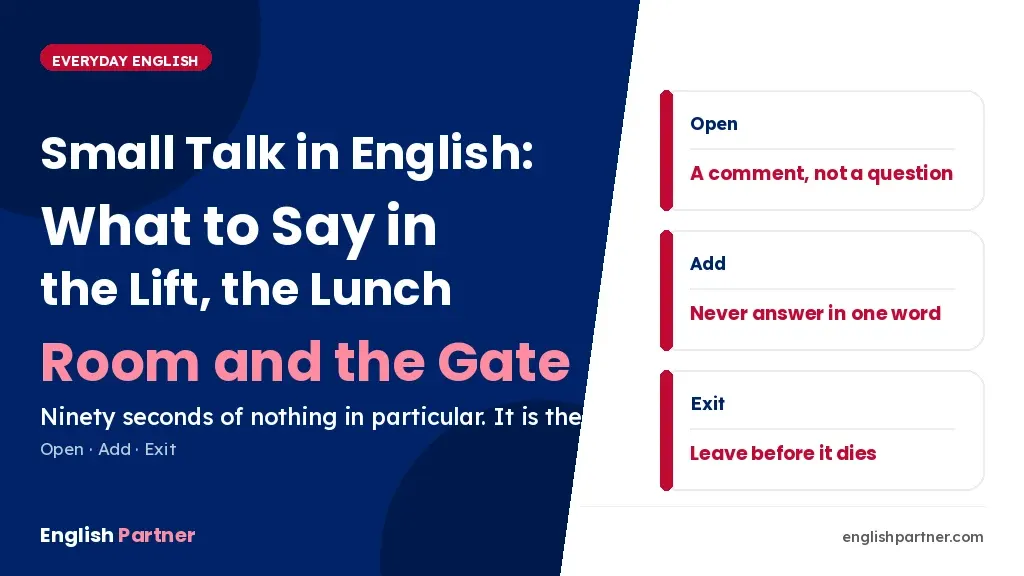
Quick answer: Three moves. Open with a comment — “Heavy rain today, isn't it?” Add a detail to every answer — never just “good”. Exit cleanly — “Anyway, I should get back.” Openers for every situation are below.
Small talk in English: why it is harder than work English
People who handle meetings and client calls in English will still stand silently in a lift with a colleague for forty seconds.
There is a reason, and it is not confidence. At work you have a task. The content tells you what words to reach for — the report, the deadline, the bug. Small talk has no content at all. You have to produce something out of nothing, in a few seconds, about nothing in particular.
That is a genuinely harder language problem, and almost nobody is taught it. Which is why five prepared openers change the situation so completely — you stop producing from nothing and start choosing from a list.
Move 1: open with a comment, not a question
A question demands an answer and puts the other person on the spot. A comment invites one without pressure, and it is much easier to produce.
- “Heavy rain today, isn't it?”
- “Long day?”
- “This lift is so slow.”
- “Traffic was terrible this morning.”
- “Quiet in here today.”
Question tags do most of the work in English small talk — “isn't it?”, “aren't they?”, “right?” They turn a statement into a gentle invitation, and a one-word agreement is a perfectly acceptable reply to them.
Move 2: the one rule that keeps it alive
This is the whole article in one line: never answer in one word.
“How was your weekend?” “Good.” That exchange is over. Not because “good” is wrong, but because it hands the entire job of continuing back to the other person, and after two rounds of that they stop trying.
Add one detail and the conversation has somewhere to go:
- “Good — we went to my sister's place in Erode.”
- “Quiet one, mostly at home. You?”
- “Busy actually, my daughter had her school programme.”
The detail does not need to be interesting. It needs to exist. “Mostly at home” is not a story, and it is enough for the other person to reply to.
And the two-letter ending — “You?” — is the most efficient thing in all of small talk. It returns the conversation without requiring a single new idea from you.
Move 3: exit cleanly
The move nobody teaches, and the reason many people avoid small talk entirely. It is not starting that worries them — it is not knowing how to stop, and standing there while it dies.
Four endings that work anywhere:
- “Anyway, I should get back. Good to see you.”
- “I'll let you go — see you tomorrow.”
- “Right, better get on. Have a good one.”
- “Nice catching up. Let's talk properly sometime.”
“Anyway” and “right” are the signal words. English speakers hear them as this is ending now, and nobody takes offence — ending a two-minute conversation at two minutes is exactly what is supposed to happen.
A clean ending also does something less obvious: it makes the next conversation easier. An awkward trailing-off makes both people slightly avoid each other afterwards.
Safe topics, and the ones to leave alone
Safe anywhere: weather, traffic, the weekend, festivals, food, cricket, the office canteen, how someone is settling in, children's schools, a long queue you are both standing in.
Leave alone: salary, caste, religion, politics, weight or appearance, why someone is not married, why someone has no children, and how much anything cost. Some of these are normal in Indian conversation among family. In English small talk, with a colleague or a neighbour, none of them are.
One Indian habit worth flagging gently: “You've put on weight” or “You've become thin” is affectionate in Tamil and lands badly in English, particularly at work. “You're looking well” says the warm part without the rest.
What to say in each situation
The lift. Thirty seconds, so one exchange is the whole thing. “Going up?” or “Long day?” Then let it be. Silence in a lift is also completely normal.
The office kitchen. “How's your week going?” is the most useful question in an office. It works on anyone, at any level, on any day.
A new colleague. “How are you finding it so far?” New joiners are usually relieved that someone spoke to them, so this is the lowest-risk small talk in existence.
The school gate. “Which class is yours in?” opens almost every parent conversation, and it leads naturally to teachers, homework and timings.
A neighbour. “Settling in alright?” followed by “We're in 3B if you need anything.” Warm, short, no obligation attached.
After a festival. “How was Diwali at your place?” The “at your place” is what makes it personal rather than formal.
The Tamil habit that does not travel
Tamil small talk works differently, and three habits carry over in ways that land oddly in English.
Direct personal questions open a Tamil conversation. "சாப்பிட்டீங்களா?" is warmth. The English equivalent — "Have you eaten?" — sounds to a colleague like you are about to invite them somewhere, or checking up on them. "How's your day going?" carries the same care and does not confuse.
Silence is comfortable in Tamil. Two people who know each other can sit quietly without it meaning anything. In English small talk a long pause reads as something being wrong, which is why the add-a-detail rule matters so much.
Tamil carries politeness in the verb. English has no such ending, so warmth has to come from the content — remembering something they told you last week, asking about their daughter's exam. That remembering is what makes English small talk feel friendly rather than mechanical.
| Tamil instinct | In English, say |
|---|---|
| சாப்பிட்டீங்களா? | How's your day going? |
| எங்க போறீங்க? | Off somewhere nice? |
| கொஞ்சம் குண்டாயிட்டீங்க | You're looking well |
| என்ன விசேஷம்? | Anything new with you? |
| வர்றேன் | See you — I'll catch you later |
That last row catches people out. Tamil says வர்றேன் — literally "I will come" — when leaving. Translating it as "I am coming" while walking away genuinely confuses English speakers. "See you" is the whole thing.
When you meet the same person every day
The hardest version of small talk is not the stranger. It is the colleague you pass four times a day, where the weather has been covered by Tuesday.
Three things that keep it from becoming a nod:
- Follow up on what they told you. "Did your daughter's exam go alright?" This is the single most valued move in English small talk, because it proves you listened.
- Rotate the topic, not the greeting. Monday is the weekend, midweek is work, Friday is plans. The structure does the work so you do not have to invent one.
- Let some pass with a nod. Four conversations a day with the same person is too many for anyone. A smile and a nod on the second pass is correct, not rude.
3 habits that make small talk harder
The second one is the biggest obstacle for most learners, and it is worth being direct about. Nobody remembers the grammar of small talk. Nobody has ever walked away from a lift thinking about someone's tense. They remember whether you spoke to them.
Which means the simple version said out loud beats the correct version said in your head, every single time.
For more everyday conversation practice with audio, the British Council has free graded material.
Your 5-day practice plan
Day five is the real one. Pick someone you see often and have never spoken to — the security guard, a neighbour, someone at the bus stop — and have one ninety-second conversation. Ninety seconds is the entire task.
When self-practice is not enough
You can memorise every opener here. What you cannot practise alone is the reply you did not expect, arriving at normal speed, with two seconds to respond before the pause becomes awkward.
That is the whole skill of small talk, and it only builds against a real person. Trainer-led practice gives you that, with feedback in your mother tongue straight after. Learners can join our spoken English classes in Coimbatore, our spoken English classes in Chennai, or our spoken English classes in Pondicherry.
Final thoughts and your next step
Open with a comment. Add one detail to every answer. Exit before it dies. Three moves, and they work in a lift, at a gate and at a wedding.
Tomorrow, say one opener to one person you would normally stay quiet around. Just the opener — you do not need the rest planned. The reply gives you the rest.