How to Explain Something Step by Step in English: Training and Handover
 Dhinesh Kumar
Content Writer
Published
Time to read
8 minutes
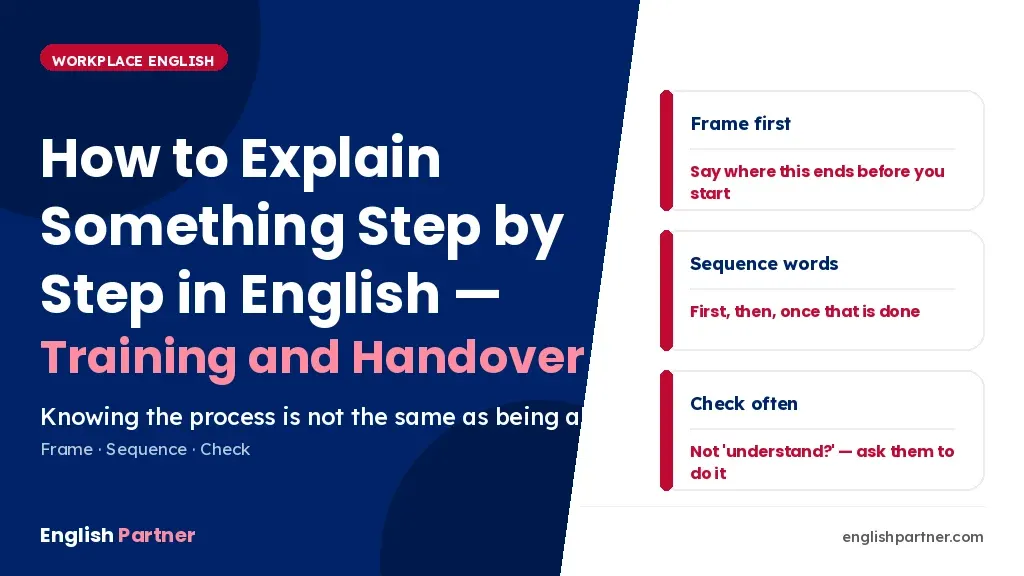
Quick answer: Four moves. Frame it first — “four steps, about five minutes”. Use sequence words — first, then, once that's done. Flag where it usually breaks. Check by asking them to do one, never by asking “do you understand?”
Knowing a process is not the same as handing it over
You have done this task three hundred times. You could do it with your eyes shut. And then a new joiner sits next to you and twenty minutes later still cannot do it alone.
That is not their problem and it is not an English problem either, exactly. It is that the steps have become invisible to you. You skip the obvious ones, merge two into one sentence, and never mention the bit that catches everyone out — because it stopped catching you out two years ago.
Explaining well is a separate skill from doing well, and in English it has a specific structure. Four moves, and most people skip the first and the last.
How to explain something step by step: move 1, the destination first
Most explanations begin at step one. The listener has no idea how long this will take, how many steps are coming, or what the finished thing looks like — so they cannot tell what matters.
One sentence fixes it:
- “We're setting up a new vendor — four steps, about five minutes.”
- “I'll show you the whole month-end close. It's long, so we'll do it in two parts.”
- “By the end of this you'll be able to raise a purchase order on your own.”
That last shape is the strongest one: say what they will be able to do. It gives the listener something to measure themselves against as you go.
Move 2: sequence words are signposts
Without them, every sentence sounds equally important and the listener cannot tell where one step ends.
Compare these two. Same information:
“You go to the vendor screen and put GST and save and then approve.”
“First, open the vendor master screen. Then enter the GST number. Once that's saved, you'll see the approval button. Finally, hit approve.”
The second is not better English in any complicated sense. It just has four signposts in it: first, then, once that's done, finally.
The full set worth having ready: first, then, after that, next, once that's done, at the same time, before you do that, finally.
“Once that's done” is the most useful of them, because it signals dependency — do not start the next step until this one finishes. That distinction prevents a lot of mistakes.
Move 3: flag where it usually breaks
This is where real expertise shows, and it is what separates a handover from a demonstration.
- “Be careful here — if you skip this, the entry won't post and you won't get an error.”
- “People usually get stuck on this one, so take your time.”
- “This field looks optional. It isn't.”
- “If it throws an error here, it's almost always the date format.”
And the opposite of this, which does real damage: never say “it's easy”. If you say something is simple and the person then cannot do it, they will not tell you. They will quietly struggle, because admitting difficulty now means admitting they could not do the easy thing.
“This part catches most people out” costs you nothing and makes it safe to be stuck.
Move 4: check by asking them to do it
“Do you understand?” is the most common question in workplace training and it is close to useless. Everybody says yes. In front of a senior, almost everybody says yes.
Replace it:
- “Why don't you do the next one and I'll watch?”
- “Show me where you'd click first.”
- “What would you do if it throws an error there?”
- “Talk me through it back, so I know I've explained it properly.”
That last one is worth adopting as a habit. It puts the responsibility on your explanation rather than on their understanding, which makes it completely safe to answer honestly.
Explaining over a call
Harder, because you lose everything the other person would have seen. Three adjustments:
Number everything out loud. “Step one — are you on the vendor screen now?” Wait for the yes. Then step two. Silence is not confirmation on a call.
Describe the screen, not just the action. “Top right, there's a blue Save button.” You know where it is; they are hunting.
Send it in writing afterwards. Four numbered lines on WhatsApp or email. A spoken explanation evaporates by the next morning, and you will be asked again.
Explaining to a client instead of a colleague
Same structure, far less detail. A client wants the outcome and the timeline, not your process.
- “There are three stages. We'll have the first done by Friday and the rest by the 20th.”
- “The delay is in the approval stage, which sits with the bank rather than with us.”
- “Happy to go into the detail if it's useful — the short version is we're on track.”
That last line is the professional move: offer the depth, do not impose it. Explaining every step to a client who wanted a date reads as not understanding what they asked.
Writing it down: the handover document
Most handovers end with "I'll send you the steps" and the document never arrives, or arrives as a wall of text. Four numbered lines beat two paragraphs every time.
| Part | What to write |
|---|---|
| Title | What this does, in plain words: "Adding a new vendor" |
| When you need it | "Whenever purchase sends a new supplier form" |
| Steps | Numbered, one action per line, starting with a verb: "Open…", "Enter…", "Click…" |
| Watch out | The one or two places it usually breaks, and what the error looks like |
| If it goes wrong | Who to ask, by name and team |
Two rules that keep it usable: one action per numbered line, and start each line with a verb. "Enter the GST number" is followable. "The GST number should then be entered in the relevant field" is not, even though it says the same thing.
And add a date at the bottom. Six months later the person reading it needs to know whether it predates the system change.
When they still do not get it
It will happen, and repeating yourself louder is the instinct to resist. Four things that actually work:
- Change the order. Show them the finished result first, then work backwards. Some people cannot follow steps until they have seen the destination.
- Do it while they watch, then swap. Explaining and doing at the same time is harder to follow than seeing it done once in silence.
- Break the step in two. If someone is stuck on step three, step three is probably two steps that you merged years ago.
- Ask what they expected. "What did you think would happen there?" Their answer usually reveals exactly which assumption of yours was never said out loud.
That last question is the most valuable one in this article. Nearly every failed explanation comes down to one assumption the expert never knew they were making.
3 habits that lose the listener
The middle one deserves repeating because it is so universal. “Understand?” gets a yes from everyone — from a new joiner who does not want to look slow, from a junior who does not want to waste your time, from anyone who thinks they will work it out later. Change the question and you get the truth.
For more on professional and instructional communication in English, the British Council publishes free business English material.
Your 5-day practice plan
Day five is the one that teaches you something. Hand over a real task and watch without helping for thirty seconds. Wherever they get stuck is exactly where your explanation was thin — and you would never have found it by rehearsing.
When self-practice is not enough
You can plan an explanation. What you cannot rehearse is the question in the middle of it — “wait, why do we do that?” — which throws you off your sequence and has to be answered in four seconds without losing your place.
Live practice with a trainer builds exactly that: interruptions mid-explanation, questions out of order, and feedback in your mother tongue afterwards. Learners can join our spoken English classes in Coimbatore, our spoken English classes in Chennai, or our spoken English classes in Pondicherry.
Final thoughts and your next step
Frame it, sequence it, flag the hard part, and check by making them do it. Four moves, and they work for a new joiner, a client or a colleague covering for you next week.
Next time you explain anything at work, start with one sentence: how many steps and how long. That single sentence changes how the whole explanation lands.