Parent-Teacher Meeting English: What to Ask and What the Answers Mean
 Dhinesh Kumar
Content Writer
Published
Time to read
8 minutes
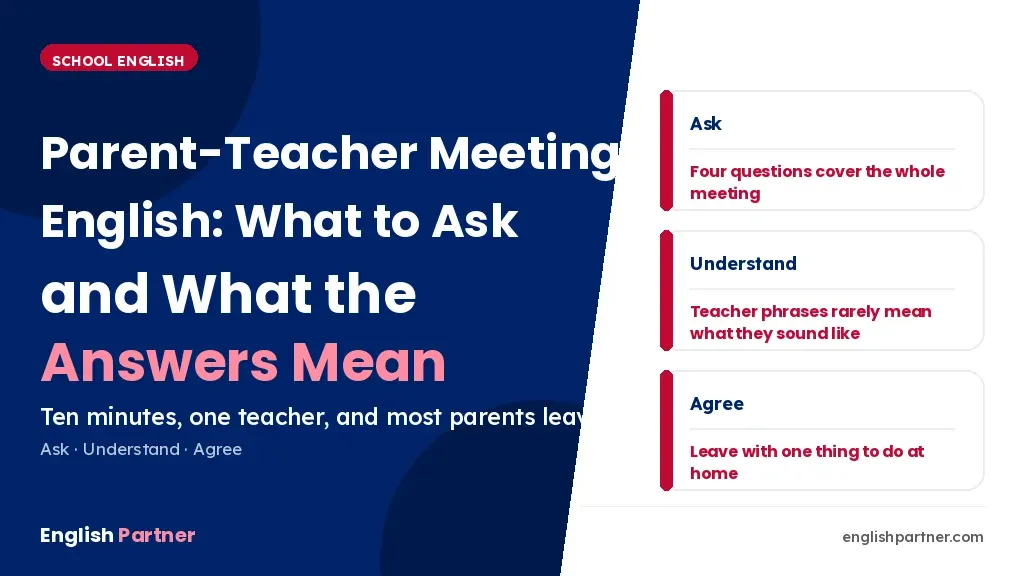
Quick answer: Four questions cover a whole meeting. “How is she doing in class?” “What is she finding difficult?” “How is she with the other children?” “What should we work on at home?” Then agree one thing and write it down before you leave.
Parent-teacher meeting English: why ten minutes get wasted
The pattern is almost identical in every school. The teacher talks for three minutes. The parent nods. The teacher asks “any questions?” The parent says “no, thank you” and leaves.
Ten minutes with the one person who watches your child for six hours a day, and almost none of it used.
Sometimes that is an English problem. Far more often it is that nobody told the parent what to ask — and the fear of not following the reply makes silence feel safer than a question.
Both are fixable, and the second one is fixable tonight.
The four questions
Notice what is not in that list: marks and rank. Those are printed on the report card you already have. The teacher's ten minutes are worth spending on what the report card cannot tell you.
Take them written on a piece of paper and read them out. That is not a sign of weak English — plenty of English-speaking parents do exactly the same, because ten minutes go quickly and it is easy to forget the one thing you came to ask.
What teachers say, and what it actually means
Teachers soften things, in every school and every country. A parent who takes the words at face value can miss the message entirely.
The first row is the one to watch for. “She's a bright child, but…” — everything before the but is politeness. The sentence after it is why the teacher wanted to see you.
Three more worth knowing:
- “She's easily distracted.” → attention in class is a real issue, not a passing comment.
- “She's struggling a bit with the basics.” → “a bit” is soft. Ask directly: “How far behind is she?”
- “There's nothing to worry about.” → this one is literal. Believe it and move on.
When you are not sure which you have heard, one question settles it: “Is this something I should be concerned about, or is it normal for this age?” Teachers answer that honestly, because it gives them permission to be direct.
Raising a problem yourself
If you have noticed something at home, describe what you saw rather than what you concluded. The first invites help; the second invites defence.
- “I've noticed she's been avoiding her maths homework — have you seen anything in class?”
- “She says she doesn't understand the science lessons. Is she asking questions in class?”
- “She's been quiet at home since the exams. Has anything changed at school?”
- “There's been some trouble with another child on the bus — I wanted to mention it.”
Each of those is a fact plus a question. None of them accuses anybody, and all four will get you a straight answer.
If your English is not strong
This is the real reason many parents stay quiet, so it deserves saying plainly: nobody in that room is assessing your English. The teacher wants to talk about your child and would rather have a parent who asks in broken English than one who says nothing.
Four sentences remove most of the difficulty:
- “Could you say that again slowly, please?” — use it as often as you need
- “Sorry, what does that mean?” — for a word you did not catch
- “Could you write that down for me?” — for a book name, a topic, anything specific
- “So you're saying she needs more practice in maths — is that right?” — repeat it back and the teacher will correct you if you misheard
That last one is the most useful sentence in the whole meeting, and it is the same technique that works at a bank counter or a hospital desk. Say what you understood; let the other person fix it.
And if it is genuinely easier, ask in Tamil. Most teachers in Tamil Nadu will switch without blinking. A meeting that happens in Tamil is infinitely better than one that does not happen at all.
A real meeting, start to finish
Here is what the ten minutes look like when they are used.
Teacher: “Thanks for coming. Divya's doing reasonably well — her English and science are good. She's a bright child, but she's been slipping in maths this term.”
You: “Thank you. What exactly is she finding difficult in maths?”
Teacher: “Mainly fractions. She gets lost and then stops trying.”
You: “Is she asking questions when she gets lost?”
Teacher: “No, that's the issue — she goes quiet instead.”
You: “And with the other children, is she alright?”
Teacher: “Yes, she's fine socially, she has a good group.”
You: “So what should we work on at home?”
Teacher: “Fifteen minutes of fractions a day would make a real difference. And encourage her to ask when she's stuck.”
You: “Fifteen minutes of fractions, and asking questions. Let me write that down. Thank you.”
Eight sentences from you. No complicated English anywhere in them, and you now know something the report card never said: she goes quiet when she is lost.
Report card words that confuse parents
The report card arrives before the meeting and is written in a vocabulary nobody explains. These are the words that cause the most worry, usually unnecessarily.
| Word on the report | What it means |
|---|---|
| Satisfactory | Acceptable, not strong. Room to improve, no cause for alarm. |
| Needs improvement | Below the expected level for the class. Worth asking about. |
| Consistent | Steady performance, good or average, without dips. |
| Participates actively | Speaks up, asks questions, joins in. A genuinely good sign. |
| Reserved | Quiet. Not negative on its own, but worth a question. |
| Shows potential | Capable of more than the current marks show. |
| Requires supervision | Does not complete work unless someone is watching. |
| Grade / percentile | A grade is the mark band; a percentile compares with the class. |
Shows potential and requires supervision appearing together is a common pairing, and it means something specific: your child can do the work and is not doing it independently. That is the conversation to have, and it is a habit problem rather than an ability one.
Online meetings and messages
More schools now run meetings on a video call or send updates on WhatsApp, and both change what you need.
On a video call, the audio is worse and the meeting is shorter. Two habits help: say your questions early rather than waiting until the end, and ask for anything specific in writing — "Could you message me the chapter names?" Numbers and book titles are the first casualties of a bad connection.
On a message, keep it short and ask one thing. "Good morning ma'am, this is Divya's mother. She says she didn't understand today's maths lesson. Should she go through anything at home before tomorrow?" Three sentences, one question, easy to answer between classes.
And what not to send: a long message listing several concerns at once. Teachers answer short messages quickly and postpone long ones, which is human rather than rude.
3 things that waste the ten minutes
The third one is the quiet failure. A parent who leaves with five things to fix usually does none of them, because five things have no starting point. “Fifteen minutes of fractions a day” gets done.
For more on how parents can support school learning at home, the British Council publishes free guidance for families.
Preparing in twenty minutes
Write the four questions on paper tonight, and add one thing you have noticed at home. Five lines on a piece of paper, and you will walk out of that room with something you did not have going in.
When self-practice is not enough
Prepared questions work until the teacher's answer goes somewhere you did not expect, and you have four seconds to respond. That moment is not about vocabulary — it is about being able to follow a reply at full speed and ask the next question.
Trainer-led practice builds exactly that, with everything explained in your mother tongue first. Learners can join our spoken English classes in Coimbatore, our spoken English classes in Chennai, or our spoken English classes in Pondicherry.
Final thoughts and your next step
Four questions, one written note, and the understanding that the teacher's polite phrasing usually has a real message inside it.
Before the next meeting, write the four questions on a piece of paper and put it in your bag. That piece of paper is the whole difference between a meeting you attended and a meeting you used.