English for Exporters and Manufacturers: Enquiry to Repeat Order
 Dhinesh Kumar
Content Writer
Published
Time to read
9 minutes
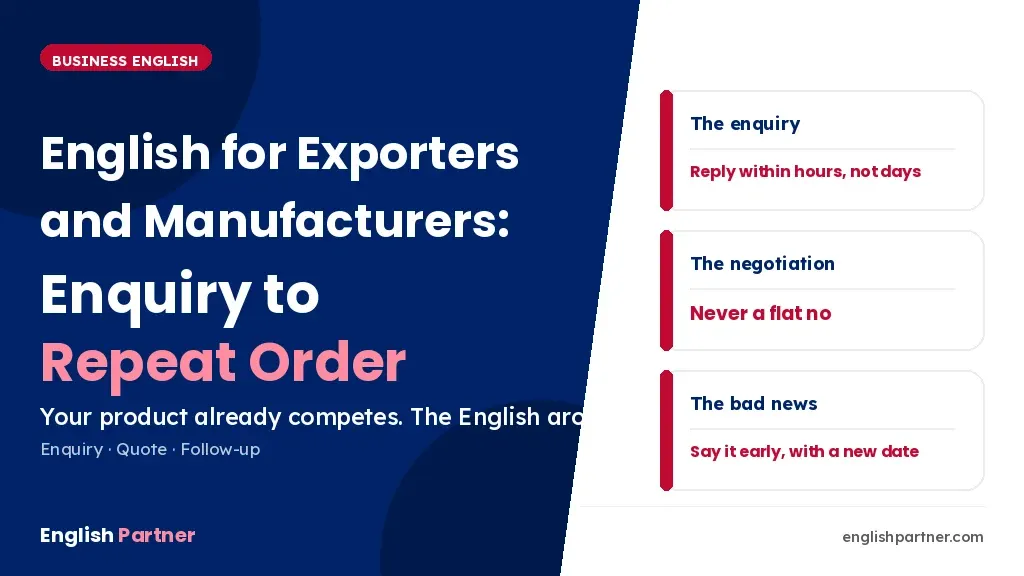
Quick answer: Four stages, four different jobs. The enquiry — reply in hours, ask two specific questions. The quote — attach validity and terms. The negotiation — never a flat no, always a condition. The bad news — early, with a new date.
English for exporters: where orders are actually lost
Tirupur, Coimbatore, Karur, Sivakasi. The product competes on quality and price already — that part is settled long before the English matters.
What is not settled is everything around it. A buyer in Düsseldorf or Dubai is choosing between four suppliers whose samples all look fine. What separates them is which one replied the same day, which one gave a clear date, and which one said something when the shipment slipped instead of going quiet.
All three of those are English problems, and none of them requires sophisticated English. They require specific English.
Stage 1: the enquiry
A buyer sends the same enquiry to several suppliers. Whoever replies first and clearest shapes the conversation that follows.
A good first reply does three things in about four lines:
- Confirm you can supply. “Thank you for your enquiry — yes, we can supply this.”
- Ask the two things you need. “Could you confirm the quantity and the required GSM?”
- Say what happens next, with a time. “Once I have those, I'll send a quotation within 24 hours.”
That is the whole email. Do not attach a company profile, a price list and a catalogue to a first reply — answer the question that was asked, and ask what you need to quote.
If you cannot supply it, say so cleanly and offer what you can: “We don't make that fabric, but we do produce a similar weight in cotton — would that be of interest?” That sentence has won more business than most catalogues.
Stage 2: the quotation
Five things a quotation email needs. Missing any of them produces another round of emails and a slower decision.
- The price, and what it includes. “USD 3.20 per piece, FOB Tuticorin.”
- Validity. “This quotation is valid for 30 days.”
- Lead time. “Production takes 25 days from receipt of the advance.”
- Payment terms. “30% advance, balance against B/L copy.”
- Minimum order. “Our minimum is 1,000 pieces per colour.”
A note on the trade terms themselves. FOB means you deliver to the port and the buyer handles freight. CIF means your price includes freight and insurance to their port. EXW means collection from your factory. Buyers quote these constantly, and confusing them changes your price by a lot — so confirm rather than assume: “Just to confirm, that's CIF Hamburg, not FOB?”
Stage 3: negotiation, without ever saying no
The price push always comes. “Your price is too high, we have another supplier at 2.80.”
The instinct is “that is our final price, cannot reduce.” That is a flat no, and a flat no ends the conversation.
The move is to attach a condition — change what is in the box rather than the number on it:
- “At 2.80 we'd need to be at 5,000 pieces — would that work for you?”
- “We could meet that if we move to sea freight instead of air.”
- “We can get closer if the payment terms move to 50% advance.”
- “That's below our cost at this quality. We could do it in the lighter GSM — shall I quote that?”
And when you genuinely cannot move, say it once, plainly, without apologising: “That's the best we can do at this volume. I understand if it doesn't work for you this time.” That sentence protects both the price and the relationship, and buyers frequently come back to it.
Stage 4: when something goes wrong
This is the stage that decides repeat orders, and it is where most exporters lose them.
A shipment slips. The instinct is to stay quiet and try to catch up. The buyer finds out when it does not arrive — and by then they have told their customer a date that is now wrong.
Tell them early, in three parts:
- The fact. “There's a delay at the dyeing stage.”
- The new date. “The new ship date is the 18th, instead of the 11th.”
- What you are doing. “I've moved your order ahead of two others to recover a week.”
No long apology. One “apologies for the delay” is plenty — the repeated “sorry sorry, very sorry” common in Indian business English reads as panic rather than politeness, and it makes the buyer less confident, not more.
Chasing payment works the same way: one fact, one question. “Just following up on invoice 1042, which was due last Friday. Could you let me know when we can expect payment?” No apology for asking. It is your money.
The phrases that do not travel
These are standard in Indian business English and either confuse overseas buyers or land wrong. They are worth replacing deliberately.
| Common here | Send instead |
|---|---|
| Kindly do the needful | Could you confirm the artwork by Friday? |
| Revert back at the earliest | Could you let me know by Thursday? |
| Please find the same attached | I've attached the quotation |
| The same will be dispatched | We'll dispatch it on the 12th |
| Prepone the shipment | Bring the shipment forward |
| Intimate us | Let us know |
| We are in receipt of your mail | Thanks for your email |
| Myself Rajesh, from… | I'm Rajesh, from… |
“Do the needful” and “prepone” are the two worth removing today. Neither exists in international English, and “do the needful” in particular leaves the buyer with no idea what you want them to do.
Trade fairs and factory visits
Four moments, and the last one is where most of the business is actually won.
Introducing the company. Two sentences, not a brochure. “We're a knitwear manufacturer in Tirupur — about 40,000 pieces a month, mostly for European buyers.”
The capacity question. Answer in numbers. “Our minimum is 1,000 pieces per colour, and lead time is 25 days.”
The price question at a stall. Do not quote blind. “It depends on the quantity and the GSM — if you send me the specs I'll have a quotation to you tomorrow.”
The follow-up. Within 48 hours, referencing something specific from the conversation. “Good to meet you at the Cologne fair — you asked about the organic cotton range, so I've attached those specs.” Buyers meet forty suppliers in three days. The one who follows up specifically is the one they remember.
The calls, not just the emails
Email gives you time to compose. A call does not, and most export teams are far stronger on paper than on a line. Four moments cover almost every buyer call.
Opening. "Hello, this is Rajesh from Sri Lakshmi Knits. Is this a good time?" That last question costs two seconds and saves a rushed call.
When you did not catch something. "Sorry, could you repeat the quantity?" Numbers are what get lost on an international line, and guessing a quantity is far worse than asking twice.
When you need to check before answering. "Let me check with production and come back to you within the hour." Never commit to a date on a call without knowing. An hour's delay costs nothing; a date you cannot hold costs the account.
Closing. "So to confirm — 3,000 pieces, the lighter GSM, shipping by the 20th. I'll send that in writing today." Repeat the numbers back, then put them in an email the same day. Every agreement made on a call should exist in writing within hours.
The follow-up most exporters never send
A buyer goes quiet after a quotation. The common response is to wait, then send a long apologetic chaser three weeks later.
Better: two short follow-ups, spaced, each adding something rather than just asking.
- After one week: "Just checking you received our quotation. Happy to adjust the specs if the price is the issue."
- After three weeks: "We've just added a lighter GSM to the same range — thought it might suit the budget you mentioned. Quotation attached if useful."
Then stop. Two follow-ups is professional; five is pressure, and pressure loses buyers who might have come back next season.
And once a year, to every past buyer: "Would you like us to hold capacity for the next season?" That one sentence, sent before the buyer starts looking, is how repeat orders actually happen.
3 habits that cost orders
The second one is the expensive one. A delay communicated on the day you discover it is a schedule change, and the buyer can manage it. The same delay discovered by the buyer on the shipping date is a broken promise — and that distinction, not the delay itself, is what decides whether there is a second order.
For current export documentation and procedure, the Directorate General of Foreign Trade publishes the official requirements.
Your 4-week plan
Use your own last ten emails. Rewriting real correspondence — your actual enquiries, your actual delay messages — teaches far more than practising on invented ones, because the awkward sentences you keep reusing are in there.
When self-practice is not enough
Email you can draft and redraft. The call cannot be redrafted — a buyer pushing on price, a video call where you have four seconds to answer, a factory visit where someone asks about capacity while walking.
Trainer-led practice builds exactly that, with feedback in your mother tongue straight afterwards. Learners can join our spoken English classes in Coimbatore, our spoken English classes in Chennai, or our spoken English classes in Pondicherry.
Final thoughts and your next step
Reply fast. Quote completely. Negotiate with conditions instead of refusals. Tell bad news early with a new date attached.
This week, open your last delay email and rewrite it in three sentences: the fact, the new date, what you did about it. That template is the one you will use most, and it is the one that decides repeat orders.