Used To, Be Used To and Get Used To: Three Phrases, Three Meanings
 Dhinesh Kumar
Content Writer
Published
Time to read
8 minutes
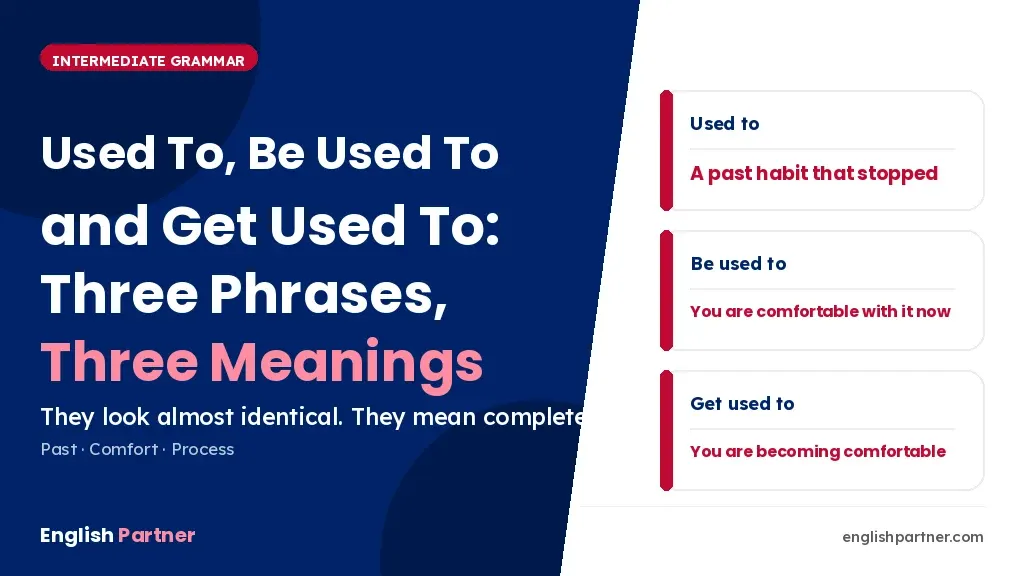
Quick answer: “Used to” = a past habit that stopped, and it takes the base verb – “I used to live in Madurai.” “Be used to” = you are comfortable with it now, and it takes -ing – “I am used to living in Chennai.” “Get used to” = you are still adjusting – “I am getting used to Chennai.”
Why these three get mixed up
Three phrases, almost the same words, and the difference between them is a single helping verb plus one letter at the end of the next word. Nothing in Tamil, Telugu, Kannada or Hindi works quite like this, so there is no mother-tongue pattern to lean on.
In Tamil you would say முன்பு நான் மதுரையில் இருந்தேன் for the past habit and எனக்கு பழகிவிட்டது for present comfort. Two completely different sentence shapes. English uses three expressions that look like variations of each other, which is exactly why learners reach for whichever one comes first.
The good news: one question sorts it out, and once you have asked it ten or fifteen times it becomes automatic.
Used to: the habit that ended
This one is about the past, and it carries an unspoken message: not any more. That is the whole point of the phrase. If the situation is still true, you do not use it.
- “I used to walk to school.” → I don't now.
- “She used to work at Infosys.” → She has changed jobs.
- “We used to live in a joint family.” → We don't any more.
The form after it is always the base verb: walk, work, live. Not walking, not walked.
Two forms to watch. In questions and negatives, the d drops because did already carries the past: “Did you use to play cricket?” and “She did not use to drink coffee.” In every positive sentence the d stays. This is the single most common spelling slip on this topic, and it shows up in emails more than in speech.
Be used to: you are comfortable with it now
This describes your present state, not your past. It means something has become normal for you.
- “I am used to waking up at five.” → It no longer feels hard.
- “He is used to night shifts.” → He does them and they are fine.
- “Are you used to the Chennai heat?” → Has it become normal for you?
After be used to you need an -ing verb or a noun. “I am used to waking up early” (-ing) or “I am used to early mornings” (noun). “I am used to wake up early” is the mistake almost everyone makes once, because used to on its own takes the base verb and your ear carries that habit across.
Here is the trick that fixes it: the to in be used to is a preposition, like the to in “looking forward to”. Prepositions take -ing. The to in used to live is part of the verb phrase, so it takes the base form. Same two letters, two different jobs.
Get used to: the change in progress
This is the one most learners never use, and it is genuinely useful. It describes the middle stage: not comfortable yet, but getting there.
- “I am getting used to the new software.” → Still learning, improving.
- “It took me a month to get used to the traffic.” → The adjustment is finished.
- “You will get used to it.” → The single most reassuring sentence in English.
Form is the same as be used to: -ing or a noun. What changes is the tense of get, which carries the whole meaning. “I am getting used to it” = happening now. “I got used to it” = finished. “I will get used to it” = hasn't started yet.
Used to be used to: how the three fit together
Put on one timeline, they describe three different points about the same situation, and seeing them together is usually the moment it clicks.
Imagine you joined a company in Bengaluru three years ago and the commute was brutal.
- “I used to hate the commute.” → Past habit, now over.
- “I got used to the commute after six months.” → The adjustment completed.
- “I am used to the commute now.” → Present state of comfort.
- “My new colleague is getting used to it.” → Someone else, mid-process.
One situation, four sentences, four different stages. That is the actual value of knowing all three instead of just the first one.
Where this shows up in real conversations
These are not textbook structures. They turn up constantly in interviews, first weeks at a new job and small talk, and using the wrong one changes what the listener hears.
In interviews. “I am used to working with clients across time zones” tells the panel this is routine for you. “I used to work with clients across time zones” tells them you don't any more, which is the opposite of what you meant. One letter and a helping verb, and the answer lands differently.
Introducing yourself at a new job. “I am still getting used to the process here” is honest, professional and buys you patience. People respond well to it because it signals effort rather than complaint.
Small talk. “Are you used to the winter here?” is a natural question. “Did you use to live in Delhi?” is a natural follow-up. Both are ordinary conversation, not grammar exercises.
The same three ideas in Tamil
Seeing the mother-tongue version next to the English one removes most of the confusion, because it shows you that you already know these three ideas. Only the English packaging is new.
| Tamil | English | Which form |
|---|---|---|
| முன்பு நான் தினமும் நடந்து போவேன் | I used to walk every day | used to + base verb |
| எனக்கு இப்போ பழகிவிட்டது | I am used to it now | be used to + noun |
| கொஞ்சம் கொஞ்சம் பழகிக்கொண்டு இருக்கேன் | I am getting used to it | get used to + noun |
| அவருக்கு நைட் ஷிஃப்ட் பழகிவிட்டது | He is used to night shifts | be used to + noun |
Notice that Tamil uses one verb, பழகு, and changes its ending to carry the stage. English keeps the words used to and changes what sits in front of them. Once you see that, you stop translating word by word and start picking the stage first.
3 mistakes trainers hear every week
The pattern behind all three is the same: the -ing. Your head can learn the rule in two minutes; your mouth takes a couple of weeks, because the base-verb version is already a habit. That gap is normal, and it closes with speaking, not with reading.
If you want the wider picture on how habit and tense structures work together, the Cambridge Dictionary grammar entry on used to sets out the forms in full.
Your 3-day practice plan
Fifteen sentences, all about your own life. Sentences about your own routine stick; sentences about a textbook character do not.
When self-practice is not enough
You can learn this rule from a chart. What you cannot do alone is catch yourself saying “I am used to wake up early” in the middle of a real conversation, because at that moment your attention is on the content, not the verb form.
That is what a trainer does — catches the slip in the moment, in the middle of a real sentence, and makes you say it again correctly before the habit settles back. The rule is explained in your mother tongue first, then drilled in speaking practice until the -ing comes out without you thinking about it. Learners can join our spoken English classes in Coimbatore, our spoken English classes in Chennai, or our spoken English classes in Pondicherry.
Final thoughts and your next step
Ask the question before you speak: finished and in the past, comfortable now, or still adjusting? Past takes the base verb. The other two take -ing. That is the entire topic.
Start today with five sentences about your school days using used to. Say them out loud. Tomorrow, five about your life now. By the third day the difference will stop feeling like grammar and start feeling like something you just know.