English Tenses Explained in Tamil: What Each Tense Looks Like in Tamil
 Dhinesh Kumar
Content Writer
Published
Time to read
9 minutes
Dhinesh Kumar
Content Writer
Published
Time to read
9 minutes
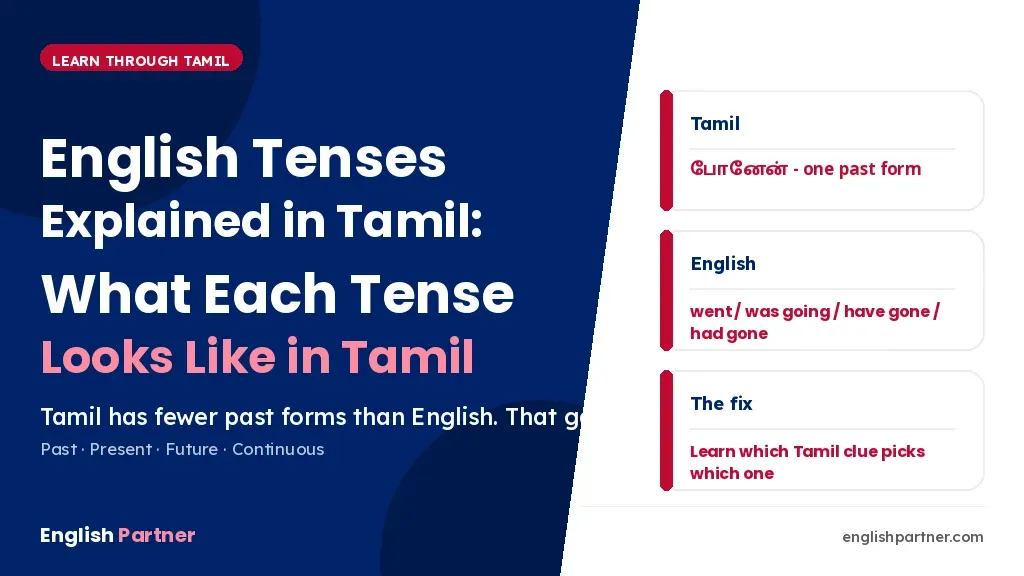
Quick answer: Tamil marks time inside the verb – போனேன் already carries the past. English marks it with separate helper words – was, have, had, will. So one Tamil past form has to split into four English ones, and the Tamil sentence does not tell you which. The clue-word table below does.
The real reason tenses feel confusing
Most learners have studied tenses three or four times – in school, in a book, maybe in an app – and still hesitate before every past sentence. That is not a memory problem. It is a mismatch between the two languages.
Look at போனேன். One word, and the past is already inside it. There is no separate word for did or was or have, because Tamil does not need one. The ending does the whole job.
Now look at what English does with the same idea: I went. I was going. I have gone. I had gone. Four different sentences, four different meanings, and the Tamil version you started from fits all four equally well.
That is the gap. You are not choosing between English forms – you are being asked for information your Tamil sentence never contained.
One Tamil past, four English pasts
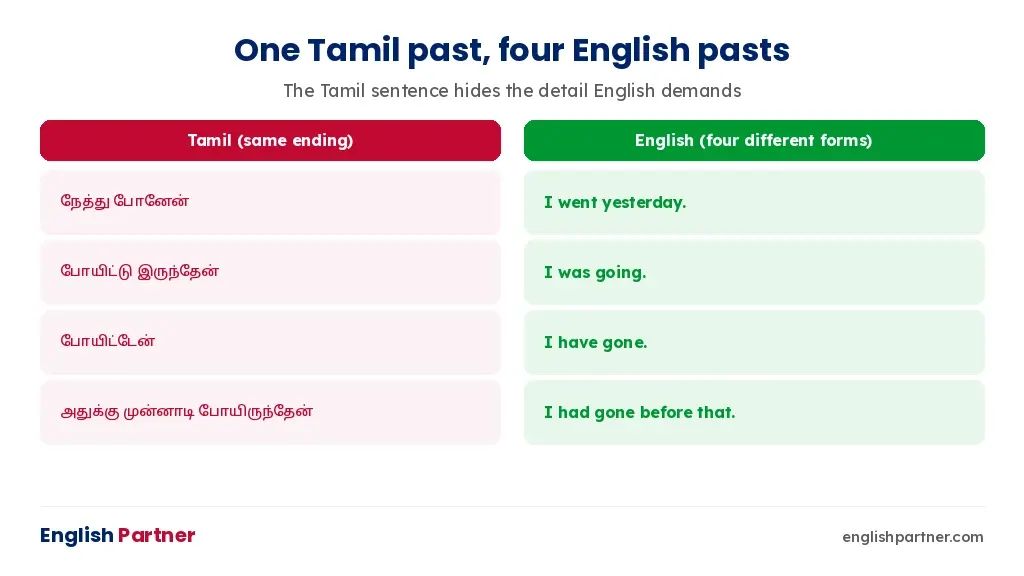
Read the pairs aloud. The left column changes very little; the right column changes completely.
This is why word-for-word translation fails with tenses specifically. With vocabulary, one Tamil word usually has one good English match. With tenses, one Tamil form has four, and picking between them needs a rule Tamil never taught you.
English tenses in Tamil: the clue-word table
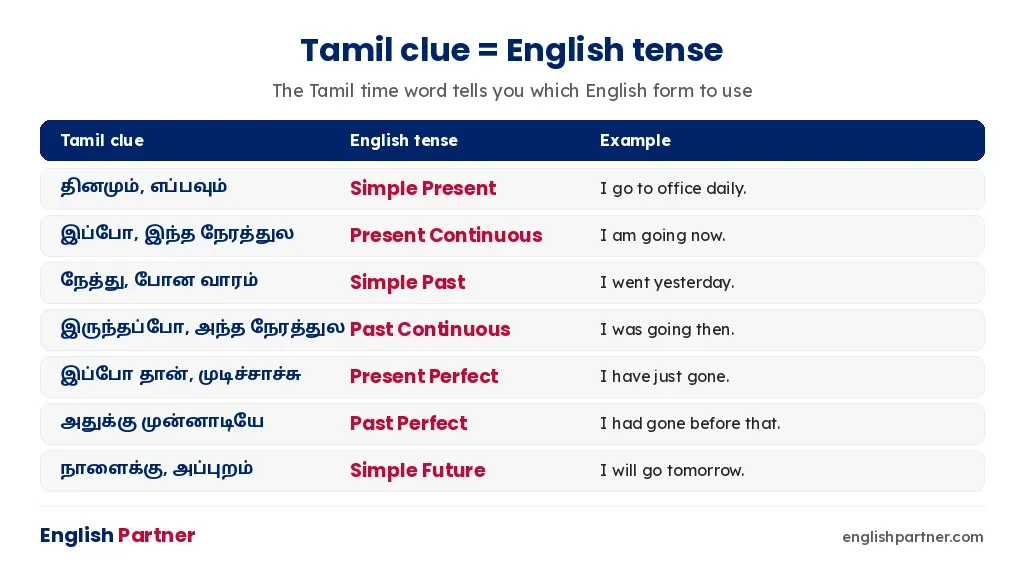
Here is the shortcut that works. Instead of memorising twelve formulas, learn which Tamil time word points at which English form. The clue word comes to you naturally in Tamil, and it carries the English answer with it.
| Tamil | English |
|---|---|
| நான் தினமும் ஆபீஸ் போறேன். | I go to office daily. |
| நான் இப்போ ஆபீஸ் போறேன். | I am going to office now. |
| நேத்து ஆபீஸ் போனேன். | I went to office yesterday. |
| நீ கூப்பிட்டப்போ நான் போயிட்டு இருந்தேன். | I was going when you called. |
| இப்போ தான் ஆபீஸ் போயிட்டு வந்தேன். | I have just been to the office. |
| அவர் வர்றதுக்கு முன்னாடியே நான் போயிருந்தேன். | I had gone before he came. |
| நாளைக்கு ஆபீஸ் போவேன். | I will go to office tomorrow. |
Notice how little the Tamil verb changes across those seven lines, and how much the English does. The work is all in the clue word – தினமும், இப்போ, நேத்து, இருந்தப்போ, இப்போ தான், முன்னாடியே, நாளைக்கு.
Three questions in Tamil that pick the tense
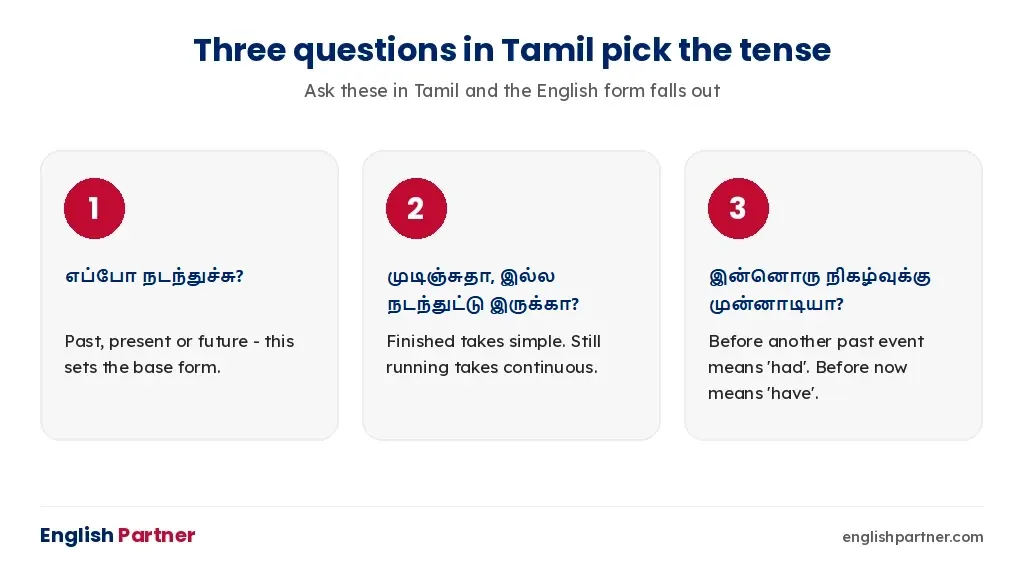
1. எப்போ நடந்துச்சு? Past, present or future. This sets the base form and is the easy part – your Tamil already knows the answer.
2. முடிஞ்சுதா, இல்ல நடந்துட்டு இருக்கா? Finished takes the simple form. Still running takes the continuous. நான் சாப்பிட்டேன் = I ate. நான் சாப்பிட்டு இருந்தேன் = I was eating.
3. இன்னொரு நிகழ்வுக்கு முன்னாடியா? If it happened before another past event, English wants had. If it happened before now, English wants have. Tamil squeezes both into முன்னாடியே, which is why this third question is the one most learners skip.
Ask these three in Tamil, in this order, and the English form is decided before you open your mouth. No formula recall needed.
The four tenses that cover most daily speech
You do not need all twelve to speak comfortably. In everyday Tamil-to-English conversation, four forms do most of the work:
| Tense | Tamil clue | Use it for |
|---|---|---|
| Simple present | தினமும், எப்பவும் | Habits, facts, routines |
| Present continuous | இப்போ, இந்த நேரத்துல | Happening right now |
| Simple past | நேத்து, போன வாரம் | Finished events |
| Simple future | நாளைக்கு, அப்புறம் | Plans and promises |
Get these four automatic first. The perfect forms matter, but they matter at the point where you are already speaking in sentences rather than words – and chasing all twelve at once is the main reason learners give up on tenses.
The two perfect forms, in plain Tamil terms
These are the two that stay confusing longest, because Tamil handles both with the same முன்னாடியே idea. The difference in English is about which point in time you are measuring from.
Present perfect – measured from now. Something happened before this moment, and the time is open or unstated. “I have finished the work.” You are not saying when; you are saying it is done as of now. Tamil equivalents: முடிச்சாச்சு, இப்போ தான், ஏற்கனவே.
Past perfect – measured from another past moment. Two things happened, and you are marking which came first. “I had finished the work before he came.” There are two past events, and had flags the earlier one. Tamil equivalent: அவர் வர்றதுக்கு முன்னாடியே.
| Tamil | English |
|---|---|
| சாப்பாடு முடிச்சாச்சு. | I have finished eating. |
| அவர் வர்றதுக்கு முன்னாடியே சாப்பிட்டு முடிச்சிருந்தேன். | I had finished eating before he came. |
| அந்த படம் ஏற்கனவே பாத்துட்டேன். | I have already seen that film. |
| அவங்க சொல்றதுக்கு முன்னாடியே தெரிஞ்சிருந்தது. | I had known it before they told me. |
A simple test: if there is only one past event in your sentence, you never need had. Had exists only to separate two past events, so if you cannot point at the second one, use the simple past instead.
3 mistakes that come straight from Tamil
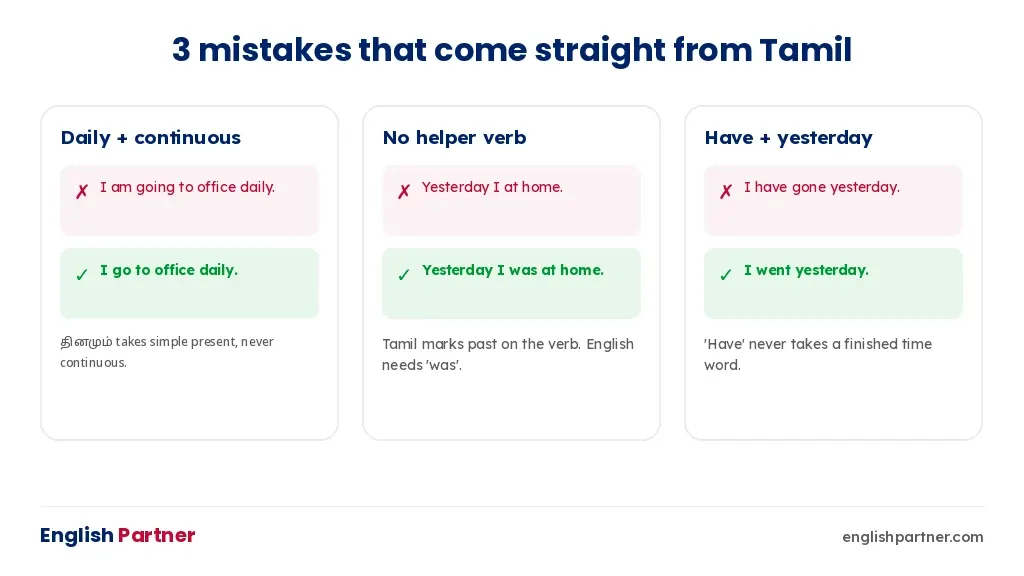
Mistake 1 – daily with a continuous form. “I am going to office daily.” தினமும் means a habit, and habits take the simple present: “I go to office daily.” The continuous says right now, which contradicts daily.
Mistake 2 – the missing helper verb. “Yesterday I at home.” In Tamil the past is already inside இருந்தேன், so nothing reminds you to add anything. English needs the helper: “Yesterday I was at home.”
Mistake 3 – have with a finished time. “I have gone yesterday.” English does not allow have next to a closed time word. Say “I went yesterday” – or keep have and drop the time: “I have gone.”
All three are Tamil patterns arriving intact in English. They are not signs of weak grammar; they are signs that nobody showed you where the two languages diverge. The British Council makes the same point about first-language transfer in adult learners.
Your 7-day plan, one tense a day
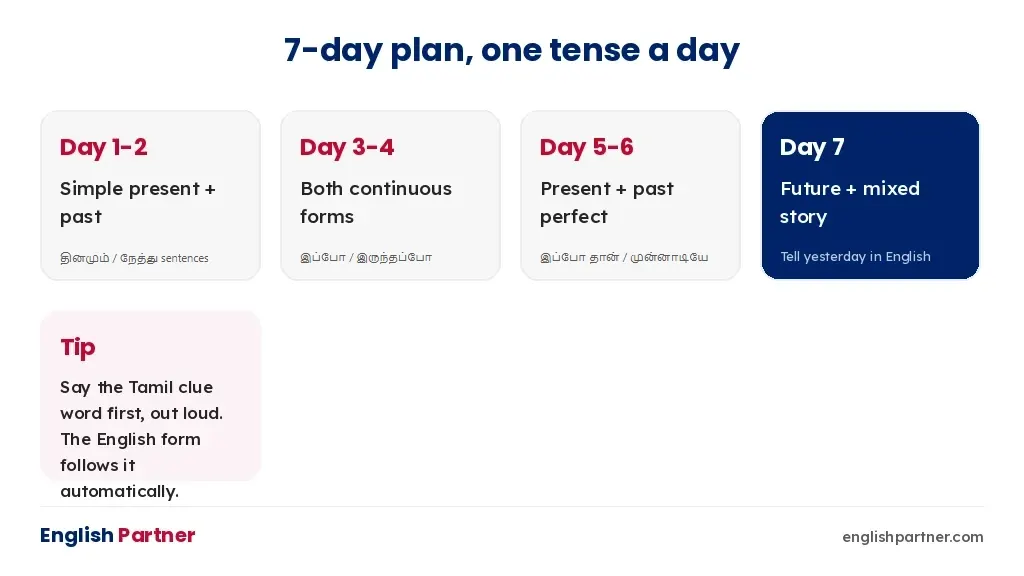
Days 1–2: Ten தினமும் sentences and ten நேத்து sentences. Simple present and simple past only.
Days 3–4: Ten இப்போ sentences and ten இருந்தப்போ sentences. Both continuous forms.
Days 5–6: Ten இப்போ தான் sentences and ten முன்னாடியே sentences. Present perfect and past perfect.
Day 7: Tell yesterday's story out loud in English, start to finish, mixing whatever forms it needs.
Say the Tamil clue word first, out loud, every time. That is the whole trick – the clue word pulls the correct English form behind it.
When self-practice is not enough
Tense rules are easy to read and hard to make automatic, because the slip happens mid-sentence while you are thinking about the content, not the grammar. Alone, you never hear it.
Trainer-led practice is what closes that gap: someone who explains the rule in Tamil, catches the wrong form as it leaves your mouth, and keeps you talking anyway. Learners can join our spoken English classes in Coimbatore, our spoken English classes in Chennai, or our spoken English classes in Pondicherry.
Final thoughts and your next step
Tamil is not the obstacle here – it is the fastest route into the rule. The obstacle is that Tamil asks for less information than English does, so the English form has to be chosen consciously until it becomes habit.
Learn the clue words, ask the three questions in Tamil, and start with the four tenses that cover daily speech. Tonight, say ten தினமும் sentences out loud. That is Day 1 done.
Want the rule explained in Tamil by a trainer? Send “Hi” on WhatsApp for a free five-minute level test in your language.
Frequently asked questions
Why are English tenses hard for Tamil speakers?
Because Tamil marks time inside the verb itself and English marks it with separate helper words. Tamil gets by with roughly one past form where English has four, so the Tamil sentence simply does not contain the detail English is asking for.
How many tenses does Tamil have compared to English?
Tamil works comfortably with three main time forms – past, present and future – marked on the verb ending. English splits each of those into four shapes (simple, continuous, perfect, perfect continuous), which gives twelve in total.
What is the easiest way to learn tenses through Tamil?
Learn the Tamil clue word, not the formula. தினமும் always points to simple present, இப்போ to present continuous, நேத்து to simple past. Once the clue is in your mouth, the English form follows it.
Why is “I am going to office daily” wrong?
Because தினமும் (daily) means a habit, and habits take the simple present: “I go to office daily.” The continuous form is for something happening right now, which contradicts “daily”.
What is the difference between “I went” and “I have gone”?
“I went” is used with a finished time – yesterday, last week. “I have gone” is used when the time is not stated or still open – just now, already, today. This is why “I have gone yesterday” is wrong.
Do I need to learn all 12 tenses to speak English?
No. Four forms cover most daily speech – simple present, simple past, present continuous and simple future. The rest can wait until those four are automatic.
Is it okay to think in Tamil while learning tenses?
Yes, for learning the rule. Tamil is the fastest way to understand what a tense means. What slows you down is converting whole sentences in Tamil while you are speaking.
Which English Partner course teaches tenses in Tamil?
Pre-Basic and Basic Level. Both explain each tense in Tamil first, then build it through daily speaking practice with a trainer who speaks your language.