Telephonic Interview in English: 10 Questions with Model Answers
 Dhinesh Kumar
Content Writer
Published
Time to read
9 minutes
Dhinesh Kumar
Content Writer
Published
Time to read
9 minutes
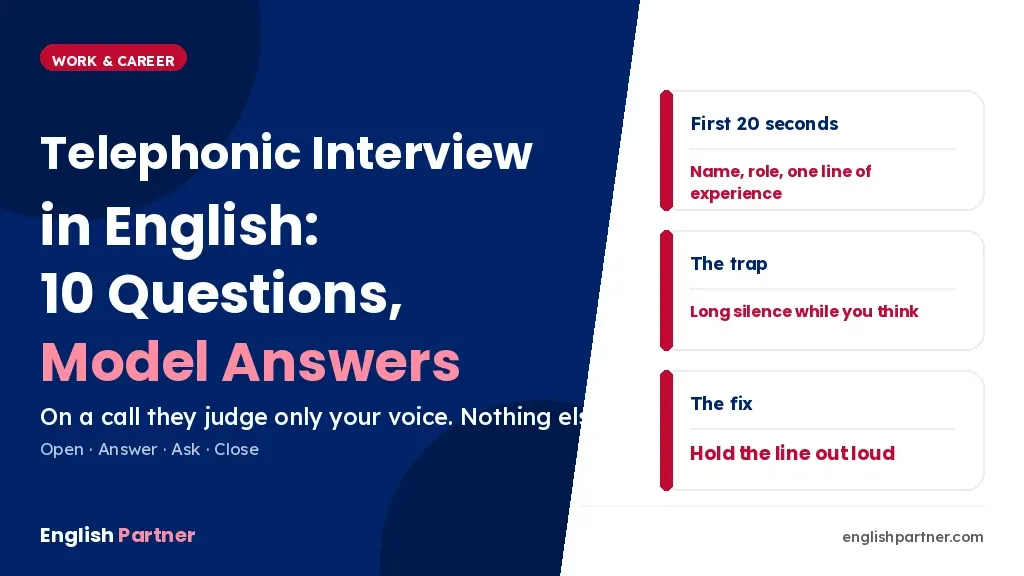
Quick answer: A telephonic round is almost always the same ten questions. Answer each in three parts – one-line answer, one example, one closing line – keep “tell me about yourself” to 45 seconds, and say “let me think for a second” out loud instead of going silent. Questions, model answers and the phone phrases are below.
Why a phone interview is harder than a face-to-face one
In a room, a lot of things speak for you. You are dressed well, you smile, you nod, you shake hands. Half the impression is formed before you say anything substantial.
On a call, all of that disappears. There is only your voice – speed, clarity, pauses and the first twelve sentences you say. That is the entire basis on which someone decides whether to move you to the next round.
The good news is that this makes it a preparable problem. You cannot rehearse a whole conversation, but you can absolutely rehearse twelve sentences, and in a telephonic round those twelve sentences are nearly all of it.
How the first minute actually goes
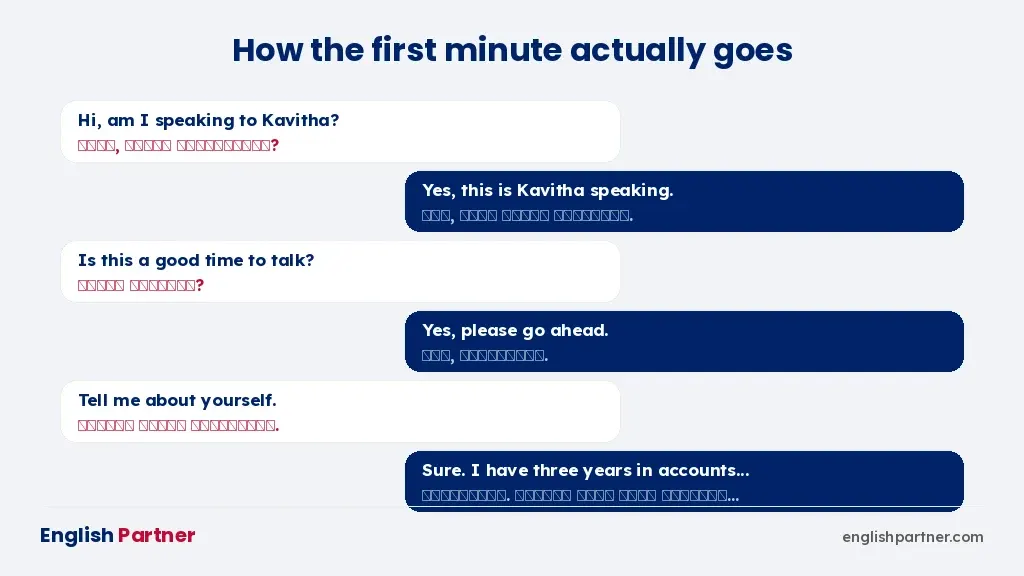
Note two things in that exchange. First, “This is Kavitha speaking” – not “I am Kavitha.” Phone English has its own opening and this is the one it uses.
Second, “Yes, please go ahead.” If the call genuinely is a bad moment, it is entirely acceptable to say: “Could we do this in twenty minutes? I am just stepping out of a meeting.” Interviewers respect that far more than a distracted answer given from a noisy street.
Telephonic interview questions and answers: the 10 you will get
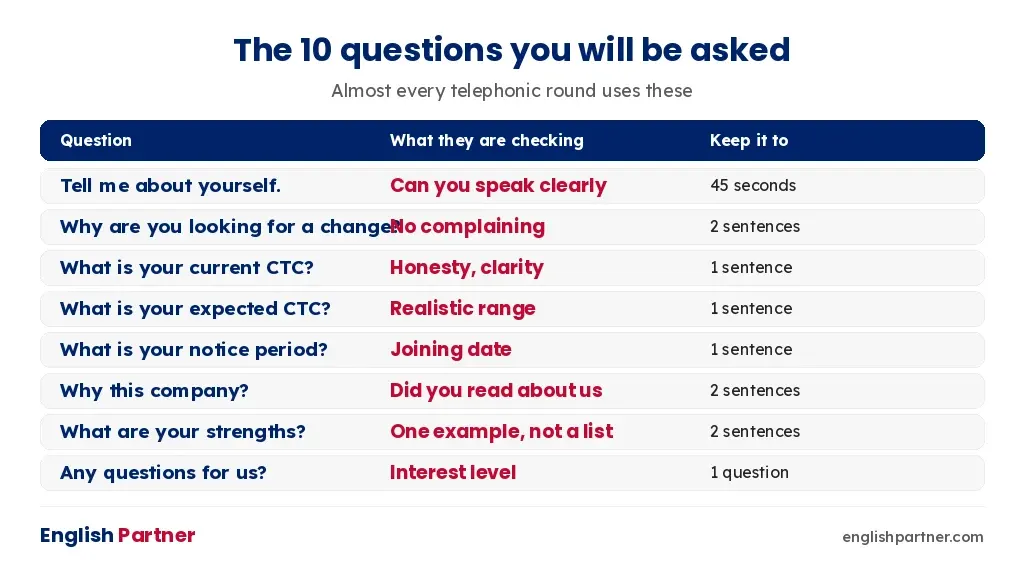
Here are the questions with a model answer for each. Change the details, keep the shape.
1. Tell me about yourself.
“I am Kavitha. I have three years of experience in accounts payable, currently with a logistics company in Coimbatore where I handle around forty vendor invoices a month. I am now looking for a role with more ownership, which is why this position interested me.”
2. Why are you looking for a change?
“I have learned a lot in my current role, but the work has become repetitive. I am looking for a position where I can take on reporting as well, not only processing.”
3. What is your current CTC?
“My current CTC is four lakhs eighty thousand per annum, fixed.” One sentence. No explanation needed.
4. What is your expected CTC?
“I am looking at around six to six and a half lakhs, based on my experience – but I am open to discussing it.” A range with a reason, never “as per company norms”.
5. What is your notice period?
“Thirty days, and I may be able to negotiate it down to about twenty.”
6. Why do you want to join this company?
“I read that you are expanding your south India operations, and this role sits in that team. I would like to be part of something that is growing rather than maintaining.” One specific fact about them is enough, and it is the question that separates prepared candidates from everyone else.
7. What are your strengths?
“I am good at keeping track of detail under pressure. During our last audit I reconciled three months of pending entries in one week without errors.” One strength with one example beats four adjectives.
8. What is your weakness?
“I take longer than most people to delegate, because I want to check things myself. I have been working on it by handing over the routine reports to my junior.” A real weakness plus what you are doing about it.
9. When can you join?
“Within thirty days of an offer, possibly sooner.”
10. Do you have any questions for us?
“Yes – could you tell me who this role reports to, and what the first three months would focus on?” Never say no. Saying no reads as no interest.
Structure every answer in three parts
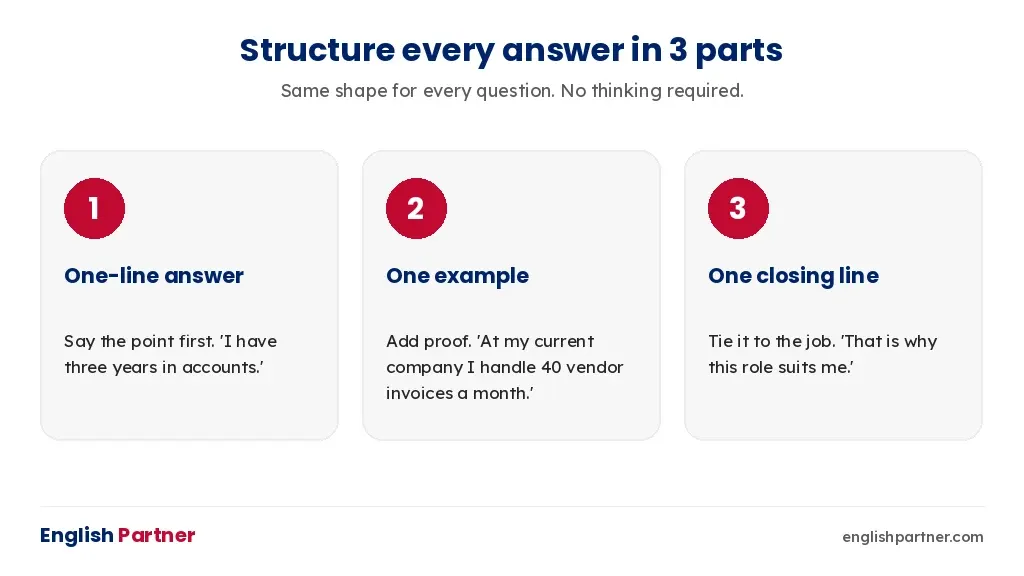
This is the part worth memorising, because it removes the need to think about structure while you are also thinking about content.
One-line answer. Say the point first. English-speaking interviewers expect the conclusion at the start, not after the background.
One example. Add a number or a situation. “Forty invoices a month” does more work than “I am hardworking.”
One closing line. Tie it back to the job. It signals you understood why they asked.
Three sentences. Every question. Once the shape is automatic, you only have to think about the facts.
The eight phrases that save a phone call
These handle the awkward moments – and awkward moments are what actually sink telephonic rounds.
| Situation | What to say |
|---|---|
| Answering the call | Yes, this is Kavitha speaking. |
| You need a moment | That’s a good question – let me think for a second. |
| You did not hear | Sorry, could you repeat that, please? |
| The line is bad | I am losing you a little – could you say that again? |
| You need to check something | Just a second, let me check that. |
| You do not know | I have not worked on that directly, but I have done something similar. |
| Buying a breath | Sure. So, to give you some context… |
| Closing the call | Thank you for your time. I look forward to hearing from you. |
Learn these as whole units. In the middle of a real call you will not have the capacity to build them word by word.
3 mistakes that end a phone interview early
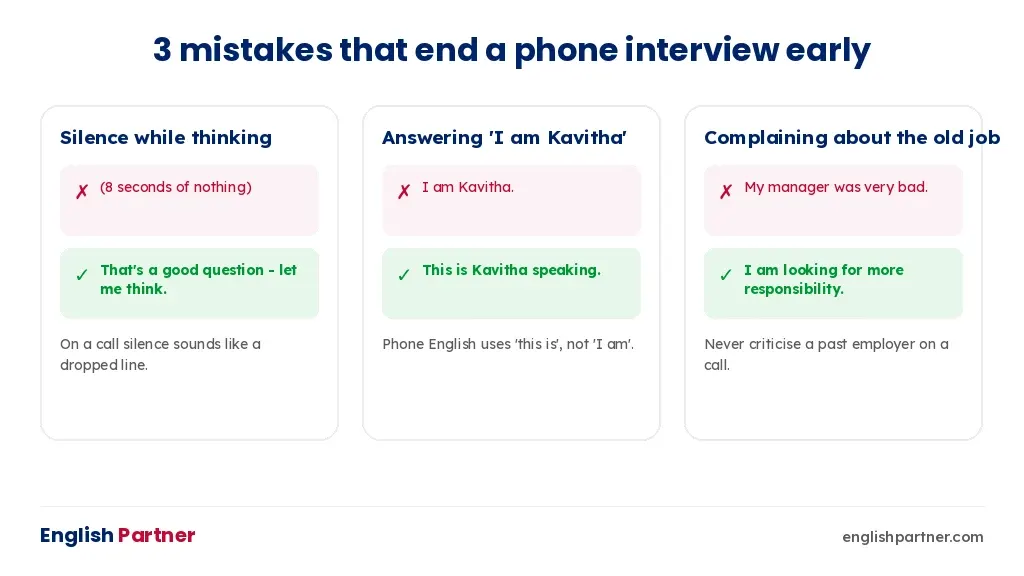
Mistake 1 – silence while thinking. Eight seconds of nothing sounds like the call dropped. Say “Let me think for a second” and the same pause becomes composure.
Mistake 2 – “I am Kavitha.” Correct English, wrong register for a phone call. “This is Kavitha speaking.”
Mistake 3 – complaining about the current job. “My manager was very bad.” Reframe it as movement towards something: “I am looking for more responsibility.”
Interviewers are listening for tone as much as content, and on a call tone is amplified. The British Council notes the same thing about assessed speaking – clarity and pacing score higher than vocabulary range.
Your 5-day preparation plan
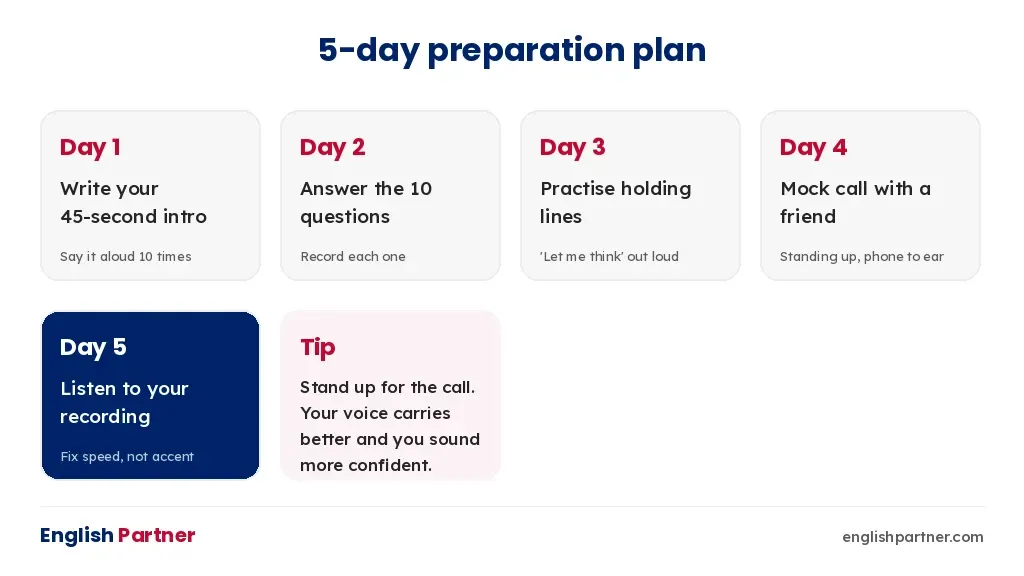
Day 1: Write your 45-second introduction and say it aloud ten times. Out loud, not in your head.
Day 2: Answer all ten questions in the three-part shape. Record each one on your phone.
Day 3: Practise the eight phrases until they come without thinking.
Day 4: One mock call with a friend. Standing up, phone to your ear, no notes.
Day 5: Listen to your Day 2 recordings. Fix speed and trailing endings – not your accent.
Stand up for the real call. Your voice carries better standing, and you will sound more certain than you feel.
When self-practice is not enough
Recorded answers get you through the first three questions. What decides the round is the unscripted middle – a follow-up you did not expect, a question about a gap in your CV, an interviewer who interrupts.
Live mock calls with a trainer are what prepare you for that: real interruptions, and feedback in your mother tongue straight afterwards. Learners can join our spoken English classes in Coimbatore, our spoken English classes in Chennai, or our spoken English classes in Pondicherry.
Final thoughts and your next step
A telephonic round is not a test of your English. It is a test of about twelve sentences, under mild pressure, with no visual support – and every one of those twelve can be prepared this week.
Tonight, write your 45-second introduction and say it out loud ten times. That one task changes the first impression on every call you take from here.
Want a live mock call with feedback in your language? Send “Hi” on WhatsApp for a free five-minute level test.
Frequently asked questions
How do I answer the phone for a telephonic interview?
Say “Yes, this is Kavitha speaking.” Phone English uses “this is”, not “I am”. Then ask or confirm whether it is a good time – it signals you are prepared, not caught off guard.
What questions are asked in a telephonic interview?
Almost always the same ten: tell me about yourself, why a change, current CTC, expected CTC, notice period, why this company, strengths, a role-specific question, availability, and whether you have questions. All ten are covered below with model answers.
How long should “tell me about yourself” be on a call?
About forty-five seconds. On a phone call anything past a minute without a pause sounds like a prepared speech, and the interviewer stops listening.
What do I say when I need time to think?
Say it out loud: “That’s a good question – let me think for a second.” Silence on a phone call sounds like the line dropped, which is far worse than a short pause you have announced.
How do I answer the expected salary question?
Give a range and one reason: “I am looking at around X to Y, based on my three years of experience – but I am open to discussing it.” Avoid saying “as per company norms”, which reads as unprepared.
Should I mention problems with my current job?
No. Reframe every reason as something you are moving towards, not away from: “I am looking for more responsibility” rather than “my manager was difficult.” Interviewers listen for complaints on calls specifically.
Does my accent matter in a telephonic interview?
Far less than your speed and clarity. Interviewers across India hear every regional accent daily. What loses marks is speaking too fast, trailing off at the end of sentences, or long silences.
Which English Partner course prepares for interviews?
Mastery in Communication covers interview and workplace English with live practice calls. Intermediate is the right starting point if everyday conversation still feels effortful.