Tanglish to English: From Mixing to Full English Sentences
 Dhinesh Kumar
Content Writer
Published
Time to read
8 minutes
Dhinesh Kumar
Content Writer
Published
Time to read
8 minutes
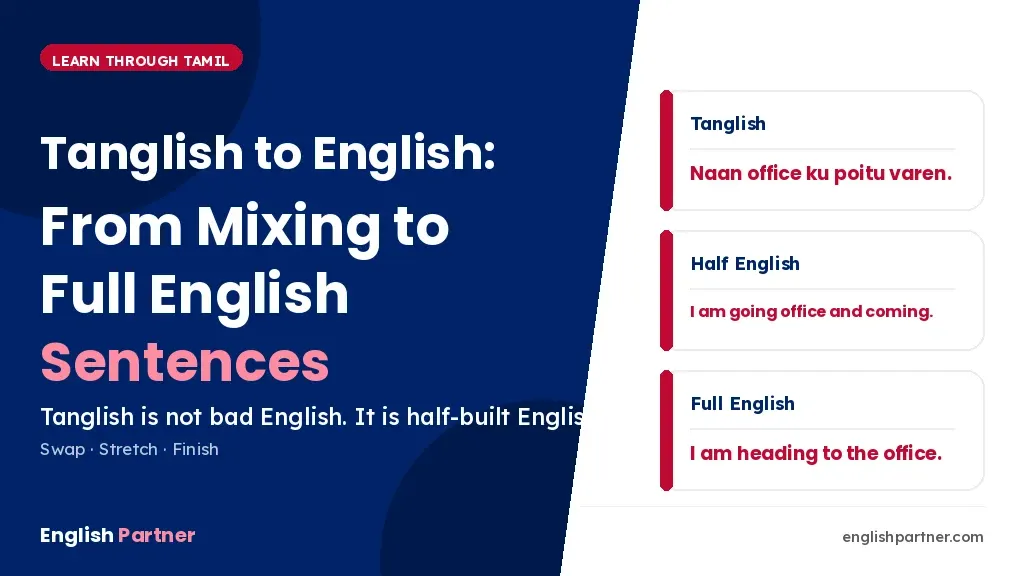
Quick answer: Tanglish is half-built English, not bad English. Shrink the Tamil side in order – nouns first, then phrases, then the verb ending last. Trying to switch everything at once is why most people quit in week one. The 20 habits to replace first and a 7-day plan are below.
Tanglish is a stage, not a failure
Almost every adult learner in Tamil Nadu speaks some Tanglish, and almost every one of them has been made to feel slightly bad about it. That framing is wrong, and it is also unhelpful.
Look at what a Tanglish sentence actually contains. “Naan office ku poitu varen” – the noun is English, the structure is Tamil. You already have the vocabulary. What you do not yet have is the English frame to hang it on.
That is a much smaller problem than “I cannot speak English”. It means the work is structural, and structure is learnable in a fixed order.
Tanglish to English: the 3-step method
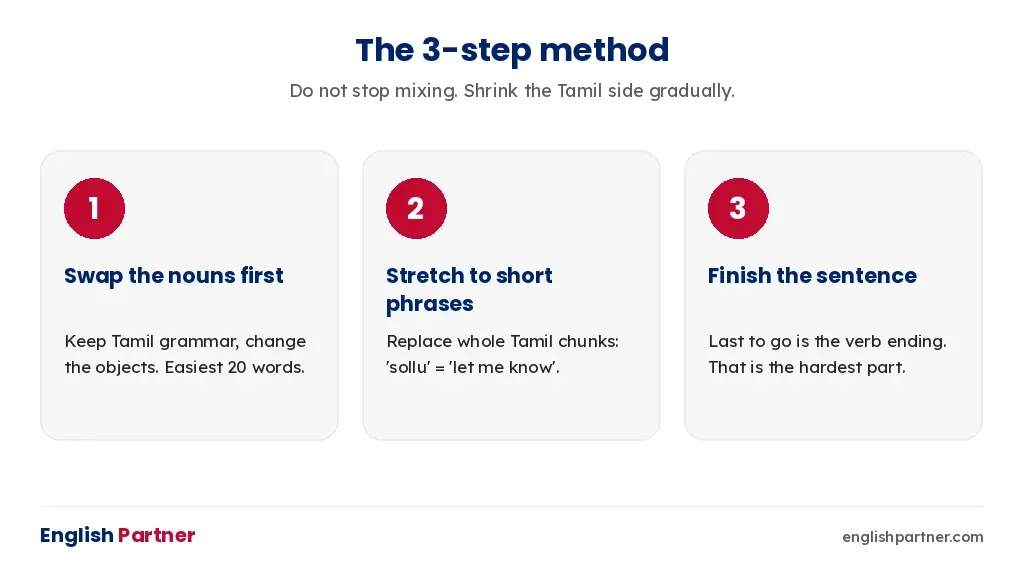
Step 1 – swap the nouns. Keep your Tamil grammar exactly as it is and change only the objects and places. கடை becomes shop, வேலை becomes work, பஸ் ஸ்டாப் stays as it is. This feels like doing nothing, which is why it works – there is no pressure, so you actually do it.
Step 2 – swap short phrases. Now replace whole Tamil chunks rather than single words. சொல்லுங்க becomes let me know. தெரியல becomes I am not sure. பாத்துக்கலாம் becomes we will see. Ten of these cover a surprising share of daily speech.
Step 3 – finish the sentence. Last comes the verb ending, and it is genuinely the hardest part. போயிட்டு வரேன் carries both going and coming in one Tamil form; English makes you pick one. Attempt this only after steps 1 and 2 are comfortable.
The order matters more than the effort. Learners who start at step 3 hit the hardest wall first and conclude they cannot do it.
Tanglish and the full English version
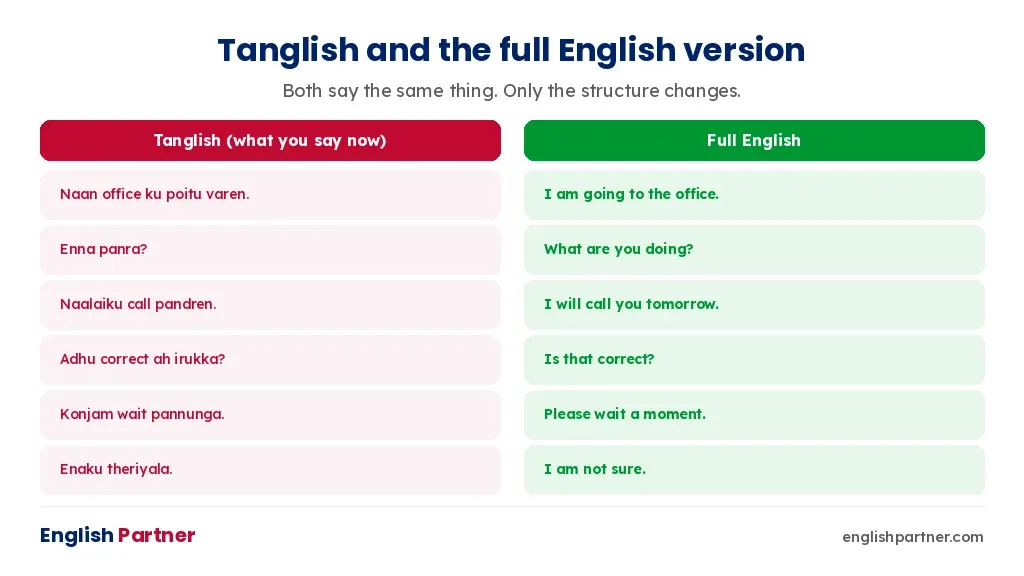
Read each pair aloud, Tanglish first and then the English. Hearing them back to back is what builds the link – the pairs are the same thought in two structures.
| Tanglish | Full English |
|---|---|
| Naan office ku poitu varen. | I am going to the office. |
| Enna panra? | What are you doing? |
| Naalaiku call pandren. | I will call you tomorrow. |
| Adhu correct ah irukka? | Is that correct? |
| Konjam wait pannunga. | Could you wait a moment, please? |
| Enaku theriyala. | I am not sure about that. |
| Naan try pannuren. | I will give it a try. |
| Message pannitu sollunga. | Send me a message and let me know. |
| Inniku leave pottutten. | I have taken leave today. |
| Bill pay panniyacha? | Has the bill been paid? |
20 Tanglish habits and the English line
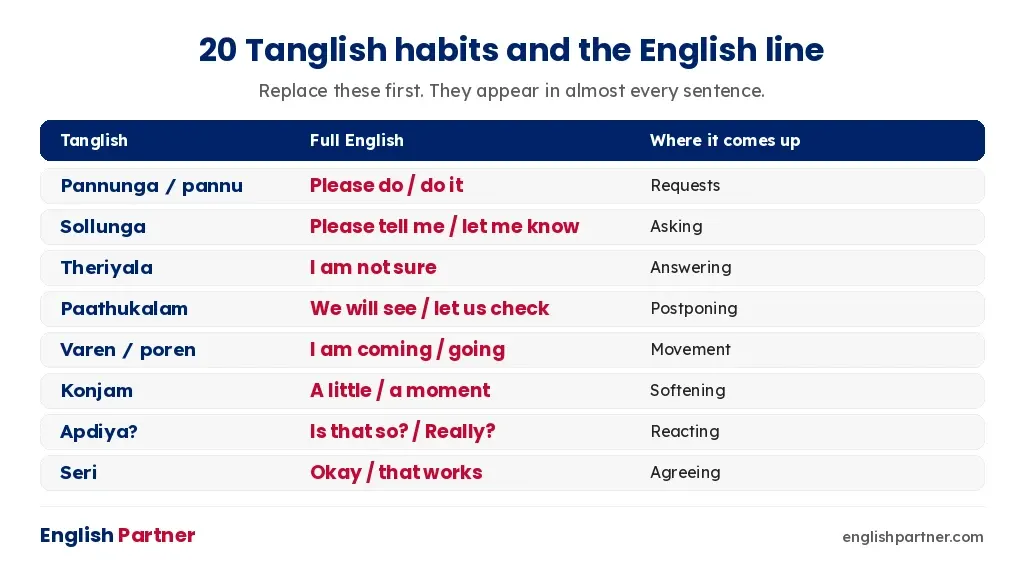
These are the ones to replace first, because they appear in nearly every sentence you speak.
| Tanglish | Full English |
|---|---|
| pannunga / pannu | please do it / do it |
| sollunga | please tell me / let me know |
| theriyala | I am not sure |
| paathukalam | we will see / let us check |
| varen / poren | I am coming / I am going |
| konjam | a little / a moment |
| apdiya? | is that so? / really? |
| seri | okay / that works |
| romba thanks | thank you so much |
| innum aagala | it is not done yet |
| ipo dhan | just now |
| appuram pesalam | let us talk later |
Pick five, use them for a week, then pick five more. Twelve at once is a study exercise; five at a time is a habit change.
Why mixing happens in the first place
It is worth understanding the cause, because it tells you what kind of practice will fix it.
English was taught as vocabulary, not as sentences. School gave you word lists and meanings. Nobody made you build fifty sentences out loud. So the words are stored individually, and individual words can only be slotted into a structure you already own – which is Tamil.
Technical and modern words have no Tamil habit. Bill, charger, meeting, network, leave, salary – you learned the object in English because that is what everyone calls it. There is nothing wrong here; this part of Tanglish is simply how the language works in Tamil Nadu.
Mixing is rewarded socially. Everyone around you understands it immediately. There is no cost to mixing and no reward for switching, so the habit never gets challenged in daily life.
Put those three together and you get the real picture: you are not short of English, you are short of English practice. That is why the fix is spoken repetition, not another vocabulary app.
3 Tanglish habits that survive into full English
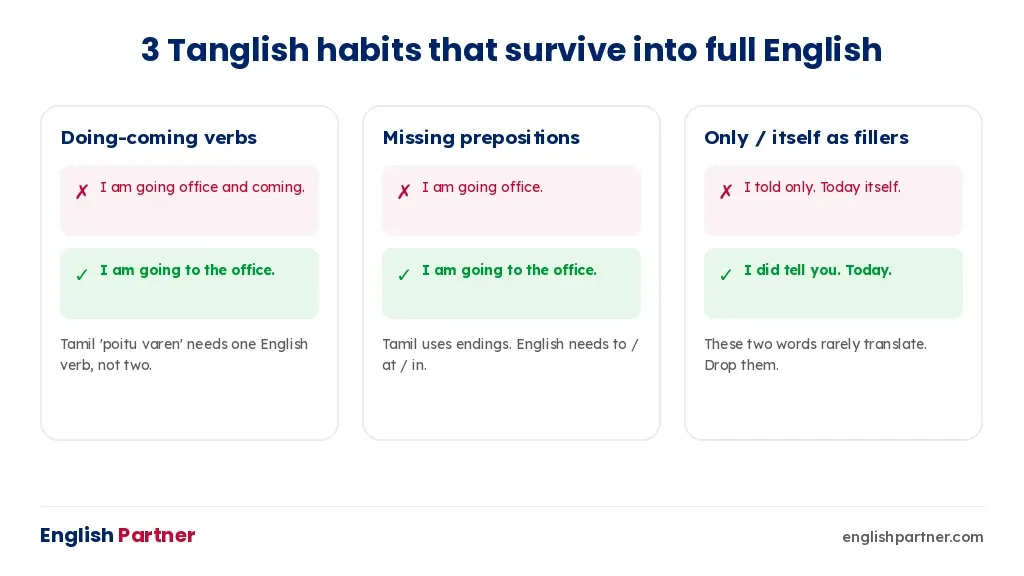
Habit 1 – the doing-coming verb. “I am going office and coming.” This is போயிட்டு வரேன் translated piece by piece. English uses one verb: “I am going to the office.” The returning is assumed.
Habit 2 – missing prepositions. “I am going office.” Tamil marks the relationship with an ending (ஆபீஸ் க்கு), so nothing reminds you to add a word. English needs to, at, in: “I am going to the office.”
Habit 3 – only and itself as fillers. “I told only.” “Today itself.” These come from தான், which has no single English equivalent. Usually the fix is to drop the word: “I did tell you.” “Today.”
All three persist long after the vocabulary has switched over, because they are structural rather than lexical. The British Council describes the same pattern as first-language transfer, and notes it responds to spoken practice rather than more grammar study.
Where Tanglish is fine and where it is not
Being realistic about this matters, because learners are often told to eliminate Tanglish entirely and then feel they have failed every time they use it.
Tanglish is completely normal with friends, family, shopkeepers, autos, colleagues you are close to. Most of Tamil Nadu speaks this way and nobody is being judged for it.
Full English is expected in four specific places: interviews, client calls, written email, and any presentation or meeting with people outside your state. These four are where the gap costs you something real.
So the target is not zero Tanglish. The target is being able to produce full English when those four situations arrive – and that requires having practised it, not just understood it.
Your 7-day plan
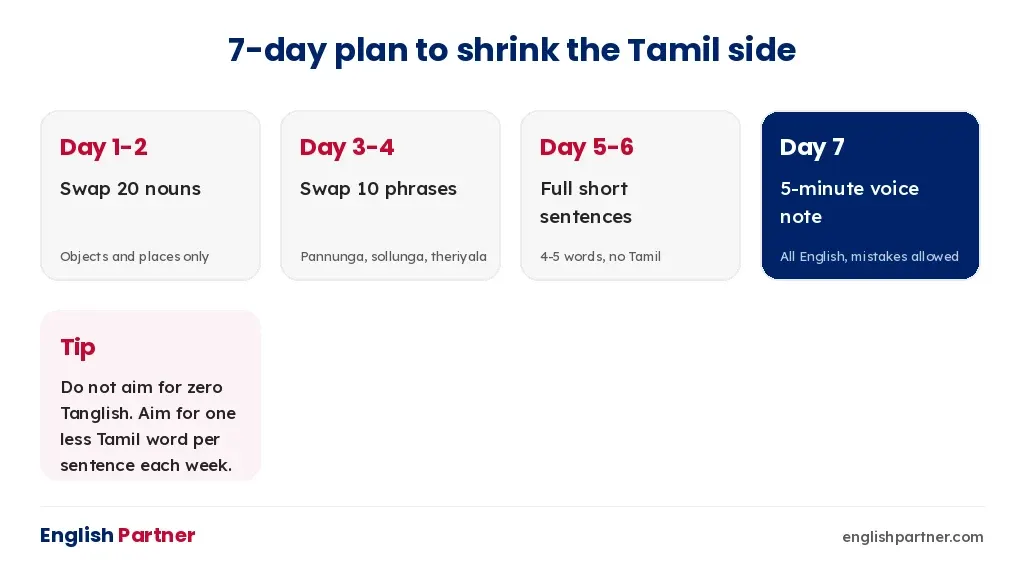
Days 1–2: Swap twenty nouns. Objects and places only, Tamil structure untouched.
Days 3–4: Swap ten phrases from the table – pannunga, sollunga, theriyala and the rest.
Days 5–6: Build full short sentences, four or five words, with no Tamil at all. I am going now. Please send it today.
Day 7: One five-minute voice note in full English. Mistakes expected and allowed.
Do not aim for zero Tanglish this week. Aim for one less Tamil word per sentence than last week – that is a target you can actually hit, and it compounds.
When self-practice is not enough
Here is the specific problem with practising this alone: Tanglish is perfectly understandable to everyone around you, so nothing in your day forces the switch. You can practise for months and still default to mixing the moment a real conversation starts.
What changes it is talking to someone who holds the conversation in English and explains the gap in Tamil afterwards. Learners can join our spoken English classes in Coimbatore, our spoken English classes in Chennai, or our spoken English classes in Pondicherry.
Final thoughts and your next step
Tanglish means you are already halfway. The vocabulary is there; the frame is not. Swap nouns, then phrases, then the verb – in that order, and not faster.
Tonight, pick twenty objects in your house and use the English word for each one in your normal Tamil sentences. That is Day 1, and it should feel almost too easy.
Want someone to hold the conversation in English with you? Send “Hi” on WhatsApp for a free five-minute level test in your language.
Frequently asked questions
Is speaking Tanglish bad?
No. Tanglish is a normal stage in learning, not a mistake. It means you already have English vocabulary and are still using Tamil structure to hold it together. The goal is to shrink the Tamil side gradually, not to feel ashamed of it.
How do I stop speaking Tanglish?
Replace in order: nouns first, then short phrases, then the verb ending last. Trying to switch everything at once is why people give up in the first week – the verb is the hardest part and it should be attempted last.
Why do I mix English words into Tamil sentences?
Because the English words came to you as isolated vocabulary rather than as whole sentences. School taught words; conversation needs frames. So the words arrive in English and the structure stays Tamil.
Is Tanglish accepted at work in India?
In casual conversation, widely. In interviews, client calls, emails and presentations, full English is expected – and that is exactly where most learners feel the gap.
What is the hardest part of moving from Tanglish to English?
The verb ending. “Poitu varen” carries going and coming in one Tamil form, and English needs you to choose one verb. This is the last thing to change and it takes the longest.
Should I avoid Tamil completely while practising?
No. Use Tamil to understand the rule, then practise the sentence in English. Removing Tamil from learning slows you down; removing it from the sentence you are speaking is the actual goal.
How long does it take to speak full English sentences?
With daily speaking practice, most adults can hold short full-English conversations in about eight to twelve weeks. The first visible change – shorter pauses – usually comes within three weeks.
Which English Partner course helps with this?
Basic Level builds full sentences through daily speaking practice. Mastery in Communication is for learners who already know the grammar but still fall back into mixing under pressure.