How to Stop Translating in Your Head While Speaking English
 Dhinesh Kumar
Content Writer
Published
Time to read
8 minutes
Dhinesh Kumar
Content Writer
Published
Time to read
8 minutes

Quick answer: You translate because English was stored in your head as a word-to-word list. The exit is to stop storing words and start storing chunks – whole ready-made groups like “could you please send me” – then speak before the sentence is finished in your head. Four steps, thirty chunks and a seven-day plan are below.
What is actually happening in those 3 seconds
Someone asks you a question. You know the answer. But there is a pause – two, three, sometimes four seconds – and by the time the sentence comes out, the conversation has moved on.
Inside that pause, three things are running one after another. Your brain forms the idea in Tamil. It converts each piece to English. Then it checks the grammar before releasing the sentence.
Three steps for what a fluent speaker does in one. That is the whole problem. Not vocabulary – most adults who feel stuck already know two or three thousand English words. Not grammar either. It is one extra step that never got removed.
How to stop translating in your head: the 4-step exit
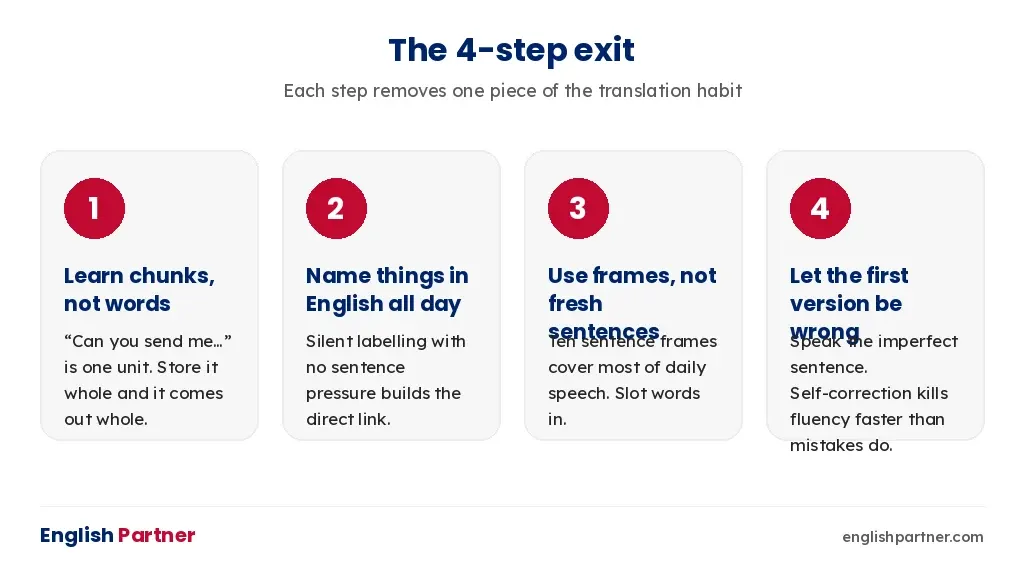
Step 1 – Learn chunks, not words. “Can you send me” is not four words. It is one unit. Store it whole and it comes out whole, with no assembly in between.
Step 2 – Name things in English all day, silently. Walking to the bus stop: road, shop, bike, water bottle, traffic. No sentences, no pressure. This builds the direct object-to-English link that translation currently blocks.
Step 3 – Use frames, not fresh sentences. Roughly ten sentence frames cover most of daily speech. Slot new words into a frame you already own instead of building from zero each time.
Step 4 – Let the first version be wrong. Say the imperfect sentence. Self-correction mid-sentence is the single biggest cause of the pause, and it teaches your brain that speaking requires checking.
Two routes to the same sentence
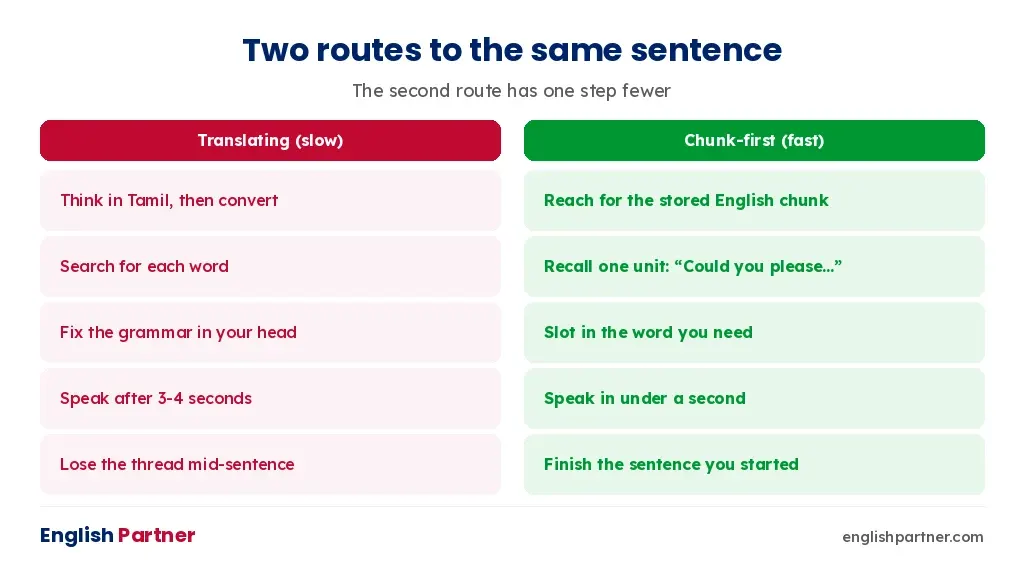
Look at what each route costs you. Suppose you want to ask a colleague to resend a file.
Translating route: think “அந்த ஃபைல மறுபடியும் அனுப்ப சொல்லணும்” = search for file, again, send = arrange them = check the tense = speak. Four seconds, and you have lost eye contact.
Chunk-first route: recall “Could you please send me…” = add that file again. Under a second, and you are still looking at the person.
Same sentence. The difference is where it was stored.
30 chunks that replace translation
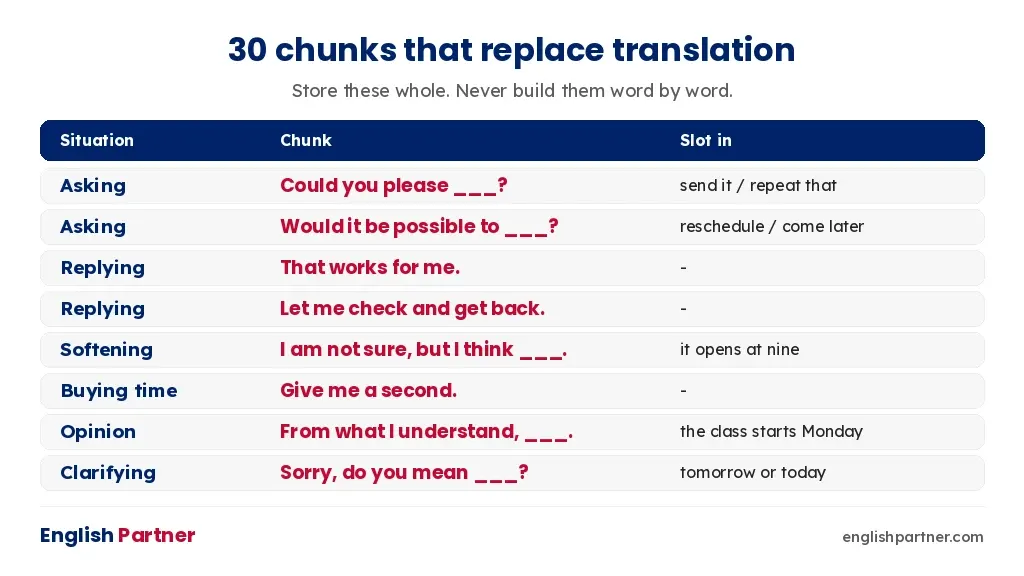
Learn these as single units. Do not break them into words, and do not look for the Tamil equivalent of each part – only of the whole.
| Tamil idea | English chunk |
|---|---|
| கொஞ்சம் அனுப்ப முடியுமா? | Could you please send me… |
| இது சரியா இருக்கும் | That works for me. |
| பாத்துட்டு சொல்றேன் | Let me check and get back to you. |
| எனக்கு சரியா தெரியலை | I am not really sure about that. |
| ஒரு நிமிஷம் | Give me a second. |
| நீங்க சொல்றது இதுதானே? | Sorry, do you mean…? |
| எனக்கு தெரிஞ்ச வரைக்கும் | From what I understand… |
| அப்புறம் பேசலாமா? | Can we talk about it later? |
| அது எனக்கு புரியல | I did not quite get that. |
| கொஞ்சம் மெதுவா சொல்லுங்க | Could you say that a bit slowly? |
Ten a day, said aloud five times each, and the chunk arrives before the Tamil does. That is the whole mechanism.
Ten more worth owning, because they buy you thinking time instead of silence:
| Tamil idea | English chunk |
|---|---|
| அப்படின்னா... | The thing is… |
| எனக்கு தோணுது | I think what happened is… |
| சரியா சொல்லனும்னா | To be honest with you… |
| அது மாதிரி எதோ ஒன்னு | Something like that. |
| அதுக்கு அப்புறம் | And after that… |
| அது எனக்கு ஞாபகம் இல்ல | I do not remember exactly. |
| நான் பாத்துக்கறேன் | I will take care of it. |
| கண்டிப்பா | Sure, no problem. |
| அது எப்படி? | How does that work? |
| கொஞ்சம் யோசிக்கணும் | Let me think about that for a moment. |
The fillers matter more than they look. “The thing is…” and “Let me think about that for a moment” give you two extra seconds while you are already speaking, which is very different from two seconds of silence while you translate. Fluent speakers use them constantly for exactly this reason.
Your mother tongue is not the problem
A lot of advice tells adults to “stop thinking in Tamil”. That advice is wrong, and it makes people more self-conscious, not more fluent.
Tamil, Telugu, Kannada and Hindi are how you understand a rule in the first place. A trainer who explains the present perfect in your language gets it across in two minutes; the same rule in English-only takes three sessions and still feels slippery. Your mother tongue is the fastest route into the rule.
What you remove is narrower than that. You remove the conversion step during speech – the two seconds where a finished Tamil sentence is waiting to be converted. Understanding in Tamil is fine. Learning in Tamil is fine. Assembling in Tamil, live, while someone waits for your answer, is the only part that costs you.
Practically, that means the rule can be explained in Tamil, and the practice has to be in English. Most adults have had the opposite – English explanations they half-followed, then no speaking practice at all.
What changes, week by week
| Stage | What it feels like | What to do |
|---|---|---|
| Week 1 | Still translating, but you notice it happening | Labelling and chunks only |
| Week 2 | Short answers come out directly, long ones still convert | Frames – slot words into what you own |
| Week 3–4 | The pause shrinks; it returns under pressure | Speak daily with one other person |
| Month 2–3 | Everyday speech is direct; new topics still convert | Add topic-specific chunks |
Notice that week three is where the pause comes back. Almost everyone reads that as failure and quietly stops. It is not failure – it is the point where you started attempting longer sentences, and longer sentences briefly bring the old habit back. Push through that week and the curve continues.
3 habits that keep the translation running
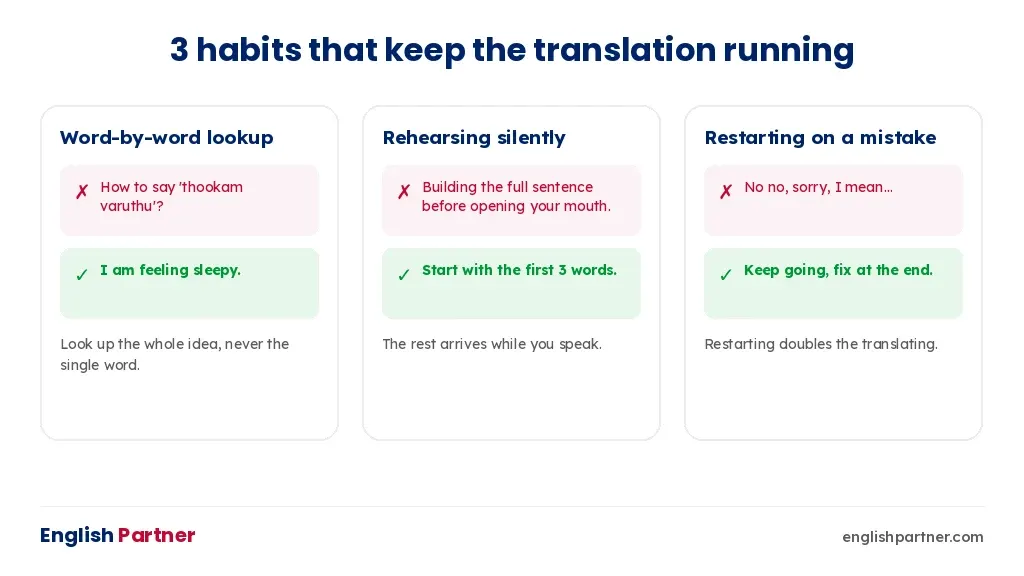
Habit 1 – word-by-word lookup. Searching for the English word for தூக்கம் வருது gives you sleep coming. Look up the whole idea instead and you get “I am feeling sleepy.”
Habit 2 – rehearsing the full sentence silently. If you wait until the sentence is complete in your head, you have already translated it. Start with the first three words and trust the rest to arrive.
Habit 3 – restarting on a mistake. “No no, sorry, I mean…” sends you back to the beginning of the loop. Keep going and fix it at the end, or not at all.
Your 7-day plan
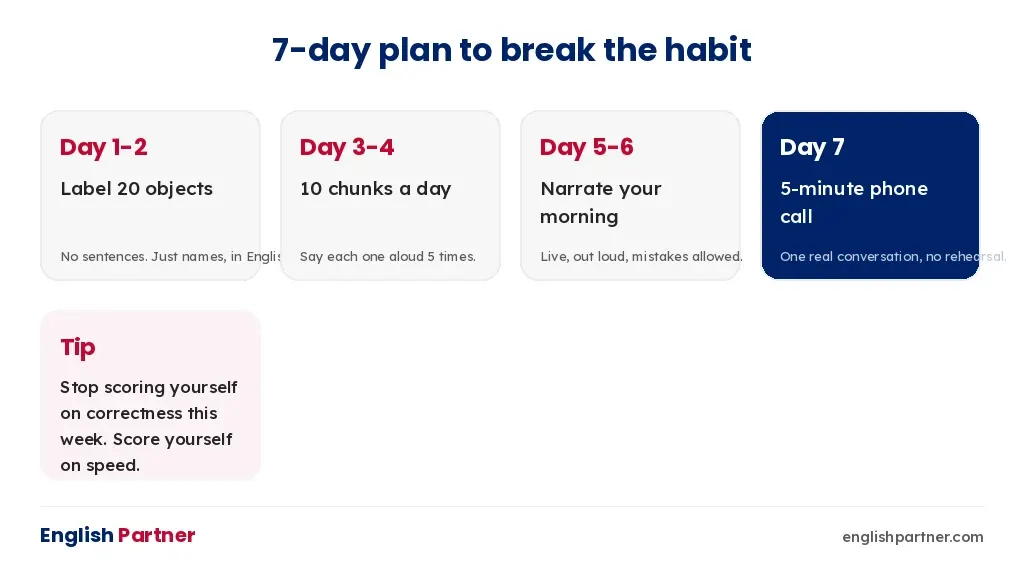
Days 1–2: Label twenty objects around you in English, silently, several times a day. No sentences.
Days 3–4: Ten chunks a day from the table above, said aloud five times each.
Days 5–6: Narrate your morning out loud as it happens – I am making tea, I am checking my phone. Mistakes allowed and expected.
Day 7: One five-minute phone call in English with no rehearsal.
Score yourself on speed this week, not on correctness. The British Council makes the same point about adult learners – regular spoken output matters more than more input.
When self-practice is not enough
Everything above works, but it has a ceiling. Alone, nobody tells you that your chunk is slightly off, and nobody keeps you talking past the point where it gets uncomfortable. That is where most adults stall around week three.
Trainer-led practice fixes the part self-study cannot: someone on the other end who explains the rule in your mother tongue, hears the pause before you notice it, and keeps the conversation going anyway. Learners in the city can join our spoken English classes in Coimbatore, or our spoken English classes in Chennai and spoken English classes in Pondicherry.
Final thoughts and your next step
The pause is not a sign that your English is weak. It is a sign that your English is stored as a translation table instead of as speech. Chunks replace the table. Speaking replaces the checking.
Start tonight with Step 2 – label twenty things around your house in English, out loud, and stop there. That is it for day one.
Want someone to practise with from week one? Send “Hi” on WhatsApp for a free five-minute level test in your language.
Frequently asked questions
Why do I translate in my head before speaking English?
Because you learned English as a set of equivalents – one Tamil word matched to one English word. Your brain still runs that conversion step before every sentence. It is a habit of storage, not a lack of vocabulary.
How long does it take to stop translating?
Most adults notice a real drop in the delay within three to four weeks of daily speaking practice, and it mostly disappears by three months. The speed depends almost entirely on how often you speak aloud, not on how much you study.
What are chunks and why do they help?
A chunk is a ready-made group of words stored as one unit – “could you please send me”, “that works for me”. Because you recall it whole, there is nothing to assemble and nothing to translate, so the sentence starts immediately.
Should I stop thinking in Tamil completely?
No. Your mother tongue is an advantage, not a problem – it is how you understand the rule in the first place. What you remove is the conversion step during speech, not Tamil itself.
Is it bad to make mistakes while trying to speak faster?
No. Speed comes before accuracy in speaking. A slightly wrong sentence said in one second builds fluency; a perfect sentence after four seconds of silent editing keeps the translation habit alive.
Does watching English films help stop translating?
It helps with listening and with chunks, but only if you repeat lines aloud. Passive watching with subtitles in your own language actually strengthens the translation habit.
What if I forget a word in the middle of a sentence?
Use a filler chunk – “what do you call it”, “something like that” – and keep going. Stopping to search mid-sentence is what restarts the translation loop.
How does English Partner help with this?
Our trainers explain in your mother tongue but push you to speak in English from day one, with daily WhatsApp speaking tasks and live calls so the direct link gets built through use.