Say, Tell, Speak and Talk: One Question Picks the Right One
 Dhinesh Kumar
Content Writer
Published
Time to read
8 minutes
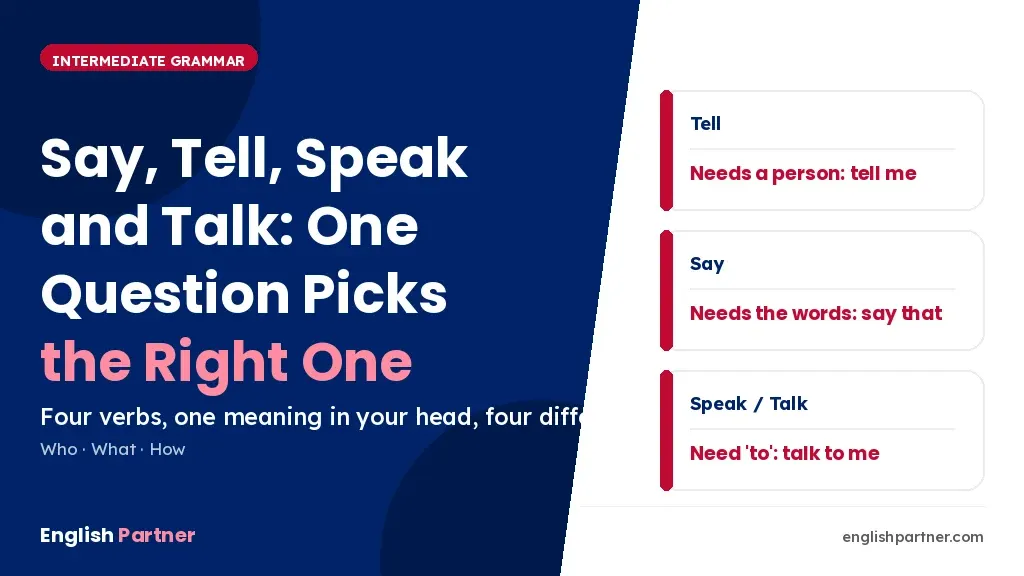
Quick answer: Tell needs a person right after it — tell me. Say needs the words — he said he was busy. Speak and talk need to before a person — I spoke to the manager. That is the entire rule.
Say, tell, speak, talk: why one idea became four verbs
In Tamil you use சொல்லு. In Telugu, చెప్పు. In Kannada, ಹೇಳು. In Hindi, कहना. One verb, and the grammar around it does not change much depending on who you are speaking to.
English split that single idea into four verbs, gave each one a different grammar pattern, and then made the patterns look almost identical. No wonder this is one of the most searched questions by Indian English learners.
Here is the part that makes it easy: you do not have to memorise four rules. You have to ask one question.
Tell: there is always a person
Tell is the strictest of the four and therefore the easiest. Somebody must come straight after it.
- Tell me the truth.
- She told him the news.
- I'll tell the manager tomorrow.
- Tell us about your experience.
If no person is in the sentence, tell is wrong. “She told that she is late” has no person, so it should be “She said that she is late.”
Four fixed expressions break this rule and are worth memorising as a set: tell the truth, tell a lie, tell a story, tell the time. No person needed in any of those.
Say: the words matter, the person does not
Say is about what was said, not who heard it.
- He said he was busy.
- She said, “I'll be there by six.”
- What did he say?
- They said nothing.
You can put a person in, but only with to in front: “He said to me that he was busy.” That is correct, though in real speech most people would use told there instead. It sounds lighter.
The fatal version is “He said me.” There is no situation in English where that is correct, and it is the single most common error with this pair.
Speak and talk: the activity, not the content
These two are about the act of speaking rather than the words. Both need to before a person.
- I spoke to the manager this morning.
- Can we talk to the client first?
- We talked about the budget.
- She speaks Telugu, Tamil and English.
The difference between the two is mostly register. Speak is slightly more formal, and it is the one used for languages and for one-way speaking — “he spoke at the conference.” Talk suits casual, two-way conversation — “can we talk?”
In an office both work for almost everything. “I need to speak to you” sounds a little more serious than “can we talk?”, which is genuinely useful to know when you are choosing how much weight to put on a request.
The four swaps that give you away
All four come from the same place: one verb in your first language, four in English. None of them stop you being understood — which is precisely why nobody corrects them, and why they survive for years.
Reported speech, where this really matters
This is the situation where the choice is forced on you daily at work, and where getting it wrong is most noticeable.
When you relay what someone said, the verb depends on whether you name the listener:
- He told me the report was ready. → listener named, use told
- He said the report was ready. → no listener, use said
- He told me to send the report. → an instruction, use told
- He asked me to send the report. → a request, use asked
That third and fourth pair are worth separating. Told me to carries authority; asked me to does not. In an email summarising a meeting, choosing the wrong one changes how the other person comes across — and people do notice that one.
Fixed expressions worth knowing as a set
Some combinations simply are what they are, and no rule will produce them. These come up constantly:
| Expression | Meaning |
|---|---|
| Tell me about it. | I completely agree / I have the same problem. |
| You can say that again. | I strongly agree. |
| To tell you the truth… | Being honest with you… |
| Let's talk it over. | Let's discuss it properly. |
| Speaking of which… | Since we are on that topic… |
| Say no more. | I understand, you don't need to explain. |
| Talk shop | Talk about work in a social setting. |
| Speak up | Say what you think / speak louder. |
“Tell me about it” is the one that catches people out. It is almost never a request for information — it means yes, I know exactly, that happens to me too.
The same four ideas in Tamil
Putting the mother-tongue version beside the English one usually settles this faster than any rule, because it shows you the split is in the English, not in the idea.
| Tamil | English | Why that verb |
|---|---|---|
| எனக்கு உண்மையை சொல்லு | Tell me the truth | "me" follows the verb |
| அவர் பிஸியா இருக்கேன்னு சொன்னார் | He said he was busy | no person, the words follow |
| நான் மேனேஜர்கிட்ட பேசினேன் | I spoke to the manager | the activity, so "to" |
| பட்ஜெட் பத்தி பேசினோம் | We talked about the budget | a topic, so "about" |
| அவங்க தெலுங்கு பேசுவாங்க | She speaks Telugu | a language always takes "speak" |
Tamil uses சொல்லு for the first two and பேசு for the next three. So Tamil already makes one of the splits English makes — content versus activity. The part English adds is the say and tell divide inside that first group, and that is the only genuinely new thing here.
Where this shows up at work
Three situations where the wrong verb is actually noticed, rather than just quietly tolerated:
Status updates. "The client told me the specs changed" is clean. "The client said me the specs changed" is the version people remember, and not for the content.
Setting up a meeting. "I need to speak to you about the timeline" works. "I need to speak you" drops the to, and because it is the opening line of a serious conversation, it lands heavily.
Passing on an instruction. "She told me to send it by Friday" versus "She asked me to send it by Friday". Both are correct English, but they describe two different relationships, and the person reading your email will take the difference seriously.
3 mistakes trainers hear every week
The pattern behind all three is the same: your mouth produces the verb before your brain checks what comes after it. This is why reading the rule fixes nothing on its own, and why the practice below is spoken rather than written.
If you want the full verb-pattern detail, the Cambridge Dictionary entry on say and tell sets out every structure with examples.
Your 3-day practice plan
Thirty sentences, all about your own week. Who you told something, what someone said, who you spoke to. Sentences about your own life stick; sentences about textbook characters do not.
When self-practice is not enough
You can learn this rule from the chart in two minutes. What you cannot do alone is catch yourself saying “he said me” in the middle of a status update, because at that moment your attention is entirely on the content.
That is the trainer's job — catching it in the moment, in a real sentence, and making you say it again correctly before the habit settles back. The rule is explained in your mother tongue first, then drilled in speaking practice. Learners can join our spoken English classes in Coimbatore, our spoken English classes in Chennai, or our spoken English classes in Pondicherry.
Final thoughts and your next step
One question, asked before you speak: is a person coming right after the verb? Yes means tell. No, and the words are coming, means say. If it is the activity itself, speak or talk, both with to.
Start today with five tell sentences about your own week, each one with a person in it. Say them out loud. By the third day the choice will stop feeling like grammar and start feeling like something you just know.