Restaurant and Hotel English: 35 Lines for Every Step
 Dhinesh Kumar
Content Writer
Published
Time to read
7 minutes
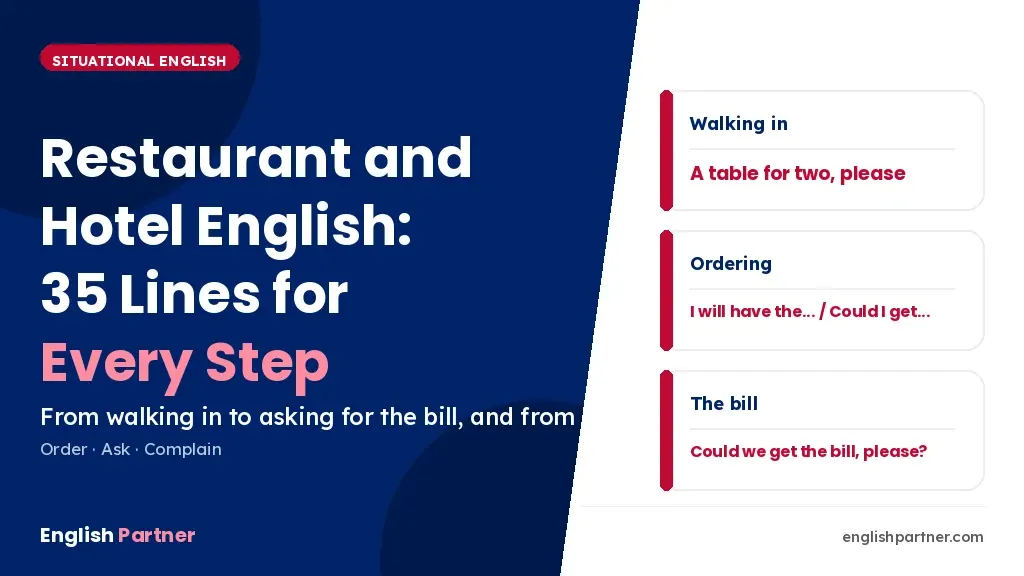
Quick answer: A whole meal needs about eight sentences. “A table for two, please.” “I'll have the chicken biryani.” “Could I get it without onions?” “Could we get the bill, please?” The full list, plus hotel check-in and checkout, is below.
Why this situation feels harder than it is
Restaurants and hotels are where people first notice their English, and there is a specific reason: someone is standing there waiting, and there is no time to assemble the sentence.
At work you can prepare. At a counter, you have about two seconds. So most people fall back on the shortest thing that works — “one coffee”, “bill” — which is understood, but is not what you wanted to sound like.
The good news is that this is the most finite situation in spoken English. A restaurant has four stages and a hotel has three. Learn roughly thirty-five short lines and you have covered all of them, permanently.
Restaurant conversation in English: the lines, stage by stage
Two things to notice in that list. Almost every line starts with “Could”, and almost every line is under seven words. That is not a coincidence — that is what polite spoken English actually looks like.
The Tamil versions, so the meaning lands first
| English | Tamil |
|---|---|
| A table for two, please. | ரெண்டு பேருக்கு இடம் வேணும். |
| What would you recommend? | நீங்க எது நல்லது சொல்றீங்க? |
| I'll have the chicken biryani. | எனக்கு சிக்கன் பிரியாணி. |
| Could I get it without onions? | வெங்காயம் இல்லாம கிடைக்குமா? |
| Is this very spicy? | இது ரொம்ப காரமா இருக்குமா? |
| Could we get the bill, please? | பில் கொண்டு வாங்க. |
| Can I pay by card? | கார்டில் கட்டலாமா? |
| Could you pack the rest, please? | மீதியை பார்சல் பண்ணுங்க. |
Hotel English: check-in to checkout
A hotel stay is even shorter than a meal. Three moments, and you can prepare all three.
Checking in. “Hi, I have a reservation under Kumar.” That is the whole opening. They will ask for ID and a card without you needing to say anything else. Then two questions worth asking up front: “What time is breakfast?” and “What time is checkout?”
During the stay. “Could I have the key for room 204?” “Could you send up an extra towel?” “The air conditioning isn't working — could someone take a look?” “Is there a laundry service?”
Checking out. “I'd like to check out, please.” “Could I get a copy of the bill?” “Could you keep my bags until four?” “Could you call a cab for me?”
Twelve lines total, and the last one — “Could you call a cab for me?” — saves more trouble than all the others combined.
Saying something is wrong, without being rude
This is the part people avoid, and avoiding it is why cold food gets eaten and wrong bills get paid.
English has a three-part formula for complaints, and it works every time:
- Soften the opening. “Sorry,” or “Excuse me,”
- State the problem as a fact, not an accusation. “this isn't what I ordered”, not “you brought the wrong thing”
- Say what you want. “could I get the chicken biryani instead?”
Put together: “Sorry, this isn't what I ordered — could I get the chicken biryani instead?” Nobody anywhere takes that badly.
Two more worth memorising. “Sorry, I think there's a mistake on the bill.” And for a hotel: “The room's quite noisy — would it be possible to move?”
Menu words that trip people up
Half the hesitation at a restaurant is not the speaking — it is not being certain what a word on the menu means, and not wanting to ask.
- Starter / appetiser — the small dish before the main food. Same thing, two words.
- Main course — the actual meal. Sometimes written as "mains".
- Side — something that comes alongside, like rice, fries or salad.
- Grilled, fried, roasted, steamed — how it was cooked. Grilled and steamed are the lighter two.
- Medium / medium rare / well done — only asked about meat, and it means how much it was cooked.
- On the side — served separately instead of poured on top. "Could I get the sauce on the side?"
- Complimentary — free. Worth knowing before you worry about the bill.
And the one question that solves all of it: "Sorry, what exactly is in this?" Nobody has ever been judged for asking it.
What the waiter says, and what it means
Listening is the harder half, because the waiter speaks fast and you only get it once. These five come up in almost every meal:
| What they say | What they mean | What to answer |
|---|---|---|
| Are you ready to order? | Shall I take your order? | Yes / Could you give us a few minutes? |
| Anything to drink? | Do you want a drink first? | Just water, please. |
| How would you like that? | Cooked how? Spicy or not? | Medium, please. / Not too spicy. |
| Is everything all right? | Is the food fine? | Yes, thank you. / Actually, could we get… |
| Anything else? | Do you want more? | No, that's all. Thank you. |
"Is everything all right?" is the one to be ready for. It is asked mid-meal, you are chewing, and it is also your opening to mention anything that is wrong. "Actually, could we get a bit more water?" is a perfectly good answer.
Ordering for a group
Ordering for four people is where it stops being a script, because you are now relaying what other people said. Three structures handle it:
- "We'll have two chicken biryanis and one veg." — the simplest, do the counting yourself first.
- "That's three dosas, and one of them without onions." — adding a change for one person.
- "Could we get everything together?" — so the food arrives at the same time, which in India you often have to ask for.
And at the end, the line that saves the most awkwardness: "Could we get separate bills?" Perfectly normal everywhere, and much easier than dividing it afterwards.
3 habits that sound rude in English
None of these are grammar errors, which is exactly why nobody corrects them. They are tone errors, and tone is what the listener actually reacts to.
The underlying pattern: Tamil, Telugu, Kannada and Hindi all carry politeness in the verb ending. English has no such ending, so it carries politeness in the structure — a question instead of a statement. That is why “Could I get…” is polite and “Give me…” is not, even with “please” attached.
The one word that does most of the work
If you take a single thing from this page, take “Could”.
- Could I get… — ordering anything
- Could we get… — asking for something at the table
- Could you… — asking someone to do something
- Could I have… — asking for something at a hotel desk
Four patterns. They cover a restaurant, a hotel, a shop, a bank and an office. You do not need to be fluent to sound polite in English — you need this one word and the question shape that follows it.
Your 3-day practice plan
Say them out loud, standing. Sitting and reading them silently does nothing for the two-second gap at the counter, which is the entire problem you are solving.
For more everyday-situation listening practice, the British Council has free audio dialogues set in restaurants and hotels.
When self-practice is not enough
Prepared lines hold until the waiter asks something you did not expect, or the hotel desk speaks faster than you can follow. That moment is where a memorised script stops helping.
Trainer-led practice builds the part you cannot script — following a question in real time and answering without a long pause. Learners can join our spoken English classes in Coimbatore, our spoken English classes in Chennai, or our spoken English classes in Pondicherry.
Final thoughts and your next step
A restaurant is four stages and a hotel is three. Thirty-five short lines, most of them starting with “Could”, and the situation is permanently handled.
Pick one meal this week and order entirely in English — including one change to the dish. That single request, “Could I get it without onions?”, is the one that proves to you that you can do this.