Question Tags: “Isn't It?” and Why Indians Overuse It
 Dhinesh Kumar
Content Writer
Published
Time to read
8 minutes
Dhinesh Kumar
Content Writer
Published
Time to read
8 minutes
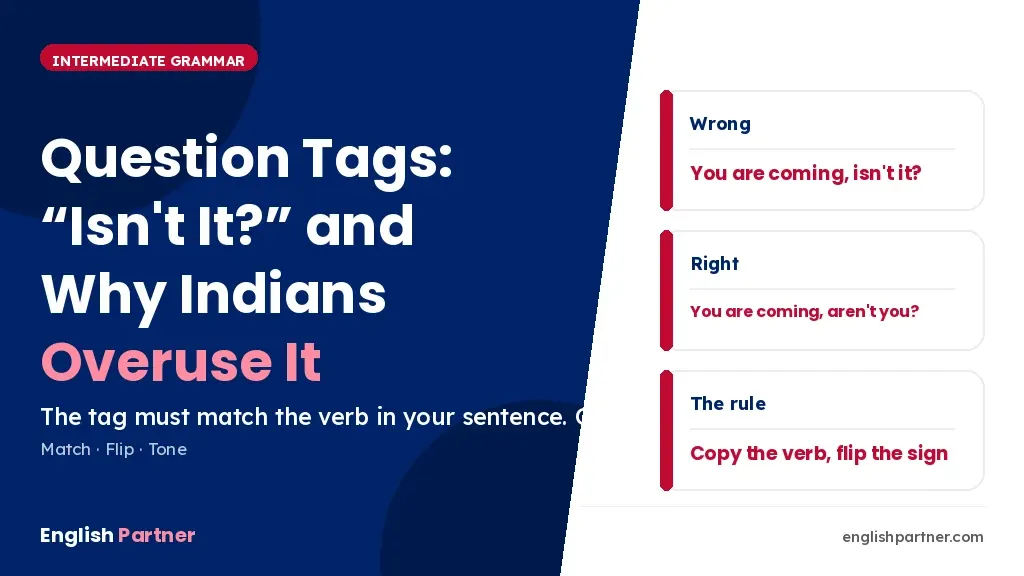
Quick answer: A question tag copies the helping verb from your sentence and flips the sign. “You are coming” → “aren't you?” “She finished it” → “didn't she?” “Isn't it?” is correct only when the subject really is it. Full chart below.
Why "isn't it?" became the all-purpose tag
Almost every Indian English speaker uses “isn't it?” for everything. “You are coming, isn't it?” “They finished it, isn't it?” “You will call, isn't it?”
There is a clear reason for it. Tamil, Telugu, Kannada and Hindi all have a single invariant tag – இல்லையா, அல்லவா, ना – that works at the end of any sentence regardless of its verb. One form, no matching required.
English does not work that way. The tag has to agree with the verb and the subject of the sentence it is attached to, which means there are roughly a dozen possible tags rather than one.
Everyone in India understands “isn't it?”, so there is no cost in daily conversation. It becomes visible in interviews, on client calls and in writing – and because it appears at the end of sentences, it gets noticed more than most slips.
Two rules build every question tag
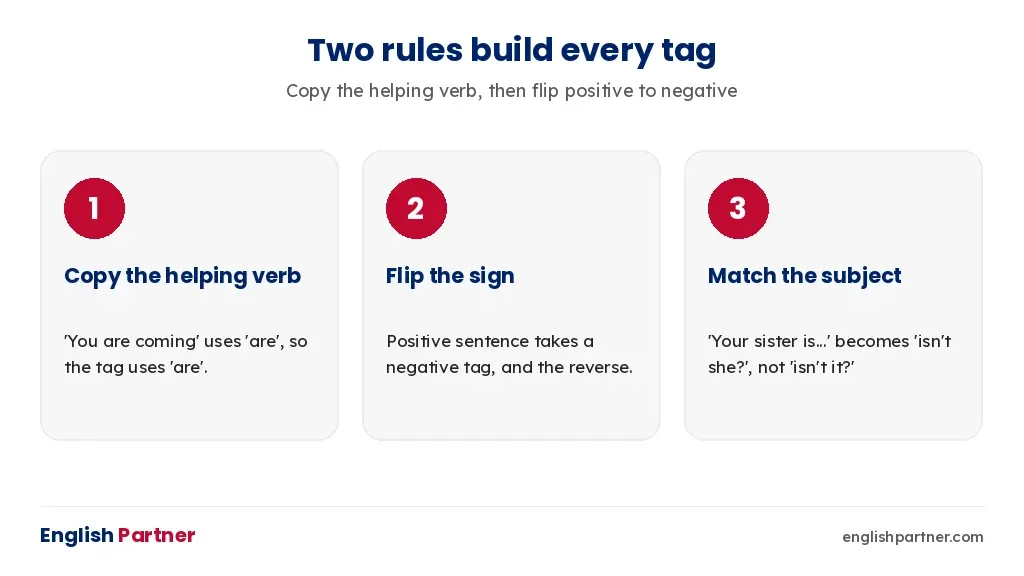
Rule 1 – copy the helping verb. Look at your own sentence and find the helper: are, is, was, have, can, will, should. That same verb goes in the tag. “You are coming” gives “aren't you?”
Rule 2 – flip the sign. A positive sentence takes a negative tag, and a negative sentence takes a positive one. “You are ready, aren't you?” but “You are not ready, are you?”
And one thing to carry with both: match the subject. “Your sister is coming” becomes “isn't she?” – not “isn't it?” The subject is a person, so the pronoun has to be one too.
Question tags examples: the full chart
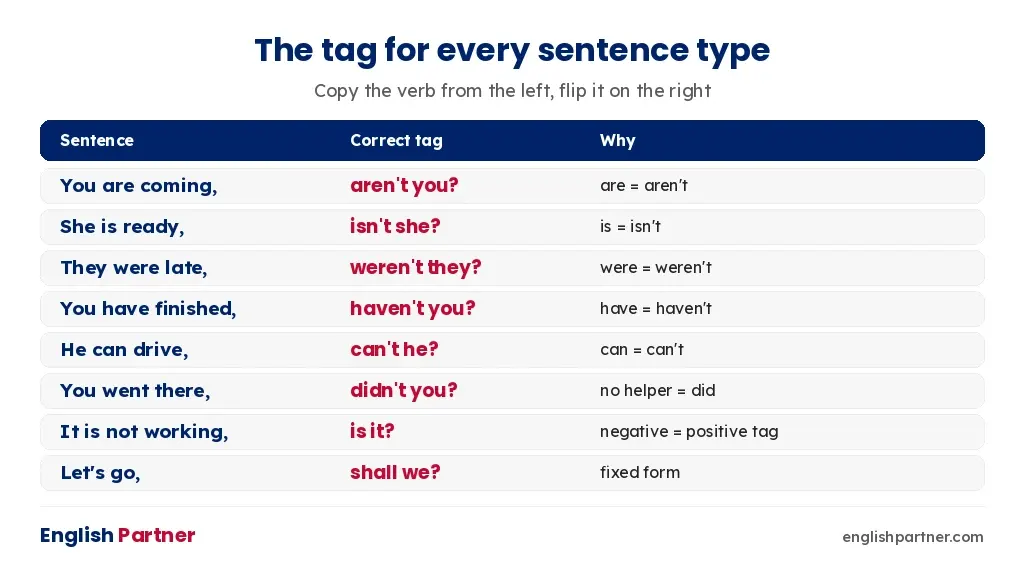
Read down the left column and cover the middle one. Say the tag yourself first, then check – that is how this becomes automatic rather than memorised.
| Sentence | Tag |
|---|---|
| You are coming tomorrow, | aren't you? |
| She is your sister, | isn't she? |
| They were at the function, | weren't they? |
| You have finished the work, | haven't you? |
| He can drive, | can't he? |
| You will call me, | won't you? |
| We should leave now, | shouldn't we? |
| You went to Chennai, | didn't you? |
| She works in that office, | doesn't she? |
| It is not working, | is it? |
| You have not eaten, | have you? |
| Let's start, | shall we? |
Two of those are worth a second look. “You went there, didn't you?” has no helping verb in the sentence, so English supplies did. And “Let's start, shall we?” is a fixed form that ignores the rule entirely.
"Isn't it?" and what to say instead
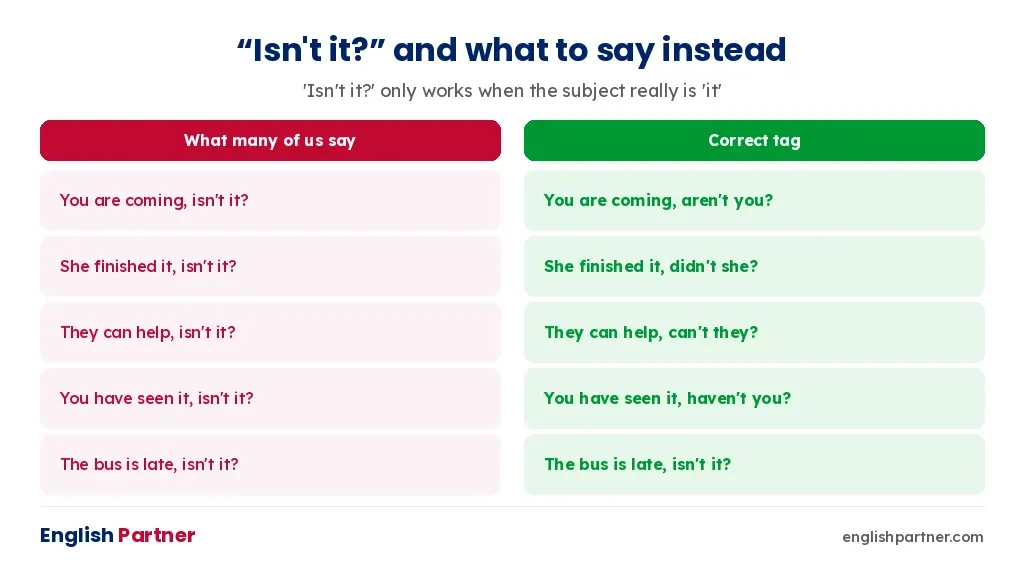
Look at the last row in that comparison. “The bus is late, isn't it?” is completely correct – because there the subject genuinely is it and the verb genuinely is is.
So “isn't it?” is not a wrong phrase. It is a correct tag being used in places where it does not belong. Once you see that, the fix stops feeling like learning a new rule and starts feeling like narrowing an old habit.
The three special cases
These do not follow the copy-and-flip rule, and all three come up often enough to learn as fixed units.
1. “I am” takes “aren't I?” “I am next in the queue, aren't I?” It looks irregular because it is – English has no contraction for am not, so aren't I fills the gap.
2. “Let's” takes “shall we?” “Let's order, shall we?” Nothing is copied here; the form is simply fixed.
3. Instructions take “will you?” or “can you?” “Close the door, will you?” “Pass me the file, can you?” A command has no subject or helper to copy, so English adds one.
The tag that also carries tone
Worth knowing, because it explains why the same tag sounds friendly in one sentence and sharp in another: the meaning of a tag depends on how you say it, not only on its form.
Falling tone – you already know the answer and expect agreement. “Lovely weather, isn't it?” This is small talk, not a real question.
Rising tone – you genuinely want confirmation. “You sent the mail, didn't you?” Here you are actually asking.
Same words, two different jobs. Indian speakers usually use the rising tone for both, which can make simple agreement sound like interrogation on a client call. Listening for this is the quickest way to make your tags sound natural rather than merely correct.
What tags are actually for
It helps to know why English bothers with them, because that tells you when to use one and when to leave it out.
A tag turns a statement into a soft question. That does three jobs in real conversation.
Checking a fact without sounding blunt. “The meeting is at four, isn't it?” is gentler than “Is the meeting at four?” – you are showing that you think you know, and inviting a correction.
Inviting agreement. “That was a long session, wasn't it?” opens a conversation rather than stating an opinion at someone. This is most of English small talk.
Softening a request or an instruction. “You will send it today, won't you?” is a reminder rather than an order – useful at work, where the direct version can read as pushy.
That third use is worth noticing if you write work emails. A tag is one of the simplest ways to make a follow-up sound polite without adding three sentences of padding around it.
3 mistakes trainers hear at Intermediate
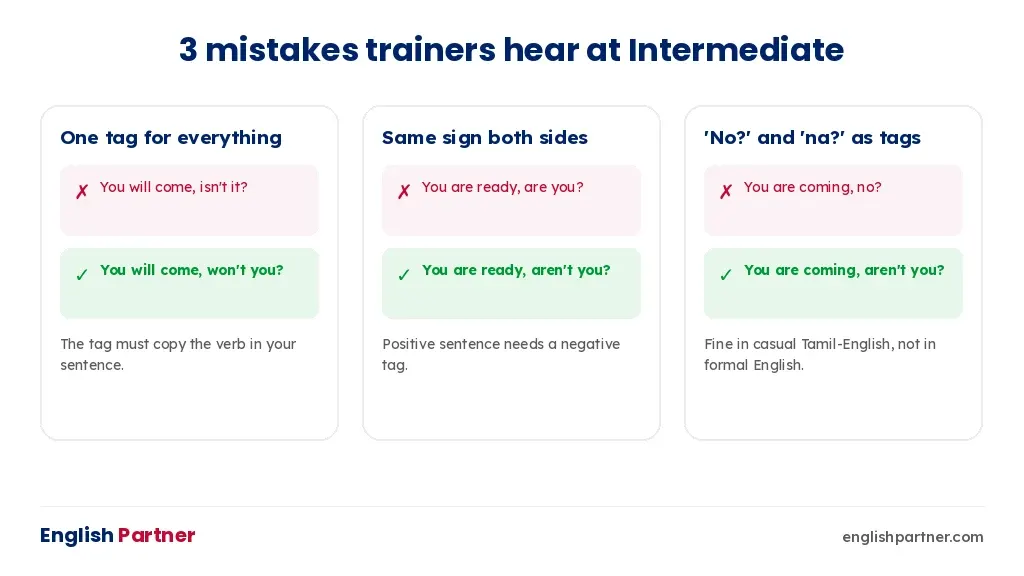
Mistake 1 – one tag for everything. “You will come, isn't it?” Copy the verb in your own sentence: “You will come, won't you?”
Mistake 2 – the same sign on both sides. “You are ready, are you?” A positive sentence needs a negative tag: “You are ready, aren't you?” (“Are you?” after a positive statement actually sounds sarcastic in English, which is not usually the intention.)
Mistake 3 – “no?” and “na?” as tags. “You are coming, no?” Completely fine among friends; replace it with the real tag anywhere formal: “aren't you?”
These are habits rather than knowledge gaps – most learners can produce the correct tag when asked slowly, and still default to isn't it in conversation. Cambridge English covers the same copy-and-flip rule in its grammar material.
Your 3-day practice plan
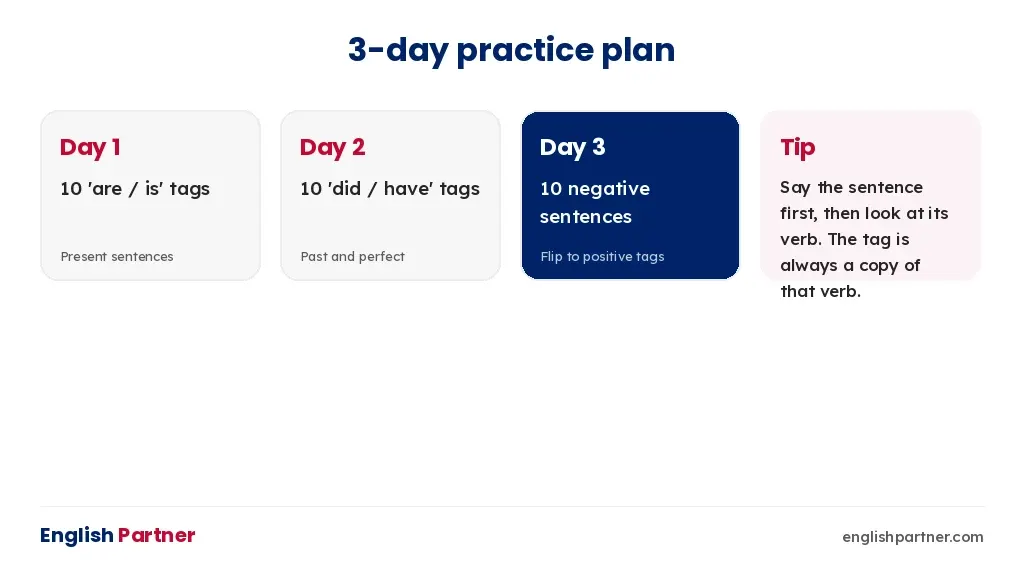
Day 1: Ten sentences with are and is, each with its tag. You are busy, aren't you?
Day 2: Ten with did and have. You called him, didn't you?
Day 3: Ten negative sentences flipped to positive tags. You have not eaten, have you?
Say the sentence first, then look at its verb. The tag is always a copy of that verb – so if you can find the verb, you already have the tag.
When self-practice is not enough
Tags are the last thing in a sentence, which means they come out while you are already thinking about what to say next. That is exactly when the old habit returns, and you will not hear it yourself.
Trainer-led practice catches it in the moment and explains it in your mother tongue straight away. Learners can join our spoken English classes in Coimbatore, our spoken English classes in Chennai, or our spoken English classes in Pondicherry.
Final thoughts and your next step
Copy the helping verb, flip the sign, match the subject. Where there is no helper, use did, do or does. Isn't it? stays – but only for sentences whose subject really is it.
Tonight, say ten sentences about your own day and add the correct tag to each. That is Day 1, and it is enough to start breaking a habit most speakers never notice.
Not sure whether Intermediate is right for you? Send “Hi” on WhatsApp for a free five-minute level test in your language.
Frequently asked questions
What is a question tag?
A short question added to the end of a statement to check or confirm something: “You are coming, aren’t you?” The tag copies the helping verb from the sentence and flips it from positive to negative, or the reverse.
Why is “isn’t it?” wrong in most sentences?
Because the tag has to match the subject and verb of your sentence. “Isn’t it?” is only correct when the subject genuinely is it – “The bus is late, isn’t it?” For “You are coming”, the tag is “aren’t you?”
How do I form a question tag?
Two steps. Copy the helping verb (are, is, have, can, will, did), then flip the sign – a positive sentence takes a negative tag. Match the subject pronoun too: “Your sister is coming, isn’t she?”
What tag do I use when there is no helping verb?
Use did, do or does. “You went there, didn’t you?” “She works here, doesn’t she?” The past takes did, the present takes do or does.
Is it okay to say “no?” or “na?” at the end?
In casual conversation among Indian speakers it is completely normal and nobody minds. In interviews, client calls and writing, use the proper tag – that is where it gets noticed.
What is the tag for “Let’s go”?
“Shall we?” – “Let’s go, shall we?” This is a fixed form that does not follow the copy-the-verb rule, along with “Open the door, will you?” for instructions.
Does “I am” take “aren’t I?”
Yes. “I am next, aren’t I?” looks odd but it is the standard form. “Amn’t I” does not exist in English, so aren’t I fills the gap.
Which English Partner course covers question tags?
Intermediate. It covers tags, conditionals and reported speech through daily speaking practice, with the rule explained in your mother tongue first.