Present Continuous Tense: “I Am Going” vs “I Go”
 Dhinesh Kumar
Content Writer
Published
Time to read
8 minutes
Dhinesh Kumar
Content Writer
Published
Time to read
8 minutes
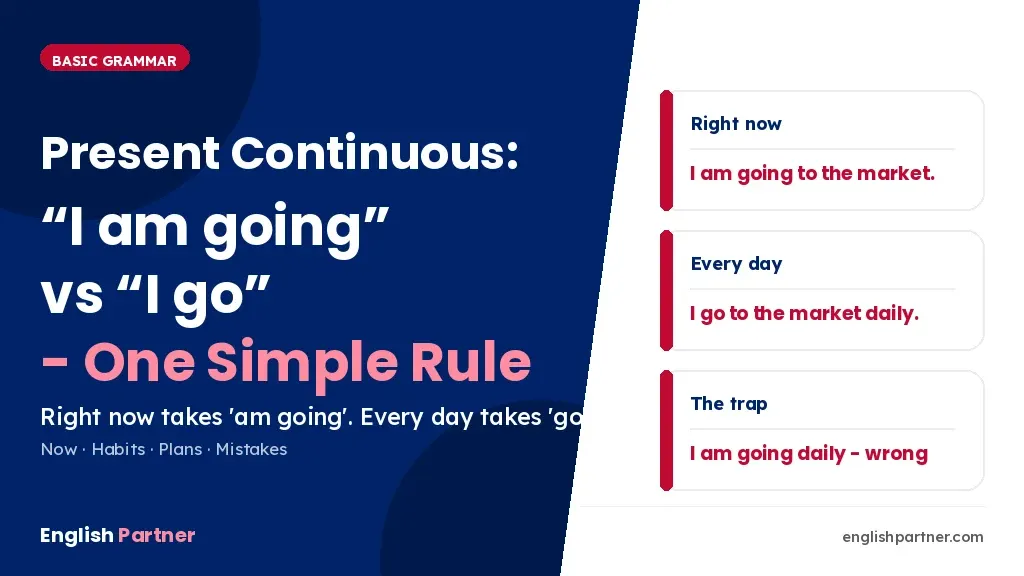
Quick answer: Right now takes am/is/are + verb-ing – “I am going.” Every day takes the plain verb – “I go.” If the sentence contains daily, always, usually or every, the continuous is wrong. Chart, 40 examples and the three usual mistakes are below.
The one question that decides it
Ask yourself: is this happening at this very moment, or is it generally true?
Happening right now, as you speak – present continuous. I am eating. She is driving. They are waiting outside.
Generally true, a routine, a fact about your life – simple present. I eat at eight. She drives to work. They wait at that stop every morning.
That is the entire distinction, and it is not difficult to understand. The difficulty is that Tamil, Telugu and Hindi often use the same verb form for both, so nothing in your mother tongue flags which English shape is needed. நான் ஆபீஸ் போறேன் works for “I go to office” and “I am going to office” equally well.
“I go” or “I am going”? The pairs side by side
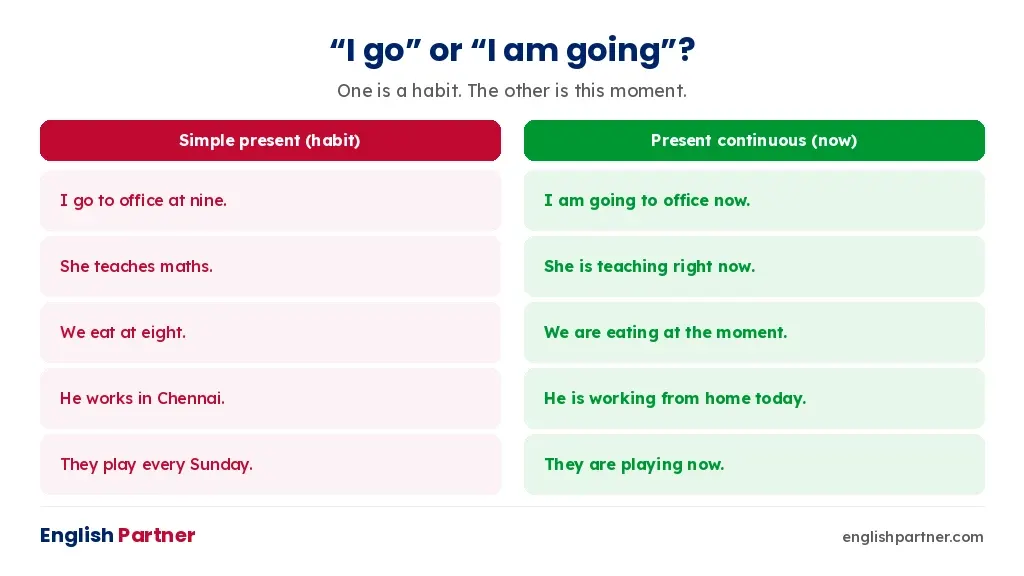
Read each pair aloud. Both are correct English – they just say different things, and saying the wrong one gives the listener wrong information rather than sounding wrong.
Here is what the mix-up actually communicates. If you say “I am going to office daily”, a listener hears an incomplete thought – as though you were going to add “…this week, but not usually.” That is why it sounds odd to them even when they understand you.
Which one: am, is or are?
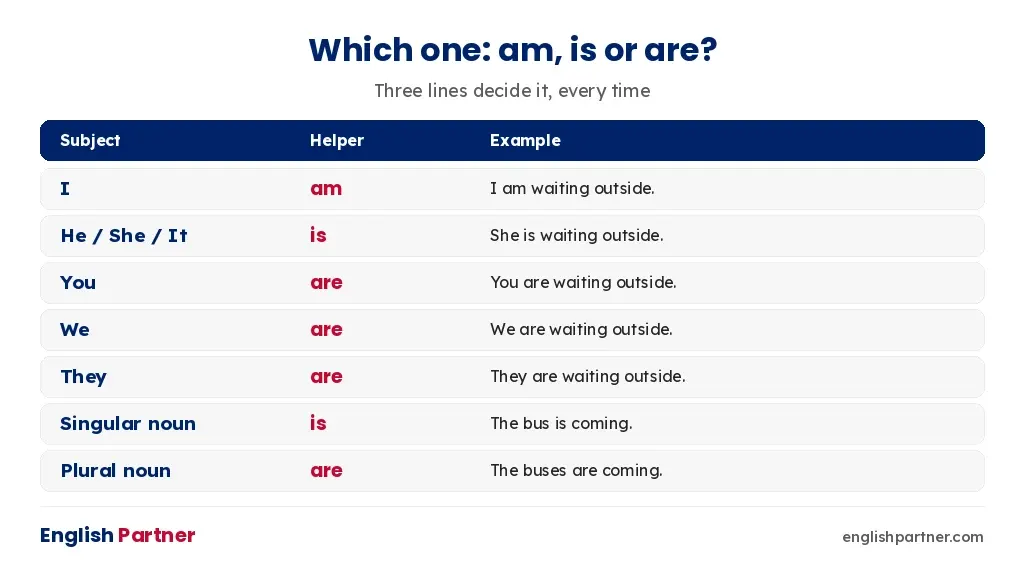
Three lines. I takes am. He, she, it and singular nouns take is. You, we, they and plural nouns take are. There is nothing irregular to learn here.
If this chart feels familiar, it is the same one behind is/am/are in simple sentences – the only new part is the -ing that follows it.
40 present continuous sentences with Tamil meaning
Things happening right now
| English | Tamil |
|---|---|
| I am waiting outside. | நான் வெளியே காத்திட்டு இருக்கேன். |
| I am having lunch now. | நான் இப்போ சாப்பிட்டு இருக்கேன். |
| She is talking to her mother. | அவங்க அம்மாகிட்ட பேசிட்டு இருக்காங்க. |
| He is working from home today. | அவர் இன்னைக்கு வீட்லேர்ந்து வேலை பாக்குறார். |
| It is raining outside. | வெளியே மழை பெய்யிட்டு இருக்கு. |
| We are watching a movie. | நாங்க படம் பாத்திட்டு இருக்கோம். |
| They are playing in the ground. | அவங்க மைதானத்துல விளையாடிட்டு இருக்காங்க. |
| The bus is coming. | பஸ் வந்திட்டு இருக்கு. |
Habits – simple present, not continuous
| English | Tamil |
|---|---|
| I go to office at nine. | நான் ஒன்பது மணிக்கு ஆபீஸ் போறேன். |
| I drink tea every morning. | நான் தினமும் காலைல டீ குடிப்பேன். |
| She teaches maths. | அவங்க கணக்கு சொல்லிக் கொடுக்குறாங்க. |
| We eat dinner at eight. | நாங்க எட்டு மணிக்கு சாப்பிடுவோம். |
| They visit every Sunday. | அவங்க எல்லா ஞாயிறும் வருவாங்க. |
| The shop opens at ten. | கடை பத்து மணிக்கு திறக்கும். |
Say both tables aloud, one after the other. Hearing them back to back is what fixes the difference – reading them silently does not.
Three shapes, one pattern
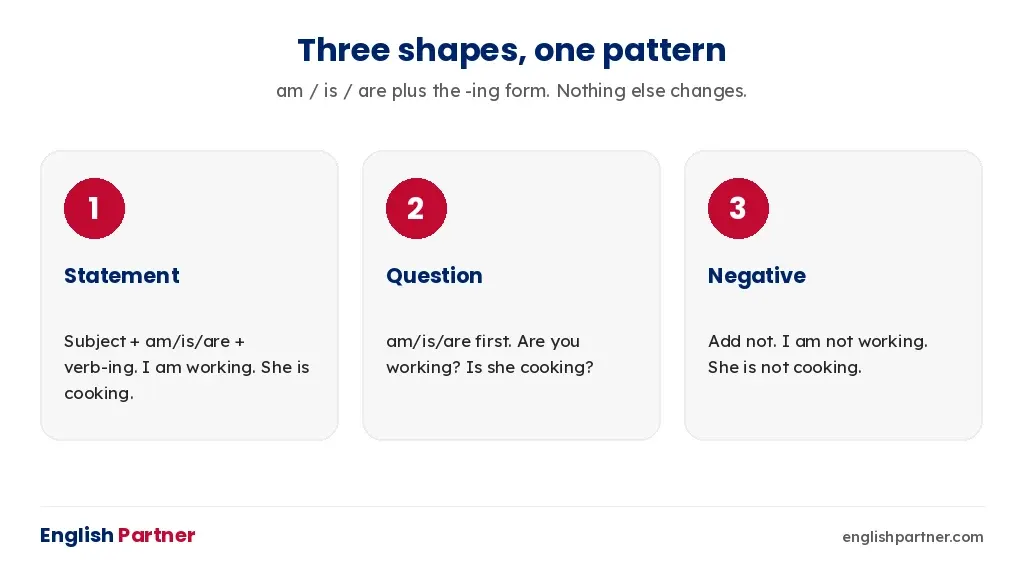
Statement: I am working. She is cooking. They are waiting.
Question: put am/is/are first. Are you working? Is she cooking? Why are they waiting? No do or does is needed – adding it (“Do you are coming?”) is a common slip.
Negative: add not. I am not working. She is not cooking. In speech these become isn't and aren't, which are perfectly correct.
| English | Tamil |
|---|---|
| Are you coming with us? | எங்க கூட வர்றீங்களா? |
| What are you doing now? | இப்போ என்ன பண்றீங்க? |
| Is he still working? | அவர் இன்னும் வேலை பாக்குறாரா? |
| I am not coming today. | நான் இன்னைக்கு வரல. |
| She is not feeling well. | அவங்களுக்கு உடம்பு சரியில்ல. |
The future use nobody teaches
Present continuous also handles fixed future plans, and this is extremely common in real speech:
“I am meeting him tomorrow.” “We are travelling on Friday.” “She is joining next month.”
All three refer to the future, with no will anywhere. English uses the continuous when the plan is already arranged, and it sounds more natural than will for anything on a calendar. “I will meet him tomorrow” suggests you have just decided; “I am meeting him tomorrow” says it is fixed.
Learning this one use immediately makes your spoken English sound less textbook, because it is what people actually say when making plans.
Spelling the -ing form correctly
Three small rules cover almost every verb, and getting them wrong is what makes written English look careless even when the grammar is right.
| Rule | Example |
|---|---|
| Most verbs: just add -ing | work = working, read = reading |
| Ends in silent e: drop the e | write = writing, come = coming |
| Short verb, one vowel: double the last letter | sit = sitting, run = running, put = putting |
| Ends in -ie: change to -ying | lie = lying, die = dying |
The third rule catches people most often – “siting” and “runing” are extremely common in emails. If the verb is short and has a single vowel before the final consonant, double that consonant.
Other things the present continuous tense is used for
Beyond this moment, the continuous does three more jobs worth knowing, because they explain sentences that otherwise look like mistakes.
A temporary situation, not just this second. “I am staying with my cousin this month.” You are not staying there at this exact second – you may be at work. The continuous marks it as temporary rather than permanent, which is why “I live in Coimbatore” and “I am living in Coimbatore for now” say different things.
A changing situation. “Prices are going up.” “The city is growing fast.” Here the continuous signals a trend in progress rather than a fixed fact.
An annoying repeated habit. “He is always coming late.” This looks like it breaks the habit rule, and it does so deliberately – adding always to the continuous expresses irritation. “He always comes late” is a neutral fact; “He is always coming late” is a complaint.
3 mistakes trainers hear every week
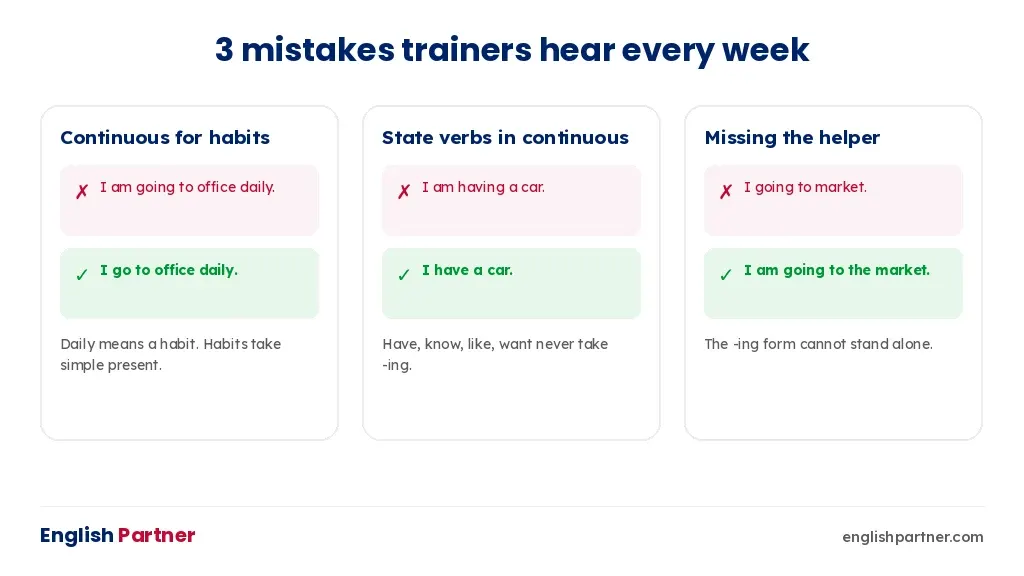
Mistake 1 – continuous for a habit. “I am going to office daily.” Daily means a habit: “I go to office daily.” This is the most frequent one by a wide margin.
Mistake 2 – state verbs with -ing. “I am having a car.” Have meaning own never takes -ing, and nor do know, like, want, need, understand: “I have a car.” (“I am having lunch” is fine, because there have means eat, not own.)
Mistake 3 – dropping the helper. “I going to market.” The -ing form cannot stand alone: “I am going to the market.”
All three are habits rather than knowledge gaps – most learners can state the rule correctly and still slip mid-conversation. The British Council makes the same observation about basic verb forms in adult learning: the fix is spoken repetition, not another explanation.
Your 3-day practice plan
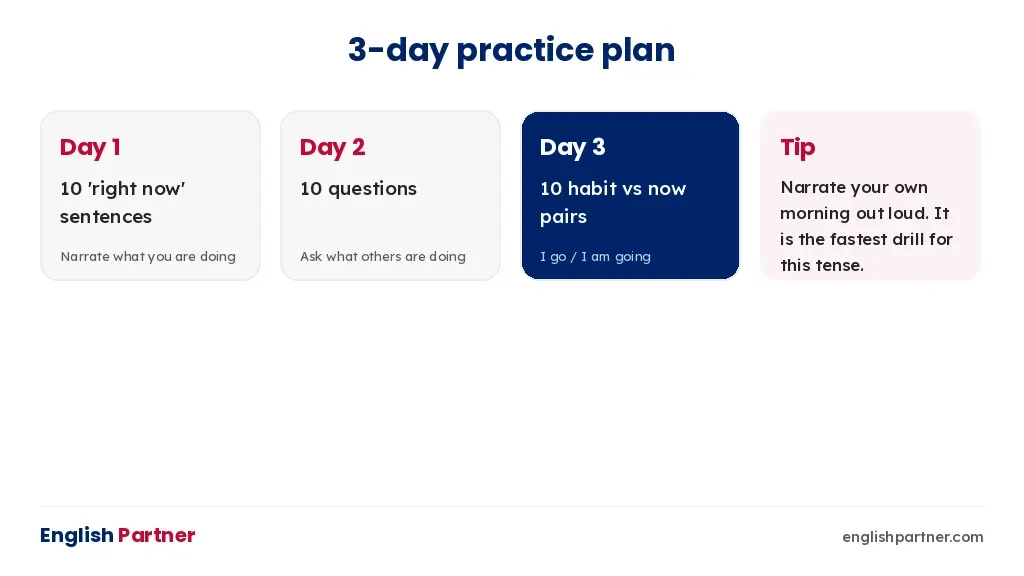
Day 1: Narrate ten things you are doing, as you do them. I am making tea. I am checking my phone.
Day 2: Ten questions about other people. What are you doing? Is he coming?
Day 3: Ten pairs – one habit sentence and one right-now sentence for the same verb.
Narrating your own morning out loud is the single fastest drill for this tense, because everything you say is genuinely happening right now.
When self-practice is not enough
This tense is understood in five minutes and used wrongly for years, because the slip happens while you are thinking about what you want to say, not about grammar – and no one corrects adults mid-sentence.
Trainer-led practice fixes exactly that: someone who catches the form as it leaves your mouth and explains it in your mother tongue. Learners can join our spoken English classes in Coimbatore, our spoken English classes in Chennai, or our spoken English classes in Pondicherry.
Final thoughts and your next step
One question: right now, or generally true? Right now takes am/is/are + -ing. Generally true takes the plain verb. State verbs never take -ing, and fixed plans can use the continuous for the future.
Tonight, narrate ten things out loud as you do them. That is Day 1 finished, and it is the drill that makes this tense automatic.
Not sure which level to start from? Send “Hi” on WhatsApp for a free five-minute level test in your language.
Frequently asked questions
What is the present continuous tense?
It describes something happening at this moment: “I am working”, “She is cooking”. The form is am, is or are plus the -ing form of the verb.
What is the difference between “I go” and “I am going”?
“I go” is a habit or a routine – “I go to office at nine.” “I am going” is this moment – “I am going to office now.” If the sentence has daily, always or usually, you need “I go”.
When do I use am, is and are?
Am goes with I. Is goes with he, she, it and singular nouns. Are goes with you, we, they and plural nouns. Three lines, no exceptions.
Why is “I am having a car” wrong?
Because have, when it means own, is a state verb and state verbs do not take -ing forms. The same applies to know, like, want, need and understand. Say “I have a car.”
Can present continuous talk about the future?
Yes, for fixed plans: “I am meeting him tomorrow.” This is very common in spoken English and sounds more natural than “I will meet him tomorrow” for an arranged plan.
How do I make a question in present continuous?
Put am, is or are first: “Are you coming?”, “Is she working today?” Nothing else in the sentence changes and no do or does is needed.
Is “I am going daily” correct?
No. Daily signals a habit, so it needs the simple present: “I go daily.” This is the single most common present continuous mistake among Indian learners.
Which English Partner course covers this tense?
Pre-Basic Level introduces it and Basic Level builds it into daily speech, both explained in your mother tongue first.