Past Perfect Tense: When “Had” Comes Before Another Past
 Dhinesh Kumar
Content Writer
Published
Time to read
8 minutes
Dhinesh Kumar
Content Writer
Published
Time to read
8 minutes
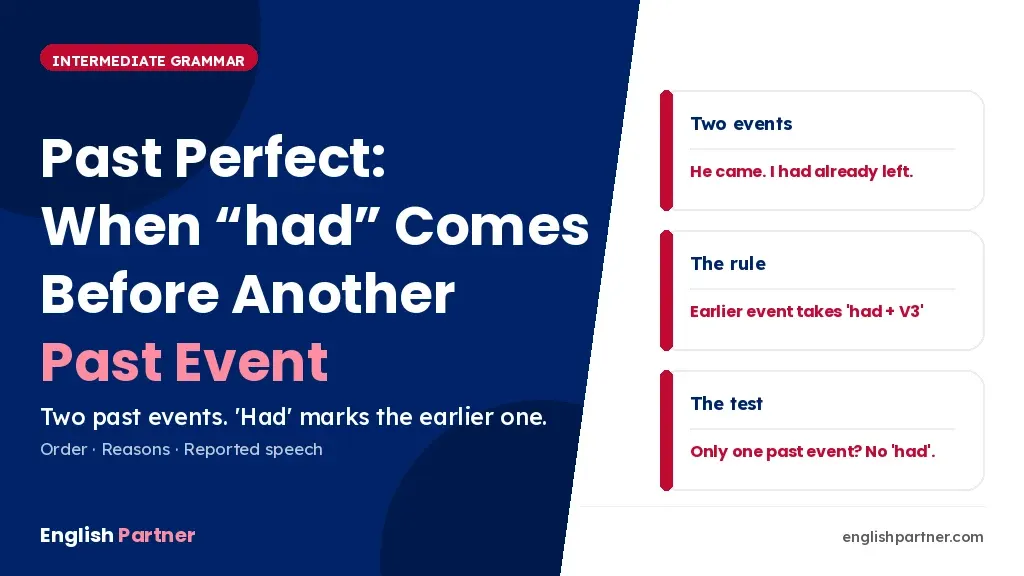
Quick answer: Had has exactly one job – marking the earlier of two past events. “He came at seven. I had left at six.” If your sentence contains only one past event, you do not need had at all. The two-event test, the signal words and the three usual mistakes are below.
Why this tense feels unnecessary (and then suddenly isn't)
Most learners manage for years without the past perfect, and in casual speech they get away with it. Then it turns up everywhere – in reported speech, in explanations at work, in any sentence about why something did not happen.
The reason it feels strange is that Tamil, Telugu and Hindi handle the same job with a time word rather than a verb change. அவர் வர்றதுக்கு முன்னாடியே நான் கிளம்பிட்டேன் uses முன்னாடியே to show the order, and the verb barely shifts.
English does it the other way around: the verb changes shape and the time word becomes optional. So you are not learning a new idea here – you are learning a different place to put information you already express.
The two-event test
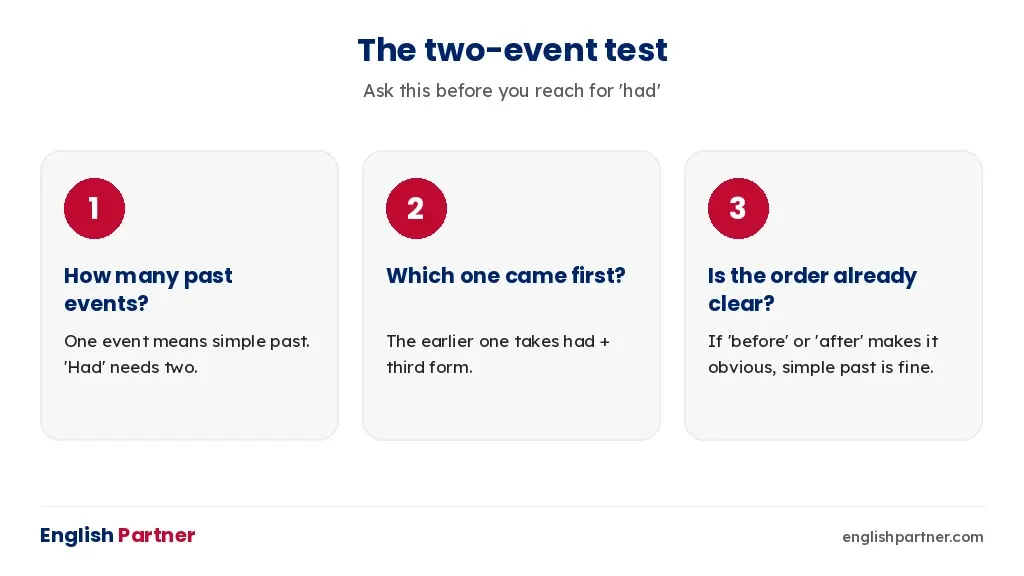
1. How many past events are in this sentence? One event means simple past, always. Had requires two.
2. Which one came first? That earlier event takes had + third form. The later one stays in the simple past.
3. Is the order already obvious? If before or after makes it clear, the simple past is acceptable in speech – though the past perfect is never wrong.
Run the test on “Yesterday I had gone to the market.” How many past events? One. So had has nothing to sit before, and the sentence should be “Yesterday I went to the market.” That single test removes the most common error in this tense.
Past perfect tense examples: the pairs side by side
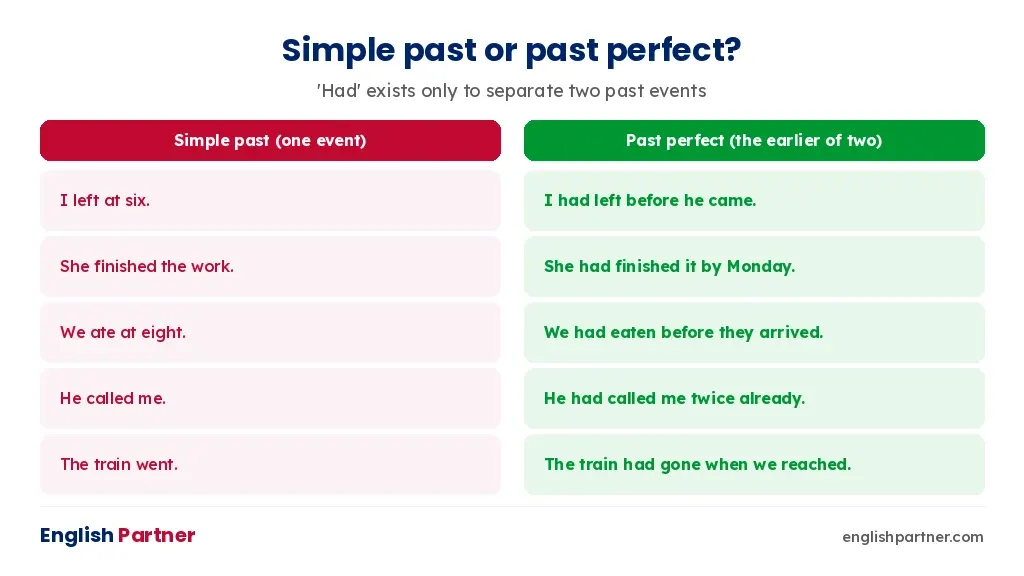
The left column reports one event. The right column places that event before a second one. Read them aloud and listen for the extra information had carries.
With Tamil meaning
| English | Tamil |
|---|---|
| I had left before he came. | அவர் வர்றதுக்கு முன்னாடியே நான் கிளம்பிட்டேன். |
| The train had gone when we reached. | நாங்க போகும்போது ட்ரெயின் போயிடுச்சு. |
| She had finished the work by Monday. | திங்கட்கிழமைக்கு முன்னாடியே வேலை முடிச்சிட்டாங்க. |
| We had eaten before they arrived. | அவங்க வர்றதுக்கு முன்னாடியே சாப்பிட்டு முடிச்சோம். |
| I had never seen that film before. | அந்த படத்த அதுக்கு முன்னாடி பாத்ததே இல்ல. |
| The shop had already closed. | கடை ஏற்கனவே மூடியிருந்தது. |
| He had called me twice before I replied. | நான் பதில் சொல்றதுக்கு முன்னாடி ரெண்டு தடவ கூப்பிட்டிருந்தார். |
| By the time I reached, everyone had left. | நான் போகும்போது எல்லாரும் போயிட்டாங்க. |
Signal words that call for "had"
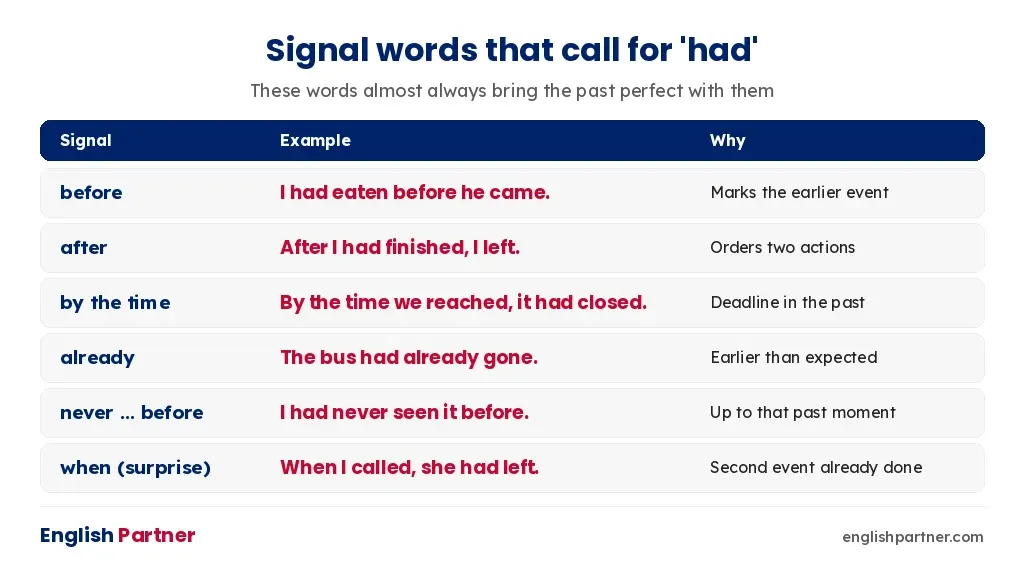
Six words do most of the work. If one of these appears with two past events, the past perfect is almost certainly what you want.
By the time is worth special attention, because it is extremely common in spoken explanations and it nearly always needs had: “By the time I reached the counter, they had stopped issuing tokens.”
Forming it: had plus the third form
The form never changes for the subject. I had, you had, he had, we had, they had – one word for everybody, which makes this tense mechanically simpler than the present perfect.
What does need care is the third form of the verb. Had is always followed by V3, never V2:
| V1 | V2 (simple past) | V3 (after had) |
|---|---|---|
| go | went | had gone |
| eat | ate | had eaten |
| see | saw | had seen |
| write | wrote | had written |
| take | took | had taken |
| speak | spoke | had spoken |
If the third-form column is where you hesitate, that is the thing to fix before practising this tense – the past perfect is impossible without it.
Questions and negatives are straightforward: “Had you eaten?” “Had she already left?” “I had not finished.” “They had not been informed.” In speech the negative shortens to hadn't.
Where you will actually use it
Two situations account for most real past perfect sentences, and both come up at work every week.
Reported speech. When you repeat what someone said about an earlier event, the tense shifts back a step. “I have already paid” becomes “He said he had already paid.” Without the shift, the sentence sounds unfinished to an English ear.
Explaining why something did not happen. “I could not submit it – the portal had closed.” “We did not wait because the manager had already approved it.” This is where the past perfect earns its place: it tells the listener the cause came first.
Notice that both uses are about order, not about how long ago something happened. The past perfect says nothing about distance in time – only sequence.
Past perfect and past perfect continuous
There is a second form worth knowing once the first is comfortable, because it answers a different question.
Past perfect says the earlier action was complete: “I had waited for an hour.” The waiting is finished.
Past perfect continuous says the earlier action was still running up to that point: “I had been waiting for an hour when he finally called.” The form is had been + verb-ing.
| Past perfect | Past perfect continuous |
|---|---|
| I had worked there for two years. | I had been working there for two years when it closed. |
| She had waited outside. | She had been waiting outside since morning. |
| It had rained in the night. | It had been raining all night, so the road was flooded. |
Use the continuous version when the duration is the point – especially with for and since. In everyday speech the plain past perfect covers most situations, so there is no need to chase this form until the first one is automatic.
3 mistakes trainers hear at Intermediate
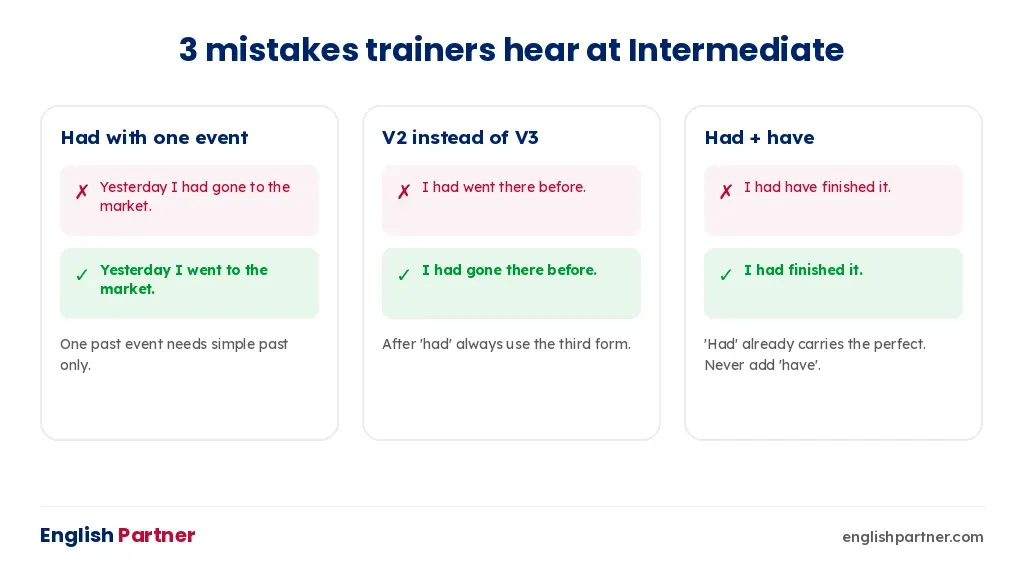
Mistake 1 – had with only one event. “Yesterday I had gone to the market.” Nothing else happened, so: “Yesterday I went to the market.” This is the one to watch for, because it is the result of over-using a newly learned tense.
Mistake 2 – V2 after had. “I had went there before.” Had always takes the third form: “I had gone there before.”
Mistake 3 – had plus have. “I had have finished it.” Had already carries the perfect meaning: “I had finished it.”
The first mistake is more revealing than the other two. Learners who have just studied this tense start putting had into every past sentence, which sounds odder than leaving it out. Cambridge English notes the same over-correction pattern in intermediate learners.
Your 3-day practice plan
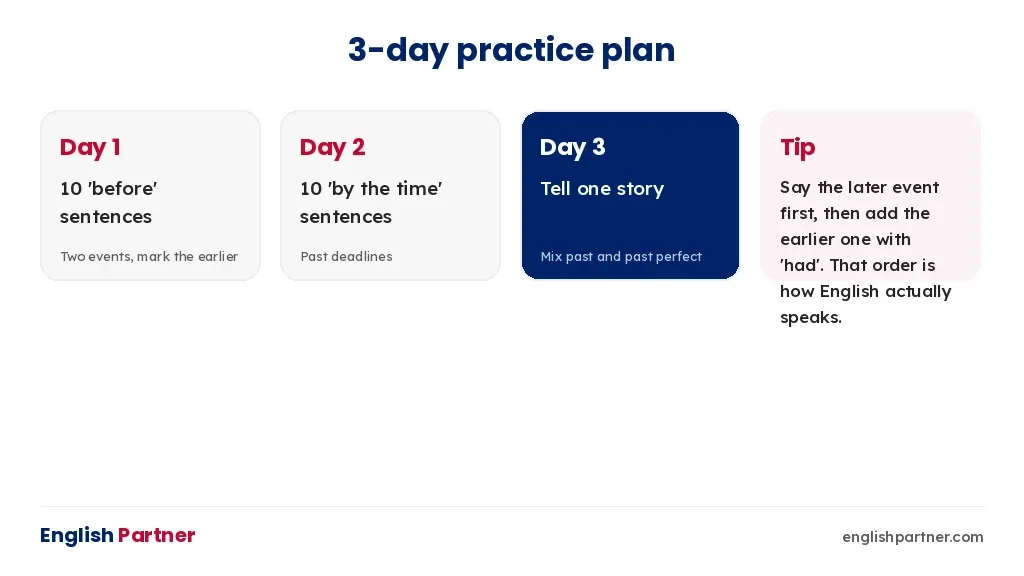
Day 1: Ten before sentences from your own week – two real events each, with the earlier one marked by had.
Day 2: Ten by the time sentences. By the time I reached the bank, it had closed.
Day 3: Tell one story out loud – something that went wrong recently – mixing simple past for the main events and past perfect for what had happened first.
Say the later event first, then add the earlier one with had. That order matches how English actually speaks, and it stops you building the sentence backwards.
When self-practice is not enough
The past perfect is the tense learners most often over-use once they learn it, and there is no way to notice that on your own – both versions sound equally fine inside your own head.
Trainer-led practice is what corrects it: someone who hears the unnecessary had and explains the two-event test in your mother tongue on the spot. Learners can join our spoken English classes in Coimbatore, our spoken English classes in Chennai, or our spoken English classes in Pondicherry.
Final thoughts and your next step
One rule, one test. Had separates two past events and marks the earlier one. One event means simple past. Had is always followed by the third form, and it never needs have after it.
Tonight, say ten before sentences about your own week. That is Day 1 done, and it is the shape you will use most.
Not sure whether Intermediate is right for you? Send “Hi” on WhatsApp for a free five-minute level test in your language.
Frequently asked questions
What is the past perfect tense?
It marks the earlier of two past events. The form is had plus the third form of the verb: “I had left before he came.” Both events are in the past; had tells the listener which one happened first.
When should I not use “had”?
Whenever there is only one past event. “Yesterday I had gone to the market” is wrong because nothing else happened – say “Yesterday I went to the market.” Had needs a second event to sit before.
What is the difference between “I went” and “I had gone”?
“I went” simply reports a past event. “I had gone” says it happened before another past event: “I had gone before he arrived.” Without that second event, the past perfect has no job to do.
Why is “I had went” wrong?
Because had is always followed by the third form of the verb, not the second. Go, went, gone – so it is “I had gone”. If the third forms are unfamiliar, learn those before practising this tense.
Which words signal the past perfect?
Before, after, by the time, already, never before, and when used for a surprise. These six account for most past perfect sentences you will need.
Do I always need the past perfect when there are two past events?
Not always. If before or after already makes the order obvious, the simple past is acceptable in speech: “I ate before he came” is fine. The past perfect is clearer in writing and always correct.
Where is past perfect used most in real English?
Reported speech and explanations. “He said he had already paid” and “The shop had closed by the time I reached” are both everyday sentences that need it.
Which English Partner course covers past perfect?
Intermediate. It covers perfect tenses, conditionals and reported speech through daily speaking practice, with the rule explained in your mother tongue first.