Make vs Do: The Rule, the Exceptions and 80 Collocations
 Dhinesh Kumar
Content Writer
Published
Time to read
8 minutes
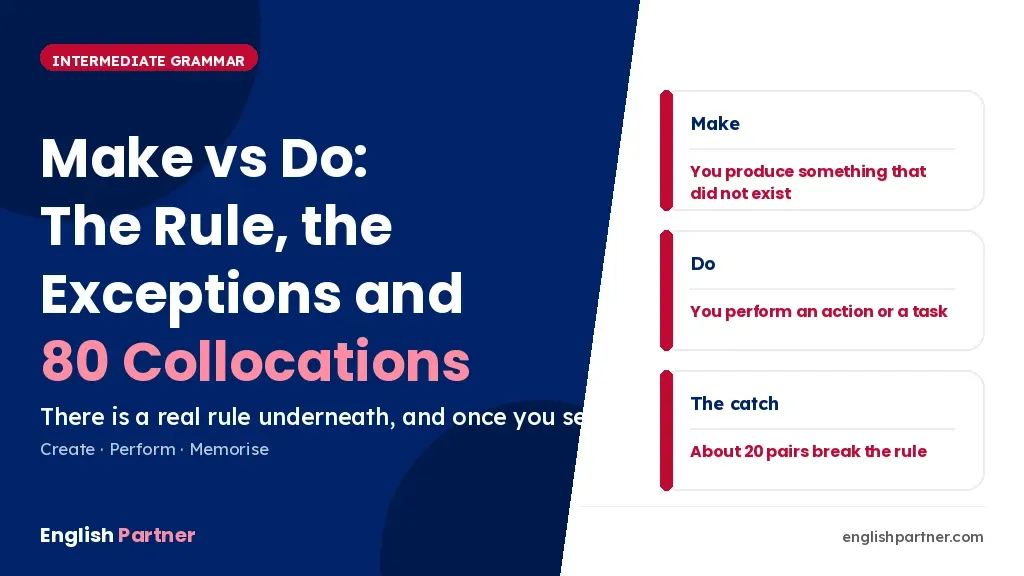
Quick answer: Use make when something new exists afterwards — make a cake, make a plan, make a mistake. Use do for actions and tasks where nothing is produced — do the dishes, do your homework, do a job. About twenty pairs break this, and they are listed below.
Make vs do: why one idea became two verbs
Tamil has செய். Telugu has చేయి. Kannada has ಮಾಡು. Hindi has करना. One verb covers the whole territory, and the sentence works.
English split that territory in two and then drew the boundary in a place that is not obvious. Worse, nobody at school explained where the line is — most of us were told to memorise lists, which is why the pairs never stuck.
There is a real rule. It is not perfect, but it handles about eighty per cent of everyday cases, which is enough to stop guessing.
The rule: does something exist afterwards?
Say the phrase, then ask: is there now a thing that was not there before?
Make — something is produced.
- Make a cake — the cake now exists
- Make a plan — the plan now exists
- Make a mistake — the mistake now exists
- Make a call — the call now exists
- Make money — the money now exists
- Make a decision — the decision now exists
Do — an action is performed.
- Do the dishes — the dishes were already there
- Do your homework — the homework was already set
- Do a job — the job already existed
- Do exercise — nothing new is produced
- Do the shopping — an activity, not a product
- Do research — the work, not the result
That last pair is worth sitting with. You do research and you make a discovery. The work is do; the thing that comes out of it is make. Once you see that split, a lot of the list stops needing memorisation.
The 80 you will actually use
Here is the practical list, grouped so the pattern stays visible.
Make — produced: a mistake · a decision · a plan · a call · a choice · a promise · an offer · a suggestion · an appointment · a complaint · a comment · a point · an excuse · an effort · an attempt · progress · money · a profit · a loss · a noise · a mess · friends · an impression · a difference · a change · a list · a note · a speech · a joke · an arrangement · a reservation · a payment · a deal · a discovery · a difference · trouble · a fuss · sense · sure · certain · the bed
Do — performed: the work · a job · homework · the dishes · the laundry · the cleaning · the shopping · the cooking · exercise · business · research · a course · a test · an exam · an experiment · your duty · your best · a favour · harm · damage · good · nothing · something · anything · the right thing · housework · the ironing · a project · a report · an interview · an assignment · a task · chores · overtime · a double take · your hair · your nails · the accounts · the maths · a deal (informal) · time (in prison)
The exceptions, and why they are exceptions
These are the ones that break the rule. Do not try to reason them out — learn each as a single unit, the way you learned a phone number.
| Phrase | Why it looks wrong |
|---|---|
| do a favour | A favour feels produced, but English treats it as an action |
| do damage | Damage is clearly produced, yet it takes do |
| do harm / do good | Both are results, both take do |
| do your duty | Duty is a task, which is consistent, but learners expect make |
| make the bed | The bed already existed — you are only tidying it |
| make time | You cannot produce time, but the phrase takes make |
| make way | You move aside; nothing is produced |
| make sure | Checking is an action, yet it takes make |
| do a deal | Also "make a deal" — both are correct, do is more British |
| do your hair | Something changes, but it takes do |
Ten of these cover almost every exception you will meet in ordinary speech. That is a short list — shorter than the eighty you are now not memorising.
Where this shows up at work
Three situations where the wrong one is genuinely noticed rather than quietly tolerated.
Owning an error. “I made a mistake on the report” sounds professional and finished. “I did a mistake” is understood, but it is the version that gets remembered — and not for the accountability.
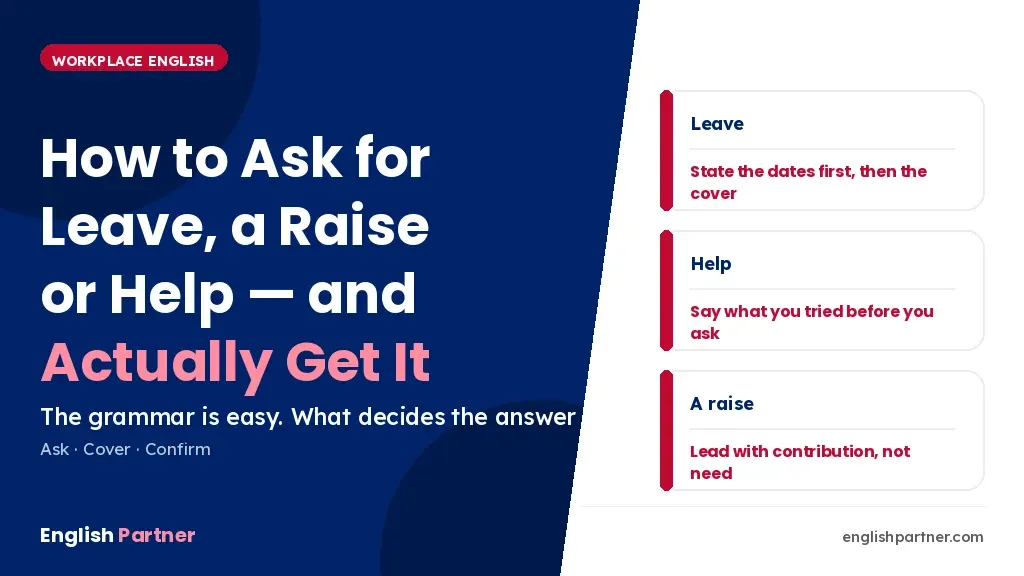
Asking for help. “Could you do me a favour?” is the standard opener. “Could you make me a favour?” stops the listener for a second, which is exactly the second you did not want in a request.
Status updates. “We made good progress this week” and “we did the testing on Tuesday” both appear in almost every standup. Progress is produced; testing is performed.
The Tamil versions, so the split is visible
| Tamil | English | Which one |
|---|---|---|
| நான் ஒரு தப்பு பண்ணிட்டேன் | I made a mistake | make — the mistake is produced |
| வீட்டு வேலை பண்ணு | Do your homework | do — it is a task |
| ஒரு முடிவு பண்ணணும் | I need to make a decision | make — the decision is produced |
| எனக்கு ஒரு உதவி பண்ணுவீங்களா? | Could you do me a favour? | do — exception, memorise it |
| பாத்திரம் கழுவு | Do the dishes | do — the dishes already exist |
Notice that Tamil uses பண்ணு for every single one. That is the whole source of the difficulty, and seeing it laid out usually settles the point faster than any rule.
Make and do with the same noun
A few nouns take both, and the meaning changes completely. These are worth knowing because the wrong one does not just sound odd — it says something you did not mean.
- Make a deal = you agree terms with someone. Do a deal = the same thing, slightly more British and more informal. These two are genuinely interchangeable.
- Make the work is wrong, but make work (no "the") means to create unnecessary tasks for someone. Do the work is the ordinary one.
- Make good = to succeed or to compensate for something. Do good = to help people. "He made good after years of struggle" and "she does good work for the community" are two different sentences.
- Make time = to free up time deliberately. Do time = to serve a prison sentence. Worth getting right.
That last pair is the one to be careful with. "I'll make time for it tomorrow" is what you want in an office. The other version is not.
A quick self-test
Cover the answers and fill in each blank. If you get eight or more, the rule has landed.
| Sentence | Answer |
|---|---|
| Could you ___ me a favour? | do |
| She ___ a good impression in the interview. | made |
| I need to ___ some research first. | do |
| He ___ a promise and kept it. | made |
| We ___ business with them for ten years. | did / have done |
| Don't ___ so much noise. | make |
| I'll ___ the dishes tonight. | do |
| They ___ a lot of progress this quarter. | made |
| Please ___ your best. | do |
| Can you ___ sure the file is attached? | make |
If you missed the favour one or the sure one, those are both exceptions — not a failure of the rule, just two phrases to add to the memorised ten.
3 mistakes trainers hear every week
None of these stop you being understood, which is precisely why they survive for years. Nobody corrects a sentence they understood.
If you want the full collocation lists with more examples, the Cambridge Dictionary entry on make or do sets them out in detail.
Your 3-day practice plan
Put each phrase inside a sentence about your own day. “I made three calls this morning” stays with you; “make a call” on a flashcard does not.
When self-practice is not enough
You can read this rule in two minutes. What you cannot do alone is catch yourself saying “I did a mistake” in a review meeting, because at that moment your whole attention is on the explanation, not the verb.
That is the trainer's job — catching it in a real sentence and making you say it again correctly before the habit settles back, explained in your mother tongue first. Learners can join our spoken English classes in Coimbatore, our spoken English classes in Chennai, or our spoken English classes in Pondicherry.
Final thoughts and your next step
One question before you speak: is something new there afterwards? Yes means make. No, it was an action or a task, means do. Ten exceptions, learned whole, cover the rest.
Start today with the six make phrases you use most at work — a call, a mistake, a decision, a plan, an effort, progress. Say each one in a sentence about something that actually happened this week.