HR Round Questions and Answers: 10 Samples That Sound Like You
 Dhinesh Kumar
Content Writer
Published
Time to read
9 minutes
Quick answer: HR rounds use the same ten questions almost everywhere. Answer each in three parts — point, proof, link — keep “tell me about yourself” to 45 seconds, and give a real number for salary. All ten with model answers are below.
What the HR round is actually testing
The technical round checked whether you can do the job. The HR round is checking something narrower and slightly unfair: whether you can hold a clear answer while mildly uncomfortable.
That is why people who know their work well still lose offers here. Nobody has ever asked them to say their own reasons out loud. The first time they attempt it is in the room, under lights, with someone taking notes.
Which is good news, because it means the whole round is preparable. There are ten questions. You can write all ten answers tonight and have said each one twenty times by the weekend.
Every answer in three parts
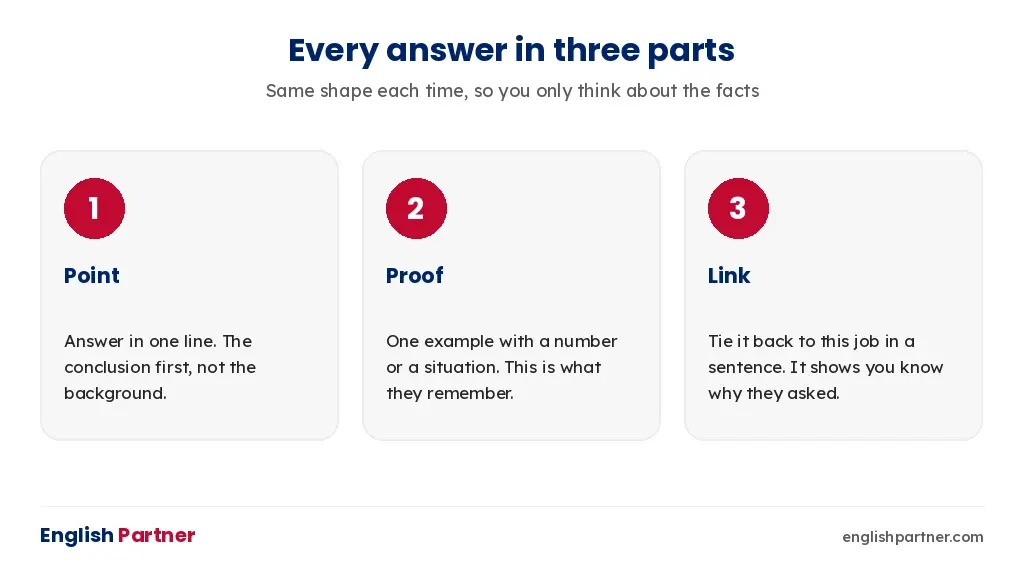
Point. The answer in one line, first. English-speaking interviewers expect the conclusion before the background — the opposite of how most people naturally tell a story.
Proof. One example, ideally with a number. This is the only part they will remember an hour later.
Link. One sentence tying it to this job. It shows you understood why they asked.
Three sentences, every question. Once the shape is automatic you only have to think about the content.
HR round questions and answers: the 10
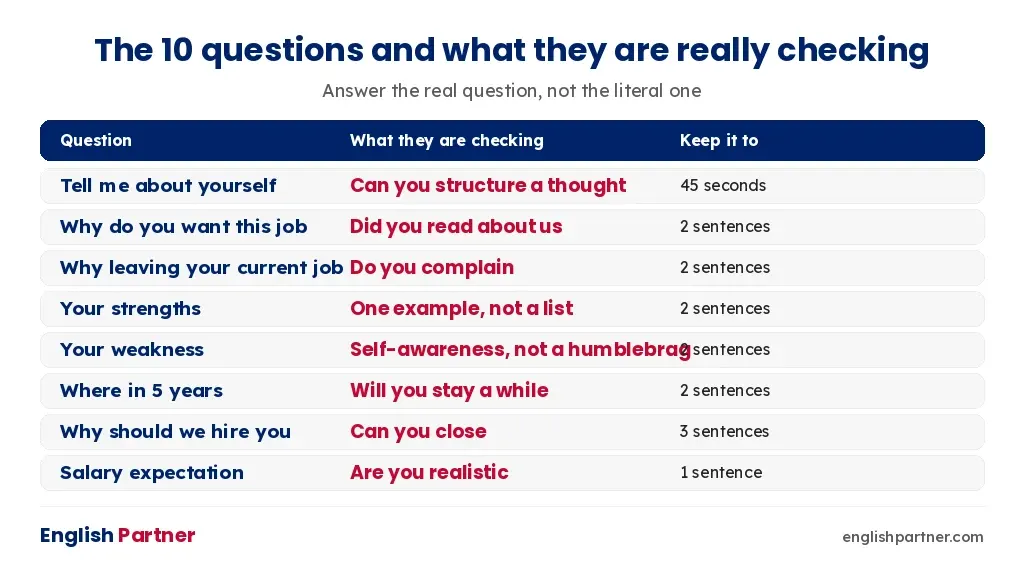
1. Tell me about yourself.
“I am Priya. I have handled accounts payable for three years at a logistics firm in Coimbatore, where I process around forty vendor invoices a month on my own. I am now looking for a role where I also own the reporting side, which is what interested me in this position.”
2. Why do you want this job?
“I read that you are expanding your south India operations and this role sits in that team. I would rather join something that is growing than something that is being maintained.” One real fact about them is enough — and it separates you from most candidates immediately.
3. Why are you leaving your current job?
“I have learnt a lot there, but the work has settled into the same cycle every month. I am looking for a role with more range.” Towards, never away from.
4. What are your strengths?
“Keeping track of detail under time pressure. During our last audit I cleared three months of pending entries in a week with no errors.” One strength with one example beats four adjectives.
5. What is your weakness?
“I hand things over late, because I want to check them myself first. I have started giving the routine monthly reports to my junior and reviewing instead of redoing.” Real weakness, real fix.
6. Where do you see yourself in five years?
“Still in finance, but leading a small team and owning the reporting rather than only preparing it.” They are checking whether you will stay long enough to be worth training.
7. Why should we hire you?
“You need someone who can take over the payables cycle without supervision. I have run it alone for two years, including during two audits. I would not need a long handover.” This is the closing question — answer it like one.
8. What is your salary expectation?
“I am looking at around six to six and a half lakhs, based on my three years of experience. I am open to discussing it.” A range plus a reason.
9. What is your notice period?
“Thirty days, and I may be able to bring it down to about twenty.”
10. Do you have any questions for us?
“Yes — who does this role report to, and what would the first three months focus on?” Never say no.
The same answer, weak and strong
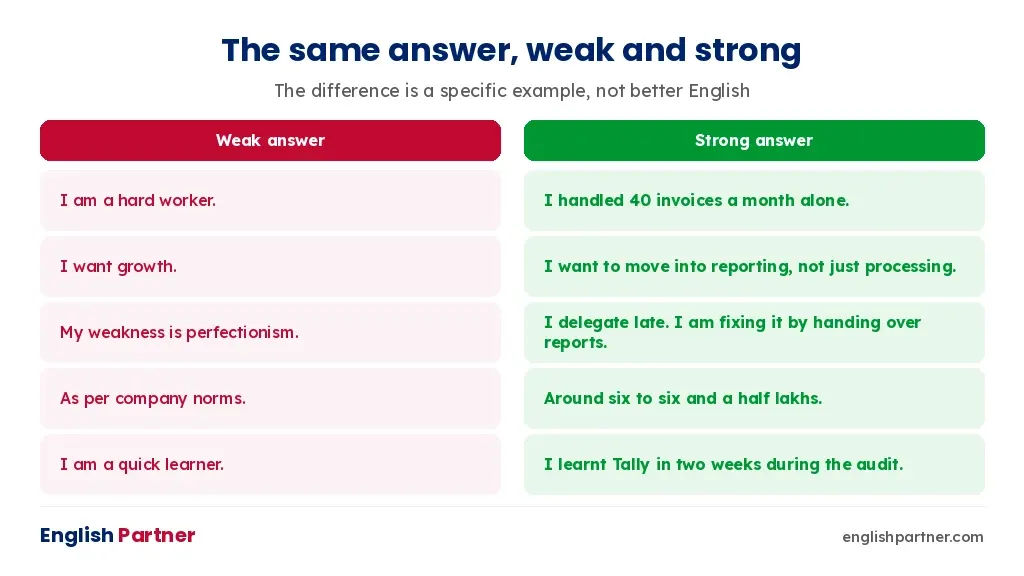
Look at what separates the columns. It is not better English. Every strong answer simply contains something specific — a number, a tool, a situation — and every weak one is a description anyone could give.
This is the single highest-return change you can make. Take each of your ten answers and ask: could the person sitting next to me say this exact sentence? If yes, it needs a detail from your actual work.
The two questions people handle worst
Salary. Most candidates say “as per company norms” hoping to stay flexible. It reads as unprepared, and it hands the number to the other side. Give a range, give the reason, and add one line of openness. That is it.
Weakness. Perfectionism and “I work too hard” have been used so often that they now signal evasion. A real weakness with a real fix does the opposite — it tells HR you can look at your own work honestly, which is most of what they are trying to find out.
Neither question is a trap. Both just reward the person who thought about the answer in advance.
What to do when you do not know the answer
It happens in most rounds, and how you handle it is itself part of the test.
The wrong move is to invent something or to go silent. Both are visible. What works is to say so plainly and then give the nearest thing you have done: “I have not worked on GST filing directly, but I have prepared the data that went into it every quarter, so I know the inputs well.”
That answer does three things at once — it is honest, it shows the edge of your experience accurately, and it still gives them something usable. Interviewers remember the candidate who said “I do not know, but here is what I do know” far more kindly than the one who bluffed.
Two more lines worth having ready: “That is a good question, let me think for a second” when you need time, and “Could you tell me a bit more about what the role needs there?” when the question itself is unclear.
3 answers that end an HR round early
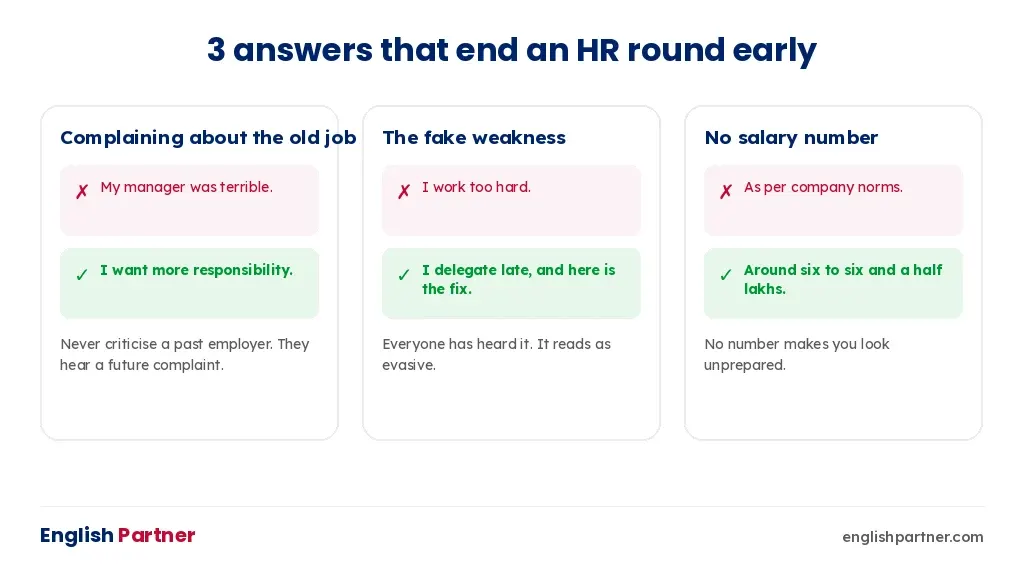
Mistake 1 – complaining about your current job. “My manager was terrible.” HR hears a future complaint about them. Reframe: “I am looking for more responsibility.”
Mistake 2 – the fake weakness. “I work too hard.” Replace with a real one and what you are doing about it.
Mistake 3 – no salary number. “As per company norms.” Give a range: “Around six to six and a half lakhs.”
None of these are English problems. They are preparation problems, which is why candidates with excellent English still make them. The British Council makes the same observation about assessed speaking — clarity and preparation outscore vocabulary range.
Your 5-day preparation plan
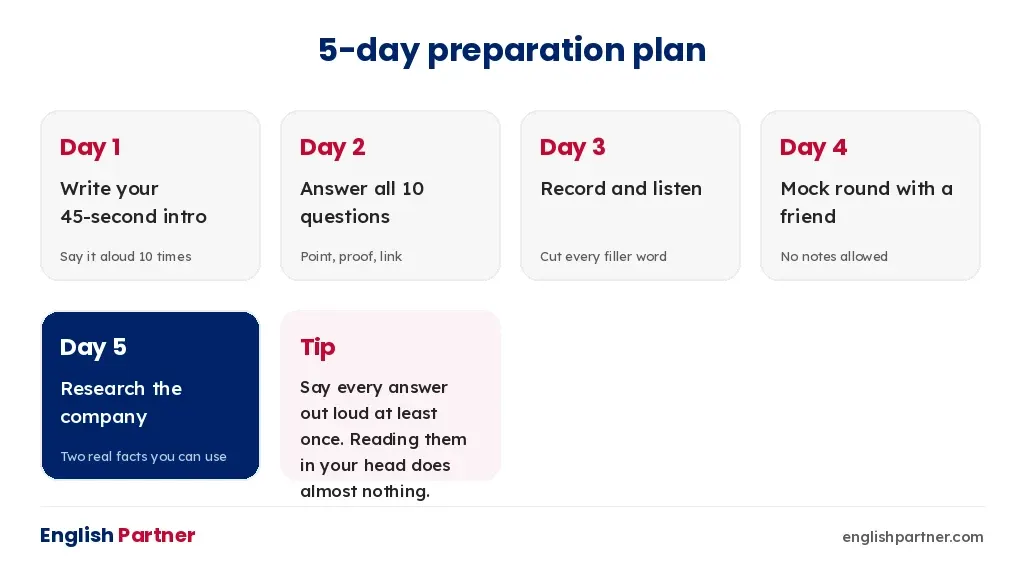
Day 1: Write your 45-second introduction. Say it aloud ten times, not in your head.
Day 2: Answer all ten questions in point-proof-link. Write them, then say them.
Day 3: Record yourself. Cut every “basically”, “actually” and “you know”.
Day 4: One mock round with a friend. No notes in front of you.
Day 5: Research the company. Find two real facts you can use in question two.
Stand up when you practise. Your voice carries better and you will sound more certain than you feel.
When self-practice is not enough
Prepared answers get you through the first three questions. What decides the round is the follow-up — the one they ask because of something you just said, which by definition you could not rehearse.
Live mock rounds with a trainer build that: real interruptions, unexpected follow-ups, and feedback in your mother tongue straight afterwards. Learners can join our spoken English classes in Coimbatore, our spoken English classes in Chennai, or our spoken English classes in Pondicherry.
Final thoughts and your next step
Ten questions, three sentences each, one specific detail in every answer. The HR round rewards preparation more than fluency, and preparation is entirely in your control.
Tonight, write your 45-second introduction and say it out loud ten times. That one task changes the first impression in every interview you take from here.
Want a live mock round with feedback in your language? Send “Hi” on WhatsApp for a free five-minute level test.