Numbers, Dates and Time in English: How to Say Them Correctly
 Dhinesh Kumar
Content Writer
Published
Time to read
8 minutes
Dhinesh Kumar
Content Writer
Published
Time to read
8 minutes
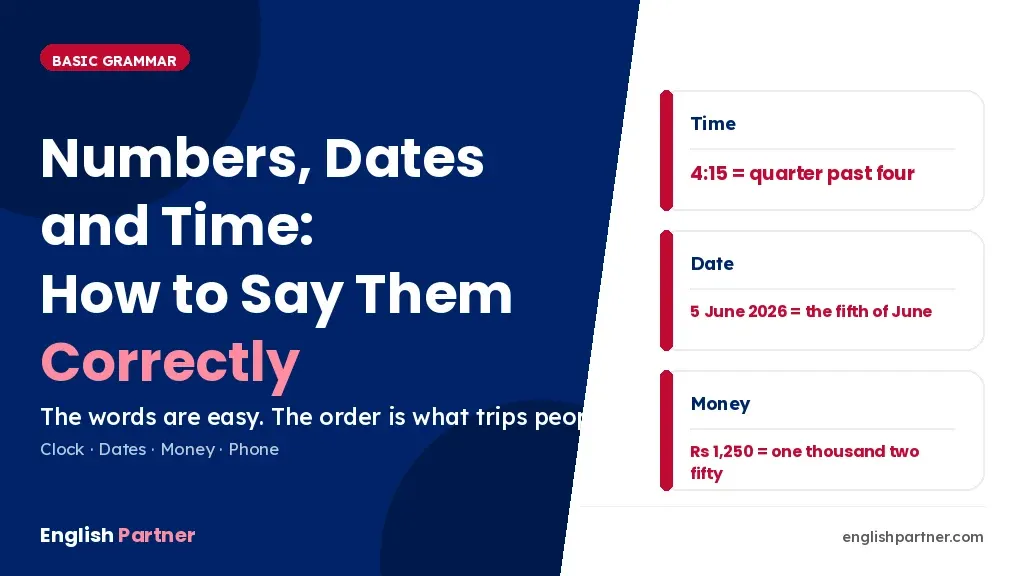
Quick answer: Time has two correct forms – “four fifteen” or “quarter past four”. Spoken dates need the ordinal – “the fifth of June”, not “five June”. Days take on, times take at, months take in. And one lakh is one hundred thousand outside India. Everything else is below.
Why numbers trip up fluent speakers
This is the odd one in English learning. People who hold a decent conversation still hesitate when asked the time or a price – and then feel embarrassed about hesitating on something so basic.
The reason is that numbers were learned as a list, not as speech. You can count to a hundred, but counting is not the same as saying “quarter to five” or “the twenty-third of March” without a pause.
There is also a real structural difference. Tamil puts the hour and minute in a different order, and Indian English uses lakh and crore, which do not exist in the system the rest of the English-speaking world uses. So this is partly practice and partly information nobody gave you.
How to say time in English: both forms
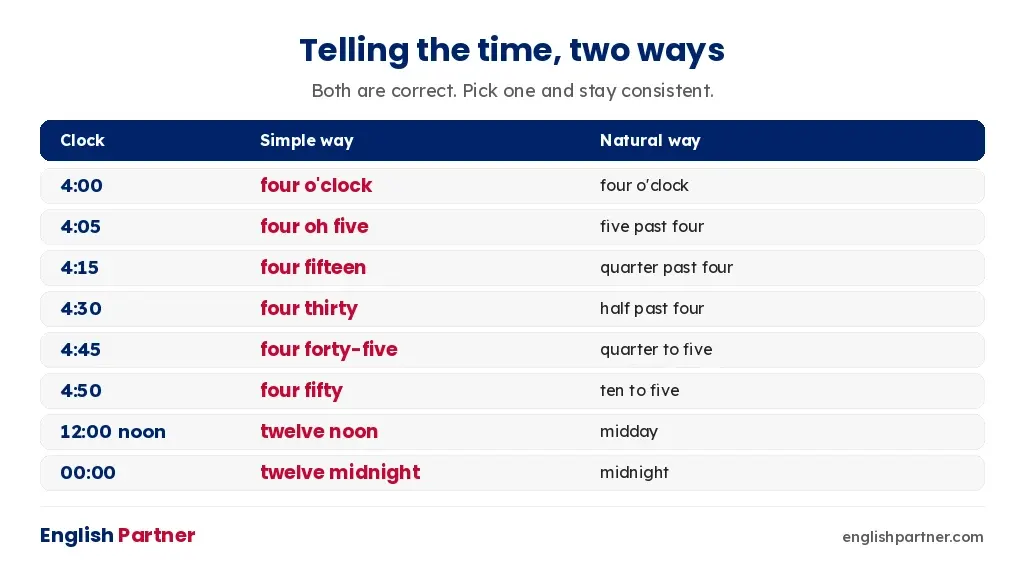
Two systems, both fully correct. The simple way just reads the numbers. The natural way uses past and to.
The rule for the natural way is short: minutes 1 to 30 use past, minutes 31 to 59 use to and move to the next hour. So 4:20 is twenty past four, and 4:40 is twenty to five – not forty past four.
| English | Tamil |
|---|---|
| It is quarter past four. | நாலு கால் ஆகுது. |
| It is half past six. | ஆறரை ஆகுது. |
| It is quarter to eight. | எட்டுக்கு கால் குறையா இருக்கு. |
| The class starts at ten sharp. | கிளாஸ் சரியா பத்து மணிக்கு. |
| Let us meet around five. | அஞ்சு மணி சுமாரா சந்திக்கலாம். |
| I will be there by seven. | ஏழு மணிக்குள்ள வந்துடுவேன். |
Note the difference between at, around and by. At five is exact, around five is approximate, by five means not later than five. Mixing these up is the main reason meeting times get confused.
Saying dates without hesitating
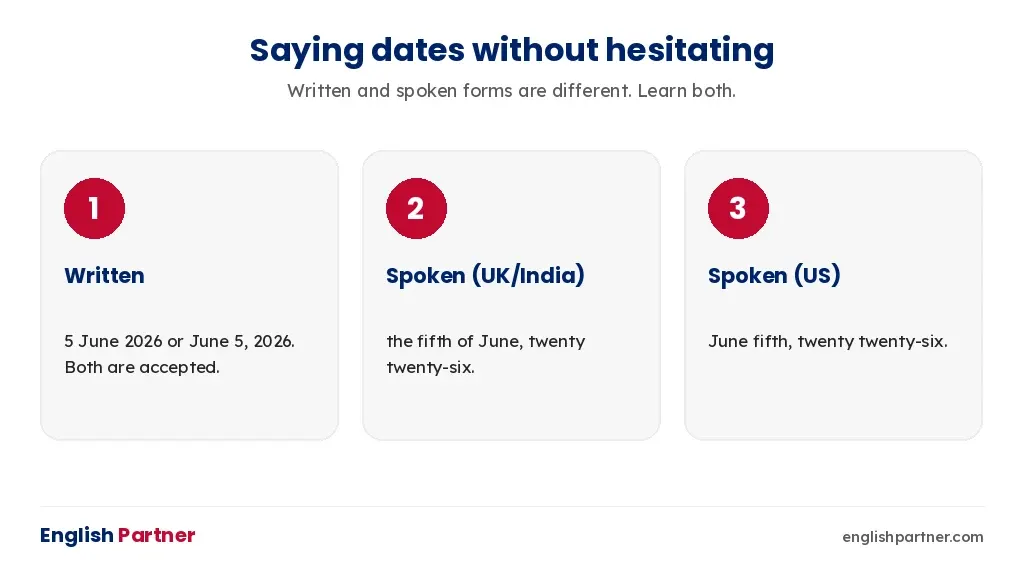
Written and spoken dates are different, and that catches people out. You write 5 June 2026, but you say “the fifth of June, twenty twenty-six.”
The ordinal is not optional in speech. First, second, third, fourth, fifth… twentieth, twenty-first, thirtieth. Saying “five June” is the single most common date mistake.
| Written | Spoken |
|---|---|
| 1 January 2026 | the first of January, twenty twenty-six |
| 3 March | the third of March |
| 12 August 1995 | the twelfth of August, nineteen ninety-five |
| 22 October 2008 | the twenty-second of October, two thousand and eight |
| 31 December | the thirty-first of December |
Years follow their own small rules. 2026 is twenty twenty-six. 2005 is two thousand and five. 1995 is nineteen ninety-five. Nobody says “two thousand twenty-six” in natural speech.
On, at and in: the three-word rule
This is the part that does most of the damage in emails, and it takes thirty seconds to learn.
| Word | Use it for | Example |
|---|---|---|
| on | days and dates | on Monday, on the fifth of June |
| at | clock times | at four o'clock, at noon |
| in | months, years, parts of the day | in June, in 2026, in the morning |
One exception worth memorising: at night, not in the night. Morning, afternoon and evening take in; night takes at.
Indian English vs standard English numbers
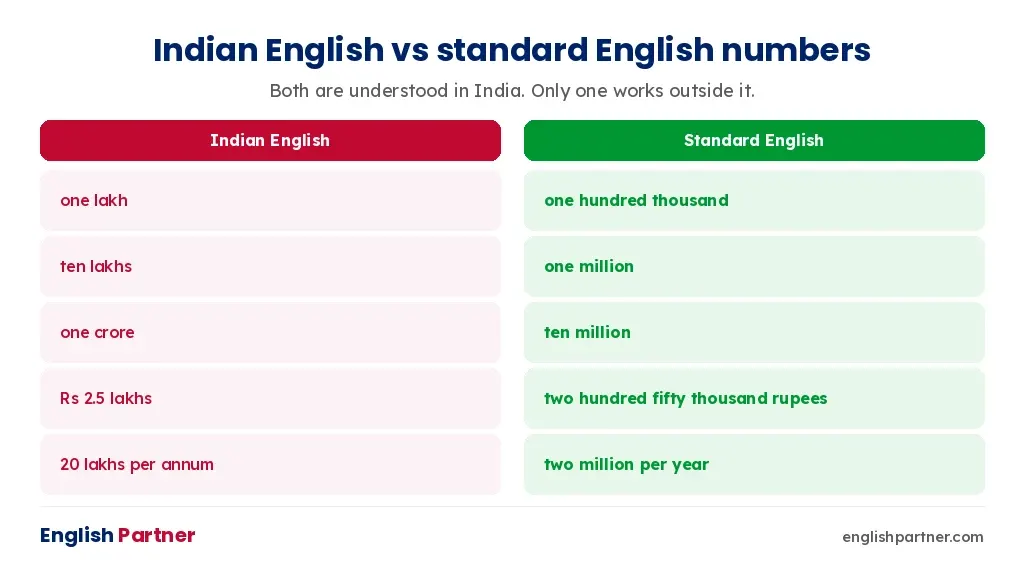
Lakh and crore are correct Indian English. They are in dictionaries and everyone in India understands them. The problem is only that they do not exist outside the subcontinent.
So if you deal with clients, interviewers or colleagues abroad, you need both versions ready. “Twenty lakhs per annum” means nothing to someone in London; “two million per year” does.
Prices and money have their own shortcuts in speech:
| Written | Spoken |
|---|---|
| Rs 250 | two hundred and fifty rupees |
| Rs 1,250 | one thousand two fifty / twelve fifty |
| Rs 45,000 | forty-five thousand |
| Rs 2,50,000 | two and a half lakhs / two hundred fifty thousand |
Phone numbers are read digit by digit with a pause every three or four, never grouped as thousands: “nine eight four – one two three – four five six seven.” For a repeated digit, “double four” is normal and quicker.
Ordinals and the four endings
Ordinals turn up in dates, floors, rankings and queue positions, and they follow a pattern that is easier than it looks.
| Ending | Numbers | Examples |
|---|---|---|
| -st | 1, 21, 31 | first, twenty-first, thirty-first |
| -nd | 2, 22 | second, twenty-second |
| -rd | 3, 23 | third, twenty-third |
| -th | everything else | fourth, ninth, twelfth, twentieth |
Three irregular spellings catch people out in writing: fifth (not fiveth), eighth (one t, not eightth), ninth (no e), and twelfth (f, not v). Those four are worth a second look because they appear in dates constantly.
Numbers in everyday sentences
Knowing the forms is one thing; dropping them into a sentence without hesitating is another. These are the shapes that come up most.
| English | Tamil |
|---|---|
| The meeting is at eleven thirty. | மீட்டிங் பதினொன்னரை மணிக்கு. |
| It takes about twenty minutes. | சுமார் இருபது நிமிஷம் ஆகும். |
| I have been here for two years. | ரெண்டு வருஷமா இங்க இருக்கேன். |
| She is in her mid-thirties. | அவங்களுக்கு முப்பத்தைந்து வயசு சுமார். |
| Two out of three were rejected. | மூணுல ரெண்டு நிராகரிக்கப்பட்டது. |
| It costs around three thousand. | சுமார் மூணாயிரம் ஆகும். |
| We are on the fourth floor. | நாங்க நாலாவது மாடியில இருக்கோம். |
| My appointment is on the ninth. | என் அப்பாயின்மென்ட் ஒன்பதாம் தேதி. |
Read these aloud rather than scanning them. Numbers are one of the few areas where silent reading gives you almost nothing – the whole difficulty lives in the mouth, not the eye.
3 mistakes trainers hear every week
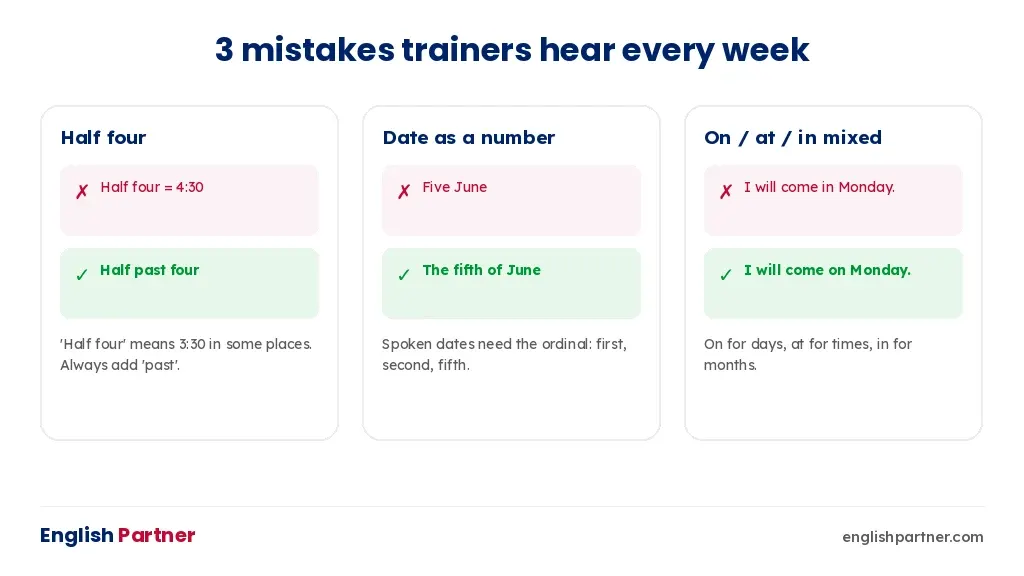
Mistake 1 – “half four”. Dropping past is risky: in some places half four is heard as 3:30. Always say “half past four.”
Mistake 2 – the date as a plain number. “Five June.” Spoken dates need the ordinal: “the fifth of June.”
Mistake 3 – on, at and in mixed up. “I will come in Monday.” Days take on: “I will come on Monday.”
All three show up in writing as well as speech, which is why they are worth fixing properly. The British Council covers the same time prepositions in its grammar material.
Your 3-day practice plan
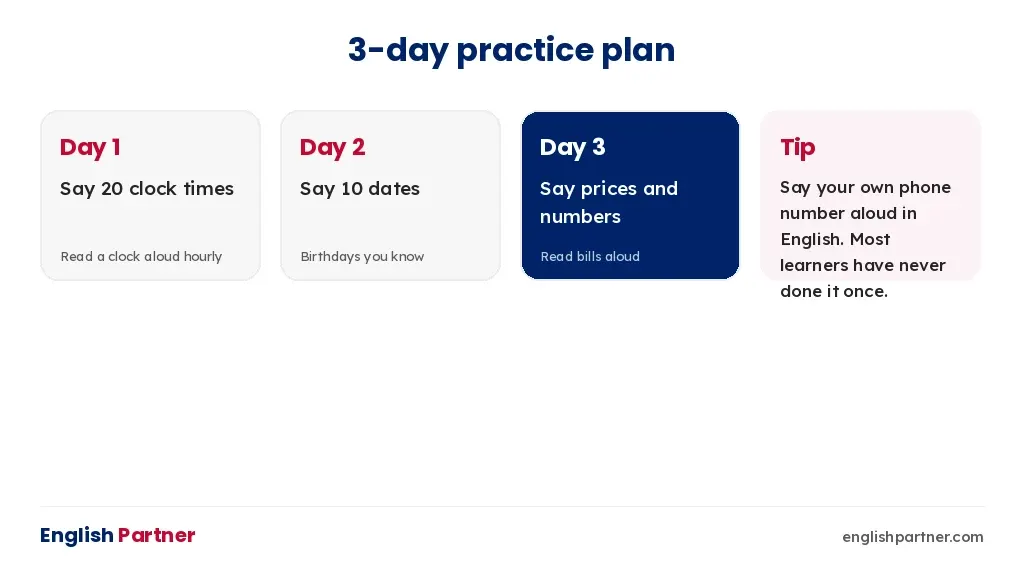
Day 1: Say the time aloud every time you check your phone, in both forms. Twenty times through the day.
Day 2: Say ten dates out loud – birthdays of people you know, in full spoken form.
Day 3: Read prices aloud. Any bill, any receipt, any price tag you pass.
And one task most learners have never done once: say your own phone number aloud in English, digit by digit. It feels strange the first time and then it is permanent.
When self-practice is not enough
Numbers go wrong under pressure rather than in practice. You know quarter to five perfectly well at home and then say “four forty-five… no, five forty-five” on a call with a client.
Speaking practice with a trainer fixes that, because the pressure is present and the correction comes in your mother tongue immediately. Learners can join our spoken English classes in Coimbatore, our spoken English classes in Chennai, or our spoken English classes in Pondicherry.
Final thoughts and your next step
Minutes 1 to 30 take past, 31 to 59 take to. Spoken dates take the ordinal. Days take on, times take at, months take in. And keep the standard-English version of lakh and crore ready if you speak to anyone abroad.
Tonight, say the time aloud in both forms every time you look at your phone. That is Day 1, and it costs no extra time at all.
Not sure which level to start from? Send “Hi” on WhatsApp for a free five-minute level test in your language.
Frequently asked questions
How do I say 4:15 in English?
Two ways, both correct: “four fifteen” or “quarter past four”. The first is simpler and is what most people use on the phone; the second sounds more natural in conversation.
What does “half four” mean?
In British English it means 4:30, but in some other places it is understood as 3:30. To avoid confusion always say “half past four”, which is unambiguous everywhere.
How do I say a date out loud in English?
In India and the UK: “the fifth of June, twenty twenty-six.” In the US: “June fifth, twenty twenty-six.” The spoken form needs the ordinal – fifth, not five – even though the written form is just “5 June”.
Is “one lakh” correct English?
It is correct Indian English and understood across India, but outside the subcontinent say “one hundred thousand”. Similarly, one crore is ten million. Both are worth knowing if you deal with clients abroad.
Do I say “on Monday” or “in Monday”?
On Monday. English uses on for days and dates, at for clock times, and in for months, years and parts of the day: “on Monday”, “at four o’clock”, “in June”, “in the morning”.
How do I say a phone number in English?
Digit by digit, with a small pause after every three or four: “nine eight four – one two three – four five six seven”. Never group them as thousands, and “double four” for 44 is normal.
How do I say years like 2026?
“Twenty twenty-six.” For years from 2000 to 2009 say “two thousand and five”. For the 1900s, split them: 1995 is “nineteen ninety-five”.
Which English Partner course covers this?
Pre-Basic Level introduces numbers and time, and Basic Level builds them into everyday conversation, both explained in your mother tongue first.