How to Disagree Politely in English: The 3-Part Formula
 Dhinesh Kumar
Content Writer
Published
Time to read
8 minutes
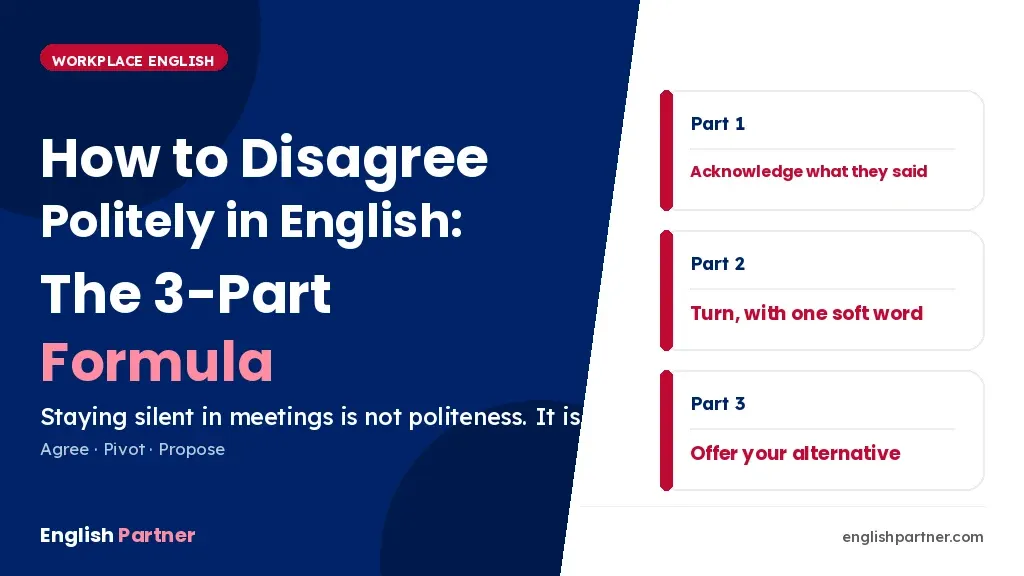
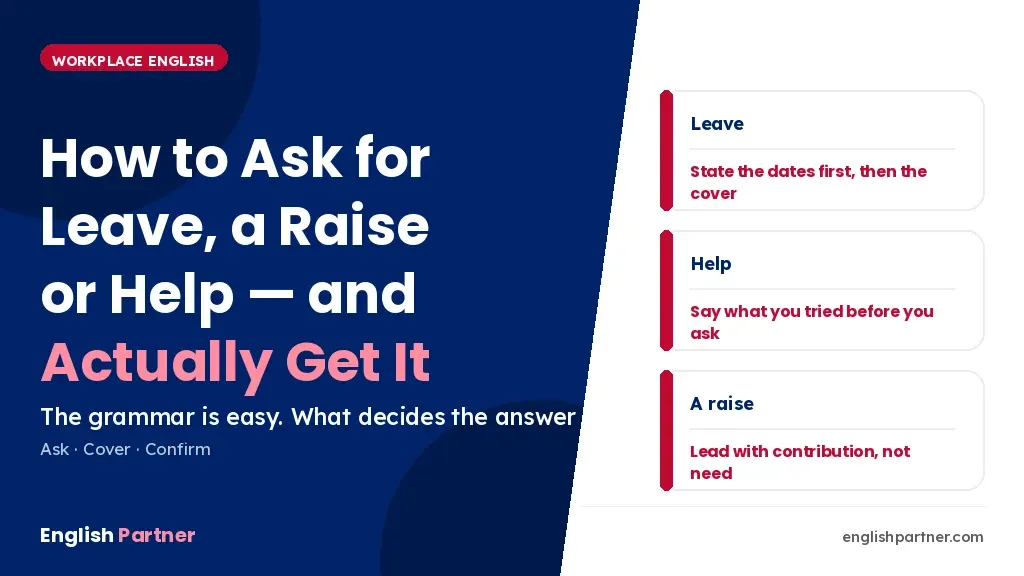
Quick answer: Three parts, in this order. Acknowledge — “That makes sense,”. Turn — “though I'd worry about the timeline.” Propose — “What if we pushed it a week?” The acknowledgement keeps the room with you; the proposal is what stops it sounding like resistance.
Silence is not politeness
Here is the situation almost everyone reading this knows. Someone proposes something in a meeting. You can see the problem with it. You open your mouth, realise you do not have the English sentence ready, and the conversation moves on without you.
Three weeks later the problem you saw actually happens, and nobody remembers that you saw it.
That is not a confidence problem and it is certainly not a politeness problem. It is a speed problem. Disagreeing in English takes a specific sentence shape, assembling that shape takes a few seconds, and meetings do not pause for a few seconds. Memorise the shape and the gap disappears.
Why direct disagreement lands badly in English
Worth understanding, because it explains the whole formula.
In Tamil, Telugu, Kannada and Hindi, politeness lives in the verb ending. You can disagree fairly directly and the respect is carried by how the word is conjugated. English has no such ending. So English carries politeness in the structure of the sentence instead — a question rather than a statement, a hedge before the objection, a proposal after it.
Which means a sentence like “That is wrong” is not rude because of the words. It is rude because of what is missing around them.
Part 1: acknowledge, without conceding
This is the part people skip, and skipping it is what makes everything after it sound hostile.
- “That makes sense,”
- “I see what you mean,”
- “That's a fair point,”
- “I understand the thinking there,”
Important: none of these means you agree. They mean I listened and I understood you. English speakers hear them as exactly that, and the room relaxes enough to actually hear your reason.
Part 2: turn, with one soft word
The turn is where the disagreement actually happens, and it should be one word.
- “…though I'd worry about…”
- “…although the timeline might be tight.”
- “…that said, the budget doesn't cover it.”
- “…my only concern is…”
Notice what is not in that list: but. “But” is not wrong, it is just heavier — it cancels everything before it, and everyone hears that. “Though” and “that said” do the same job while keeping your acknowledgement intact.
Part 3: propose, always
This is the part that decides whether you are seen as a problem-solver or an obstacle, and it takes one extra clause.
- “What if we tried…?”
- “Would it work to…?”
- “Could we look at…instead?”
- “One option might be…”
Even when you do not have a full alternative, you can propose a process: “Could we check with the client before committing?” That still counts, and it still moves things forward.
Disagreeing with a senior
This is the real question most people have, and the answer is: change the strength, not the structure.
Ask permission first. “Can I push back on that a little?” or “Can I offer a different view?” It takes two seconds, and it turns an interruption into an invitation.
Give them room to be right. “I might be missing something, but…” is the most useful phrase in this entire article. It costs you nothing, and it means that if you are missing something, nobody loses anything.
Take it offline when it is sensitive. “Could we talk about this after the call?” Some disagreements should not happen in front of twelve people, and recognising which ones is its own professional skill.
Close properly. If the decision goes the other way: “Happy to go with it if you'd prefer.” That is the disagree-and-commit line. Your objection is on record, the team moves, and you are not the person who keeps relitigating it.
Disagreeing in writing
Email is easier, because you have time — and harder, because tone does not travel. Three rules:
Keep it short. A long justification reads as defensive. Two sentences is usually enough.
Flag, do not accuse. “One thing I'd flag — the timeline looks tight given the scope.” You are pointing at the problem, not at the person.
End with a question. “Would it work to push delivery to the 14th?” A question invites a reply. A statement invites a silence.
Put together: “Thanks for sending this. One thing I'd flag — the timeline looks tight given the scope. Would it work to push delivery to the 14th?” Three sentences, clear disagreement, nobody is offended.
How to disagree politely in English: the four situations
The formula is easy to read and harder to produce under pressure. These are four real moments with the complete sentence already assembled.
| Situation | What to say |
|---|---|
| A deadline you cannot meet | That timeline makes sense for the scope as written, though I'd worry about the testing week. What if we delivered the core by the 10th and the rest a week later? |
| A client asking for free extra work | I see what you need there, and it's a fair ask. It does sit outside what we scoped, though. Would it work to add it as a second phase? |
| A colleague's plan you think will fail | I might be missing something, but I think we'll hit the same issue we had in March. Could we check with the data team before we commit? |
| Your manager assigning something unrealistic | Can I push back on that a little? I can take it on, but something else will slip. Which of the two should I prioritise? |
Look at the last one closely. It does not refuse anything. It hands the decision back with the cost attached, which is almost always the strongest form of disagreement available to you at work.
What to say when you are wrong
Half of disagreeing well is conceding well, and most people do this badly — either over-apologising or going quiet.
- “You're right, I hadn't thought about that.” — clean, costs nothing, builds trust
- “Fair enough, that answers my concern.” — closes it without drama
- “Good point. Let's go with your version.” — ends the discussion cleanly
What not to do: “Sorry, sorry, my mistake, I shouldn't have said anything.” Over-apologising in English reads as a lack of confidence, not as politeness, and it quietly makes people less likely to invite your opinion next time.
Being wrong in a meeting is not a problem. Being wrong and handling it badly is what gets remembered.
3 mistakes that make disagreement land badly
The third one is the expensive one. Silence in a meeting is read as agreement in every English-speaking workplace, and you will be held to that agreement later. “Can I push back on that a little?” takes two seconds and prevents all of it.
If you want to read more on how workplace communication conventions differ across cultures, the British Council has free material on professional English.
Your 5-day practice plan
Write five real disagreements from your own last month, in the three-part shape. Real ones, not invented ones — the whole point is that the sentence has to be ready for situations you actually face.
When self-practice is not enough
Written phrases work until the moment someone pushes back on your pushback. That reply is the one you cannot rehearse, because you do not know what it will be.
Live practice with a trainer builds exactly that: real interruptions, follow-up questions, and feedback in your mother tongue straight afterwards. Learners can join our spoken English classes in Coimbatore, our spoken English classes in Chennai, or our spoken English classes in Pondicherry.
Final thoughts and your next step
Acknowledge, turn, propose. Three clauses, in that order, and almost every polite disagreement in English fits the shape.
This week, pick one meeting and use just the opener: “Can I push back on that a little?” You do not even need the rest ready. That sentence buys you the few seconds you need to build the others.