How to Ask for Leave, a Raise or Help in English — and Actually Get It
 Dhinesh Kumar
Content Writer
Published
Time to read
8 minutes
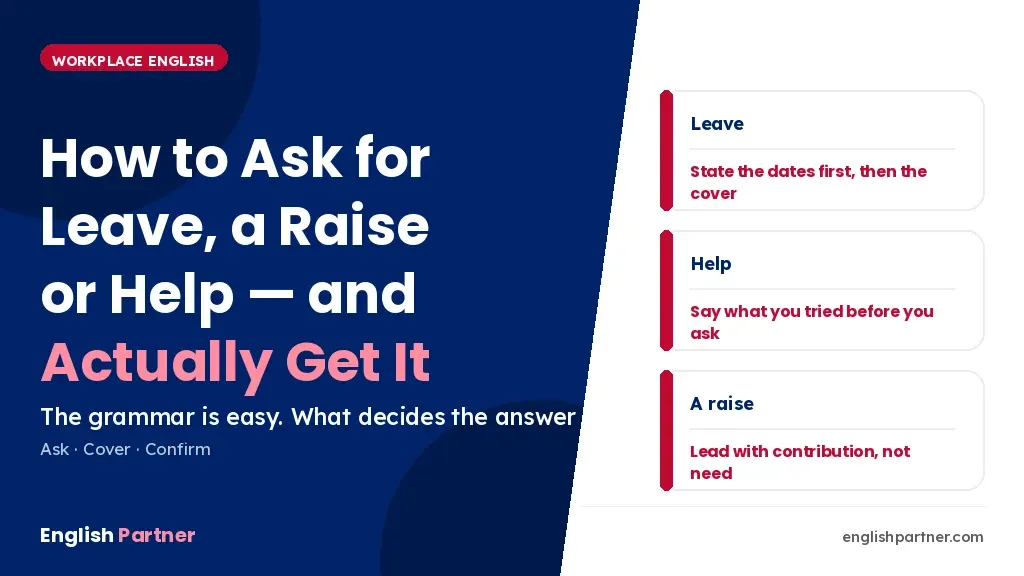
Quick answer: Three parts, in this order. The ask — “I'd like to take leave on the 14th and 15th.” The cover — “I'll finish the report first and Arun can handle the calls.” The confirmation — “Shall I put it in the system?” Dates before reasons, every time.
Why these asks feel harder in English
Most people can produce every sentence in this article. The problem is not vocabulary.
The problem is that Tamil, Telugu, Kannada and Hindi carry respect in the verb ending, so you can lead with the reason, build up to the request, and the politeness is handled by how you conjugate. English has no such ending. It carries politeness in structure and order instead.
Which is why a request that would sound perfectly respectful in Tamil — long background first, request at the end — lands in English as hesitant and hard to answer. The words were fine. The order was wrong.
How to ask for leave in English
Your manager has one question in their head: which days, and who covers it? Answer both before they ask.
Planned leave. “I'd like to take leave on the 14th and 15th. I'll close the month-end report before I go, and Arun can take the client calls. Shall I put it in the system?”
Three sentences. Dates, cover, confirmation. Notice there is no reason in there at all, and nobody will ask for one.
Short notice. Acknowledge it, then move fast. “I know this is short notice — something's come up at home and I need tomorrow off. I've already handed the calls to Arun.”
Sick leave. Keep it short and do not over-explain. “I'm not well today, I'll be taking a sick day. I'll check messages in the evening if anything's urgent.” You do not owe anyone a list of symptoms.
Half day. “Could I take the second half of Friday off? I'll make sure the dispatch list is done before lunch.”
Asking for help without sounding incapable
This is the ask people avoid most, and avoiding it costs more than asking ever does.
The fix is one clause: say what you already tried.
- “I've checked the entries twice and reconciled the first two sheets, but the totals still don't match — could you take a look?”
- “I've gone through the documentation and tried two fixes. Could I get fifteen minutes with you on this?”
- “I'm not sure I've understood the requirement correctly — could you confirm before I build it?”
Each of those shows effort and judgement. Compare with “Can you do this for me?”, which gives your colleague no information and makes it sound like you want the work moved rather than solved.
And when someone is busy, add the size of the ask: “This'll take about ten minutes — when's good?” People say yes to a known amount of time far more readily than to an open-ended one.
Asking for more time on a deadline
Never deliver the problem without a proposal attached. The two sentences look similar and land completely differently.
- Weak: “I can't finish by Friday.” → now your manager has a problem
- Strong: “I'll have the draft by Friday and the final by Tuesday — does that work?” → now they have a decision
Two more worth having ready. “I can hit Friday if we drop the appendix — or Tuesday with everything in. Which would you prefer?” And when something genuinely changed: “The scope grew after the client call — could we move the date to the 20th?”
Say it early. A deadline request made on Tuesday is a planning conversation; the same request on Friday evening is a problem.
Asking for a raise
The hardest one, and the one where the order matters most.
First, ask for the meeting — not for the money. “Could we set up some time to talk about my role and compensation?” That sentence does the whole job of opening the subject without forcing an answer in a corridor.
In the meeting, lead with contribution. Have four things ready, and make them specific:
- “I've been handling the Chennai accounts since March, which wasn't in my original role.”
- “Collections improved from 60 days to 38 over that period.”
- “I've been training the two new joiners for the last quarter.”
- “Given that, I'd like to discuss moving my compensation to…”
Do not lead with personal need. Rent, fees and expenses are real, and they are not something your manager can act on — they are not a reason your role is worth more. Contribution is.
Have a close ready for a no. “I understand. What would need to change for this to be possible in six months?” That question turns a refusal into a plan, and it is the single most useful sentence in the whole conversation.
The same asks in writing
Half of these happen over email or WhatsApp rather than face to face. The structure does not change; the length does. Written asks should be shorter than spoken ones, not longer.
| Ask | What to send |
|---|---|
| Planned leave | Hi Priya — I'd like to take leave on the 14th and 15th. I'll close the month-end report before I go and Arun will cover the client calls. Shall I put it in the system? |
| Sick leave | Hi Priya — I'm not well today, so I'll be taking a sick day. I'll check messages in the evening if anything's urgent. |
| Work from home | Hi Priya — would it be alright if I worked from home on Thursday? I have nothing in the office diary that day and I'll be online the usual hours. |
| More time | Hi Priya — the scope grew after Tuesday's call. I can have the draft to you by Friday and the final by the 20th. Does that work, or would you rather I cut the appendix and hold Friday? |
| Raise meeting | Hi Priya — could we set up 30 minutes this week or next to talk about my role and compensation? Happy to work around your calendar. |
Notice there is no subject-line drama, no "humbly request", and no paragraph of background. Each one is two or three sentences and ends with something the other person can answer.
Reading the answer you get
English managers rarely say a flat no, which means you have to read the reply rather than just hear it.
- "Let me check and get back to you." — a real maybe. Follow up in two days; it is not a brush-off, but it will be forgotten.
- "That's a bit tight." — a soft no to those exact dates. The right reply is "Would the following week work better?"
- "Can you not move it?" — they want the leave but not then. Answer honestly; if you cannot, say so plainly once.
- "In principle, yes, but…" — a yes with a condition attached. Listen hard for the condition, because that is the actual answer.
- "Sure, go ahead." — done. Confirm it in writing the same day so it exists somewhere other than a conversation.
That last habit is worth building regardless of how the conversation went. A one-line message — "Thanks — putting the 14th and 15th in the system" — ends the ambiguity for both of you.
3 mistakes that get you a no
The second one deserves a word, because it is the most common habit among Indian professionals writing in English, and it is well-intentioned.
“Sorry sorry, very sorry to disturb you sir, if possible only…” feels respectful. In English it reads as a lack of confidence in your own request, and a manager reading it unconsciously discounts the ask. One “sorry” is plenty; often zero is correct. “Could I take Friday off?” needs no apology at all — you are asking for something you are entitled to.
For more on professional communication conventions in English-speaking workplaces, the British Council publishes free material on business English.
Your 5-day practice plan
Write each one as though you are sending it today, about something real. Practice sentences about an imaginary job produce imaginary confidence.
When self-practice is not enough
A written request you can draft and redraft. What you cannot rehearse is the follow-up — “why those exact dates?”, “can you not move it?”, “what's the business case?” — arriving while you are standing there.
Live practice with a trainer builds that: real pushback, real follow-up questions, and feedback in your mother tongue straight afterwards. Learners can join our spoken English classes in Coimbatore, our spoken English classes in Chennai, or our spoken English classes in Pondicherry.
Final thoughts and your next step
Ask, cover, confirm. Dates before reasons, effort before help, contribution before compensation. The grammar was never the hard part — the order is.
This week, take the one ask you have been putting off and write it in three sentences. Not four. Three sentences is usually the whole conversation.