Group Discussion Topics with Sample Answers and the 4 Phrases That Win
 Dhinesh Kumar
Content Writer
Published
Time to read
8 minutes
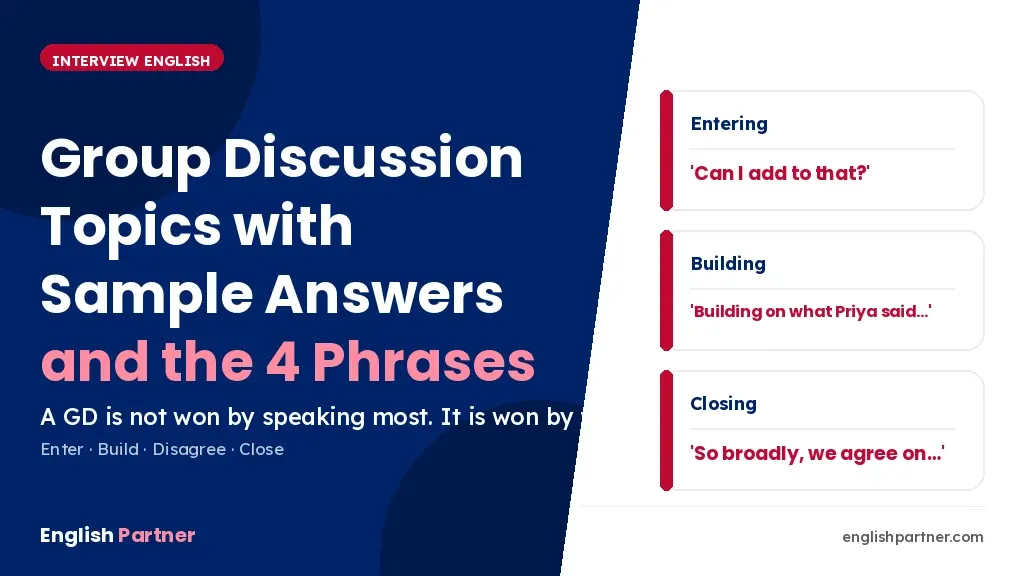
Quick answer: Four moves win a GD. Enter in the first 90 seconds (“Can I start us off?”), build on someone (“Building on what Priya said…”), disagree with a reason (“I see it differently, and here's why”), and summarise at the end (“So broadly, we agree on…”). Topics and sample answers follow.
What the panel is actually scoring
Almost everyone prepares for a GD by reading up on topics. That is the wrong preparation, because the panel is barely listening to your facts.
They are scoring four things: did you enter early, did you listen to others, did you give reasons, and did you help the group get somewhere. You can know nothing about electric vehicles and still score well on all four.
This is genuinely good news if your English is not strong, because all four are structural moves, and each one is a short memorisable sentence.
Group discussion topics for 2026, with sample openings
Here are eight current topics with an opening line you could genuinely use. Notice that none of them starts with a fact — each one frames the question.
1. Will AI replace entry-level jobs in India?
“Can I start us off? I think the real question is not whether AI replaces jobs, but how fast reskilling can keep up. If we take those two speeds separately…”
2. Work from home or work from office?
“There are two very different things here — productivity and company culture. The evidence on productivity is fairly clear; the culture argument is where the disagreement actually is.”
3. Should social media be regulated in India?
“I'd separate this into content regulation and data regulation, because the arguments for each are completely different.”
4. Is online education as effective as classroom learning?
“It probably depends on the subject and the age group. For skills training the evidence looks positive; for young children, less so.”
5. Climate action versus economic growth for developing countries
“The framing of this as a trade-off might be the thing worth questioning first.”
6. Are Indian startups creating real value or just valuations?
“It's worth splitting by sector — the answer for fintech is quite different from the answer for quick commerce.”
7. Should electric vehicles be subsidised?
“Two questions underneath this one: can the grid handle it, and who actually benefits from the subsidy.”
8. Does remote work help or hurt women's careers in India?
“There's an access argument and a visibility argument here, and they point in opposite directions.”
See the pattern? Every one of those splits the topic into two parts. That single technique works on any GD topic in existence, including ones you have never thought about, and it is scored as analytical ability.
Move 1: entering early
The most common reason capable people fail a GD is that their first contribution comes at minute six. By then the panel has already formed an impression, and a late entry rarely changes it.
You do not need the best point to go first. You need a point. If you are unsure, define the topic — that counts fully as a contribution:
- “Can I start us off? I think the core question here is…”
- “Before we go further, should we define what we mean by…?”
- “There seem to be two sides to this — shall we take them one at a time?”
If the GD has already started and you cannot find a gap, the phrase is simply “Can I add to that?” at normal volume. It works almost every time.
Move 2: building on someone, which is the one people skip
This is the highest-scoring move in a GD and the one almost nobody does, because everyone is busy rehearsing their own point instead of listening.
- “Building on what Priya said, I'd add…”
- “That's a good point, and it connects to…”
- “I agree with Arun, and the reason I think so is…”
Two things happen at once. The panel sees that you listened, and the person you named becomes an ally rather than a competitor. Use someone's name — panels notice that you learned it.
Move 3: disagreeing without attacking
Disagreement is scored positively. Rude disagreement is not. The structure is the same one that works in a meeting: acknowledge, turn, give a reason.
- “I see it a bit differently — here's why.”
- “That holds for cities, though I'd question it for smaller towns.”
- “I take the point, but the numbers seem to go the other way.”
What loses marks: “No, that's wrong.” Not because it is impolite, but because it contains no reason. In a GD, an opinion without a reason scores as nothing at all.
Move 4: the summary that gets you remembered
Most GDs end in a mess — everybody talking, time running out, no conclusion. Whoever summarises is remembered as the leader of that group, and it takes twenty seconds.
“So broadly, we seem to agree on three things: that the cost is the main barrier, that access improves either way, and that the timeline is the open question. The one thing we didn't resolve was…”
You do not need permission and you do not need to be the strongest speaker in the room. You need to have been listening, and to start about a minute before time is up.
Handling the difficult moments
Someone talks over you. “Just a second, let me finish the point.” Firm, polite, completely normal. Giving way every time is read as a lack of conviction.
The GD drifts off topic. “Are we still on the original question?” Panels like this one — it shows you were tracking the discussion rather than waiting for your turn.
Someone has not spoken at all. “Arun, what's your take on this?” This is the single most generous move available in a GD, and panels mark it as leadership every time.
You know nothing about the topic. Listen for the first two minutes, then enter with structure: “From what's been said, there seem to be two positions here…” That is a real contribution and it buys you the rest of the round.
A full GD, line by line
Reading the moves separately is one thing. Here is how they fit together in a real ten-minute round on "Work from home or work from office?"
| Time | What you say | Which move |
|---|---|---|
| 0:20 | Can I start us off? There are two separate things here — productivity and culture. The data on productivity is fairly settled; the culture argument is where the real disagreement is. | Enter + frame |
| 2:30 | Building on what Priya said about junior employees, I'd add that the learning happens informally — you pick things up by overhearing them. | Build |
| 5:10 | I see it a bit differently there. Commute time is not a small factor in Indian cities — for a lot of people it is two hours a day back. | Disagree with a reason |
| 7:00 | Arun, you work in a hybrid setup — what's your take? | Bring in a quiet person |
| 9:15 | So broadly, we agree productivity holds up remotely, that junior learning suffers, and that commute time matters more in India than in the studies we quoted. The open question was whether hybrid actually fixes the culture problem or just splits it. | Summarise |
Five contributions across ten minutes. Not the most speaking in the room, and almost certainly the highest score — because every one of the four moves is in there, and three of them mention someone else.
What to do in the two minutes before it starts
Most GDs give you a minute or two with the topic before anyone speaks. Three things to do with that time, in order:
- Split the topic into two parts. Not three, two. This gives you your opening line and a structure to return to later.
- Write one example you can actually name. One concrete example, from your own college, job or city, beats five vague claims. "In my last company…" is strong evidence in a GD.
- Decide you will speak in the first ninety seconds. Decide it before the round starts, because once it begins there is never a comfortable moment to begin.
What not to do: write a full speech. You will read it out, it will sound rehearsed, and the second someone disagrees you will have nothing left.
3 mistakes that lose a GD
The second one is worth sitting with, because it is the opposite of what most people believe. Speaking the most does not win a GD. Three strong contributions with reasons attached beat eight weak ones, every time, in every format.
For more on structured speaking and interview formats, the British Council has free professional-English material.
Your 5-day plan
Record every round. A GD is the one interview format where you genuinely cannot feel how you came across — you are too busy thinking about what to say next. The recording is the only honest feedback you get alone.
When self-practice is not enough
You can memorise all ten phrases today. What you cannot practise alone is being interrupted, or having someone disagree with your point and having to respond in four seconds. That is the entire skill a GD tests.
Live mock GDs with a trainer build exactly that — real interruptions, real pushback, and feedback in your mother tongue straight afterwards. Learners can join our spoken English classes in Coimbatore, our spoken English classes in Chennai, or our spoken English classes in Pondicherry.
Final thoughts and your next step
Enter early, build on someone, disagree with a reason, summarise at the end. Four moves, ten sentences, and they work on a topic you have never seen.
Today, take any topic from the list above and give yourself sixty seconds to split it into two parts out loud. That one technique is what the opening line of every strong GD contribution is built on.