100 + Daily use english sentences
 Vishaleni
Content Writer
Last Updated
Time to read
15 minutes
Vishaleni
Content Writer
Last Updated
Time to read
15 minutes
Tips for Natural Usage
You know English words. You understand when someone speaks. But the moment you open your mouth — you freeze.
Sound familiar?
The problem is not your vocabulary. The problem is you don’t have ready-made sentences to pull from.
Think about how you speak in your mother tongue. You don’t build sentences word by word. You use sentences you already know — sentences that come automatically.
That is exactly what this blog will do for you.
Here are 100 daily use English sentences — covering 10 real-life situations you face every single day. Learn them, practise them, and watch your confidence go up immediately.
What Are Daily Use English Sentences?
Daily use English sentences are short, practical sentences you can use in real conversations — at home, at work, in shops, on calls, or anywhere else.
They are not textbook English. They are living, breathing sentences that fluent English speakers use automatically — without thinking.
For example:
- “Could you repeat that, please?”
- “I’ll get back to you on this.”
- “Do you have this in another size?”
These are not difficult. But if you don’t practise them in advance, they won’t come to you naturally when you need them.
That is why learning these sentences in advance is one of the smartest things you can do for your spoken English.
Why Should You Learn Daily English Sentences?
Most people spend months reading grammar rules but still cannot hold a simple conversation. That’s because grammar knowledge ≠ speaking confidence.
When you practise real sentences:
- You respond faster — no more long pauses
- You stop translating in your head before speaking
- You sound more natural and fluent
- Your confidence grows every single day
The goal is not perfection. The goal is communication. And these 100 sentences will help you communicate in almost any situation.
100 Daily Use English Sentences (10 Real Situations)
1. Greetings & Introductions
These are the sentences you use every single day — when you meet someone, when you start a conversation, when you say goodbye.
| # | Sentence | When to Use It |
|---|---|---|
| 1 | Good morning! How are you? | Meeting someone in the morning |
| 2 | I’m doing well, thank you. | Responding to “how are you” |
| 3 | Nice to meet you. | When you meet someone for the first time |
| 4 | I’ve heard a lot about you. | When meeting someone you’ve been told about |
| 5 | Please call me [your name]. | Giving your name casually |
| 6 | It’s been a long time! | Meeting someone after a long gap |
| 7 | How’s everything going? | Friendly check-in with someone you know |
| 8 | Have a great day! | Saying goodbye during the day |
| 9 | Take care. See you soon. | A warm goodbye |
| 10 | Let’s catch up sometime. | Ending a conversation with a plan to meet again |
Tip: Don’t stop at “Good morning.” Follow it immediately with a question. That’s what starts a real conversation.
2. At Work / Office Conversations
These sentences are especially important if you are working in a corporate job, BPO, IT company, or any professional environment.
| # | Sentence | When to Use It |
|---|---|---|
| 11 | Can we schedule a meeting? | Requesting a discussion with your team or manager |
| 12 | I’ll send you the details over email. | Committing to follow up via email |
| 13 | I need a few more days to complete this. | Asking for a deadline extension |
| 14 | Could you please clarify what you mean? | When you don’t fully understand an instruction |
| 15 | I’ll get back to you on this. | Buying time before giving a final answer |
| 16 | Let me check and confirm. | When you need to verify something before responding |
| 17 | I have a quick question. Do you have a minute? | Before asking your colleague or manager something |
| 18 | That’s a great idea. | Appreciating a colleague’s suggestion |
| 19 | I’m working on it. I’ll update you shortly. | Giving a status update |
| 20 | Thanks for your feedback. I’ll keep that in mind. | Responding to criticism or suggestions professionally |
Tip: In office situations, the way you say something matters more than what you say. These sentences are polite but confident — that combination works best at work.
3. Shopping & Market
Whether you are at a local shop, a mall, or an online pickup counter — these sentences will make shopping in English completely easy.
| # | Sentence | When to Use It |
|---|---|---|
| 21 | How much does this cost? | Asking the price of an item |
| 22 | Do you have this in a different size? | Shopping for clothes or footwear |
| 23 | Can I try this on? | In a clothing store, before entering the trial room |
| 24 | Is there any discount on this? | When you want a price reduction |
| 25 | I’m just looking, thank you. | When a salesperson approaches but you’re still browsing |
| 26 | Do you accept UPI or card payment? | Asking about payment options |
| 27 | I’d like to return this. | Returning a product |
| 28 | Can I get a receipt for this? | Asking for a bill or invoice |
| 29 | Do you have this in stock? | Checking product availability |
| 30 | I’ll think about it and come back. | Politely saying you’re not ready to buy yet |
Tip: Shopkeepers and sales staff appreciate clear communication. A simple sentence like “I’m just looking” will stop an uncomfortable 10-minute sales pitch.
4. At Home & Family Conversations
English isn’t only for outside. Practising at home with family is the fastest way to improve your spoken English.
| # | Sentence | When to Use It |
|---|---|---|
| 31 | What would you like to eat today? | Asking family members about food preference |
| 32 | Can you please turn down the volume? | When the TV or music is too loud |
| 33 | I’ll be home by 7. | Informing family about your return time |
| 34 | Could you help me with this for a minute? | Asking for help with a household task |
| 35 | Don’t worry. Everything will be fine. | Comforting a family member |
| 36 | I’m really tired today. I need some rest. | Expressing exhaustion at home |
| 37 | Let’s go out this weekend. | Planning a family outing |
| 38 | Thank you for cooking. This is delicious! | Complimenting food made at home |
| 39 | Please remind me about this tomorrow. | Asking a family member for a reminder |
| 40 | We need to talk about something important. | Starting a serious conversation |
Tip: Most people feel less shy speaking English with strangers than with their own family. It’s the opposite of what you should do — practise at home first where there is no pressure.
5. Making & Declining Requests
Knowing how to ask for something — and how to say no politely — is one of the most useful skills in English.
| # | Sentence | When to Use It |
|---|---|---|
| 41 | Could you do me a favour? | Before making any request |
| 42 | Would you mind helping me with this? | A polite way to ask for help |
| 43 | I hate to ask, but can you lend me some money? | Asking for a financial favour |
| 44 | Is it okay if I leave early today? | Requesting permission |
| 45 | Can you please keep this between us? | Asking someone to keep something private |
| 46 | I’m afraid I can’t do that right now. | Declining a request politely |
| 47 | I’d love to help, but I’m tied up at the moment. | Saying no without being rude |
| 48 | Let me see what I can do. | Not promising but showing willingness to try |
| 49 | I’d prefer not to, if that’s okay. | A soft, respectful refusal |
| 50 | Can we find another way to handle this? | Suggesting an alternative instead of flat refusal |
Tip: In English, how you decline matters more than the refusal itself. Sentences 46 to 50 let you say no while still keeping the relationship warm.
6. Expressing Feelings & Emotions
Fluent English speakers don’t just describe facts — they express feelings clearly. This section helps you do exactly that.
| # | Sentence | When to Use It |
|---|---|---|
| 51 | I’m really excited about this! | Showing enthusiasm |
| 52 | Honestly, I’m a bit nervous. | Admitting nervousness without embarrassment |
| 53 | I feel so relieved right now. | After a stressful situation ends |
| 54 | That really hurt my feelings. | Expressing that something someone said upset you |
| 55 | I’m proud of what I’ve done. | Acknowledging your own achievement |
| 56 | I don’t feel comfortable with this. | Setting a boundary politely |
| 57 | I’m overwhelmed. I need a break. | When you feel mentally exhausted |
| 58 | That made me very happy. Thank you. | Expressing gratitude with emotion |
| 59 | I’m disappointed, but I understand. | Handling a negative outcome gracefully |
| 60 | I’m just not in the right headspace today. | A modern, natural way to say you’re not at your best |
Tip: Expressing feelings clearly makes you sound more confident and human — not weak. Fluent speakers do this naturally.
7. Asking for Help & Directions
Whether you are lost in a new city or stuck on a task — these sentences help you ask clearly and receive help easily.
| # | Sentence | When to Use It |
|---|---|---|
| 61 | Excuse me, can you help me? | Approaching a stranger for help |
| 62 | I’m looking for [place name]. Am I going the right way? | Asking for directions |
| 63 | How far is it from here? | Asking about distance |
| 64 | Is there a bus stop nearby? | Asking about public transport |
| 65 | Could you point me in the right direction? | Asking someone to guide you |
| 66 | I think I’m lost. Can you help me find [location]? | When you are completely unsure where you are |
| 67 | Can you show me on the map? | Asking someone to help you with your map or phone |
| 68 | Which road should I take? | At an intersection or fork in the road |
| 69 | Is this the right platform for [destination]? | At a railway station |
| 70 | Thank you so much. You’ve been very helpful. | After receiving directions or help |
Tip: In India, most people will try to help you even if their English is limited. Asking clearly in English often gets you faster and more accurate help.
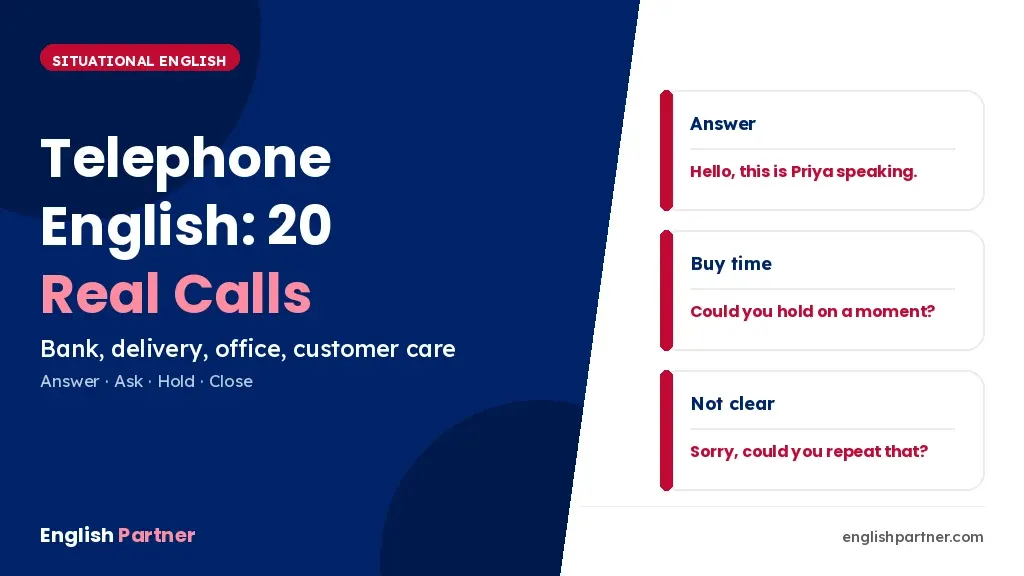
8. Phone & WhatsApp Conversations
In today’s world, a huge part of English communication happens over calls and messages. These sentences are essential.
| # | Sentence | When to Use It |
|---|---|---|
| 71 | Hello, who am I speaking with? | Answering an unknown call professionally |
| 72 | Is this a good time to talk? | Before starting a conversation on a call |
| 73 | I’m sorry, I missed your call. Can we talk now? | Returning a missed call |
| 74 | I can barely hear you. Could you speak up? | When the line is unclear |
| 75 | Let me call you back in 10 minutes. | Asking to postpone the conversation |
| 76 | I’ll send you the details on WhatsApp. | Moving a conversation to a message |
| 77 | Can you share your location? | Asking for a live location |
| 78 | Please let me know once you reach. | Asking someone to confirm they arrived safely |
| 79 | I’ll check and reply to your message soon. | Acknowledging a WhatsApp message professionally |
| 80 | Sorry for the late reply. I was in a meeting. | Explaining a delayed response |
Tip: Phone calls in English feel much harder than they are. Practise sentences 71 to 75 out loud — confidence on calls comes from familiarity, not grammar.
9. Job Interviews & Professional Settings
If you are preparing for a job interview or a promotion, these sentences will make you sound polished and prepared.
| # | Sentence | When to Use It |
|---|---|---|
| 81 | I have [X] years of experience in this field. | Introducing your background |
| 82 | I’m a quick learner and I enjoy taking on new challenges. | Highlighting a strength |
| 83 | My biggest strength is my ability to work under pressure. | Answering “what’s your strength?” |
| 84 | I’m currently working on improving my [skill]. | Honestly addressing a weakness while showing growth |
| 85 | I’m very passionate about this role because… | Showing genuine interest in the job |
| 86 | Could you tell me more about the team I’ll be working with? | Asking a smart question at the end of the interview |
| 87 | I’m flexible with the working hours. | Showing willingness to adapt |
| 88 | I’m looking for a role where I can grow professionally. | Expressing career ambition |
| 89 | Thank you for this opportunity. I look forward to hearing from you. | Closing the interview confidently |
| 90 | I’m comfortable with the offered package. | Responding to a salary offer positively |
Tip: Interviewers are not just testing your knowledge — they are testing your communication. Practising these sentences aloud before the interview can change your outcome completely.
10. Travel & Transportation
Whether you travel within your city or across the country, these sentences will keep you confident and in control.
| # | Sentence | When to Use It |
|---|---|---|
| 91 | One ticket to [destination], please. | Booking a bus or train ticket |
| 92 | What time does the next train/bus leave? | Checking departure times |
| 93 | Is this seat taken? | Before sitting next to someone |
| 94 | Could you please open the window? | In a train or bus with someone near the window |
| 95 | How long does it take to reach [place]? | Asking about journey duration |
| 96 | I have a reservation under [your name]. | At a hotel or ticket counter |
| 97 | Could I upgrade to a better seat? | Requesting an upgrade |
| 98 | I’d like to check in, please. | At a hotel or airport |
| 99 | Is breakfast included? | Asking about hotel inclusions |
| 100 | Thank you. I really enjoyed the journey. | A friendly close to a travel experience |
Tip: Travel situations move fast. If you freeze and look confused, you may miss your bus, train, or flight. Having these sentences ready means you stay in control even in unfamiliar places.
How to Practise These 100 Sentences Every Day
Reading these sentences once won’t make them automatic. Here’s a simple daily practice plan that actually works:
Step 1 — Read Aloud (5 minutes): Pick one category per day. Read each sentence out loud. Don’t just read in your head — your mouth needs the practice, not just your brain.
Step 2 — Mirror Practice (5 minutes): Stand in front of a mirror and say the sentences as if you’re in that real situation. This removes the feeling of awkwardness before it happens in public.
Step 3 — Use One Sentence Today: Pick any one sentence from the list and use it in a real conversation today. Just one. This builds the habit of actually speaking.
Step 4 — Voice Note to Yourself: Record yourself saying 5 sentences and listen back. You’ll quickly hear what to improve — without needing anyone to judge you.
Step 5 — Weekly Review: At the end of each week, go back to the categories you practiced. Can you say the sentences without looking? That’s your real progress check.
Mistakes to Avoid While Using Daily English Sentences
Translating before speaking — The biggest trap. If you think in Tamil, Kannada, or Hindi and then translate to English in your head, you will always be slow. Try to think directly in English, even if it’s broken at first.
Waiting until your English is “perfect” — Fluency comes from speaking, not from waiting. Every mistake you make out loud is a lesson. Every mistake you keep to yourself is a missed opportunity.
Using only textbook phrases — “I am going to the market” is correct but sounds unnatural. Native speakers say “I’m heading to the market.” Learn from real conversations, not only textbooks.
Avoiding English in public — Many people practise at home but freeze outside. The gap between comfort and confidence is repetition in real environments. Push yourself to use at least one English sentence per day in a real situation.
Memorising without contextualising — Don’t just memorise sentences — understand when and why you use them. This is why every sentence in this blog comes with a “when to use it” column.
How English Partner Helps You Master Daily English
Practising alone has its limits. You can memorise sentences, but you cannot practise speaking without someone to speak with.
English Partner gives you exactly that — a trained speaking partner who works with you daily to help you use these sentences naturally.
Here’s what makes English Partner different:
- Daily speaking practice — Not one class per week. Daily practice that builds real fluency
- Real-life situation training — Trainers put you into office, interview, and shopping scenarios so the sentences become automatic
- Mistake correction without embarrassment — Trainers correct you in a way that builds your confidence, not breaks it
- Structured progress — You don’t just learn more sentences. You track your improvement from Basic to Advanced level
If you are serious about speaking English fluently — not just “knowing” English — English Partner’s spoken English course is built exactly for that.
Final Words
Practising alone has its limits. You can memorise sentences, but you cannot practise speaking without someone to speak with.
English Partner gives you exactly that — a trained speaking partner who works with you daily to help you use these sentences naturally.
Here’s what makes English Partner different:
- Daily speaking practice — Not one class per week. Daily practice that builds real fluency
- Real-life situation training — Trainers put you into office, interview, and shopping scenarios so the sentences become automatic
- Mistake correction without embarrassment — Trainers correct you in a way that builds your confidence, not breaks it
- Structured progress — You don’t just learn more sentences. You track your improvement from Basic to Advanced level
If you are serious about speaking English fluently — not just “knowing” English — English Partner’s spoken English course is built exactly for that.
Practising these on your own only takes you so far — at some point somebody has to correct you. That is what the basic spoken English course is for, and if English is easier to grasp in your mother tongue, start with learning English through Tamil.
Frequently asked questions
How many daily use English sentences should I learn per day?
Start with 5 sentences per day from one category. That's 35 sentences a week — enough to build real fluency over time. Quality and consistency beat cramming 50 sentences in one day and forgetting them all.
Do I need to memorise all 100 sentences?
Not all at once. Focus on the categories most relevant to your daily life — office, phone calls, and greetings are the most commonly used. Return to the others as you need them.
Will learning these sentences make me fluent in English?
These sentences are a strong foundation, but fluency comes from consistent practice in real conversations. These sentences give you the tools — daily speaking practice turns them into habits.
What is the best way to practise these sentences at home?
Say them out loud daily. Record yourself. Use them with family members. The more you hear your own voice saying these sentences, the more natural they will feel when you need them.
Can I use these sentences at work even if my English is basic?
Absolutely. Several categories in this blog — especially the Office and Phone sections — are written specifically for people who are building their professional English. Start with 3 sentences per week and add more as you get comfortable.