Classroom Conversation Between Student and Teacher: Simple Examples to Speak English Confidently
 Vishaleni
Content Writer
Published
Time to read
7 minutes
Vishaleni
Content Writer
Published
Time to read
7 minutes
What Is a Classroom Conversation?
A classroom conversation is the everyday spoken exchange between a teacher and a student during a lesson.
It includes greetings, instructions, questions, answers, and polite requests.
These conversations follow simple, repeated patterns. Once you learn the patterns, you can use them again and again without thinking too hard.
For learners in Bangalore, Chennai, or Hyderabad, this kind of practice is especially helpful.
It builds the confidence you need to speak English in school, college, training sessions, and even at work later.
Why Classroom English Feels Different
The way you speak with friends is relaxed and casual. The way you speak with a teacher is usually more polite and structured.
This shift in tone confuses many learners at first. You may know the words but feel unsure about the right level of politeness to use.
That is exactly why focused practice matters. When you learn the correct phrases, you stop guessing and start speaking with ease.
According to the British Council, regular real-life practice is one of the most effective ways to build spoken fluency.
Common Phrases Used in Classroom Conversations
Before we look at full dialogues, let us first build your foundation with simple, ready-to-use phrases. These phrases cover the most common moments in any classroom. Learn them, repeat them aloud, and they will soon become natural.
Greetings and Starting the Class
These phrases help you begin the day politely and create a friendly tone.
| Teacher Says | Student Says |
|---|---|
| Good morning, everyone. | Good morning, teacher. |
| How are you today? | I’m fine, thank you. |
| Let’s begin our lesson. | I’m ready. |
| Please take your seats. | Yes, teacher. |
Asking for Permission
Asking permission is one of the most useful skills in any classroom. These phrases keep your request polite and clear.
| Situation | What You Say |
|---|---|
| To enter the class | May I come in, please? |
| To leave the room | May I go to the restroom? |
| To speak | May I say something? |
| To borrow something | May I borrow a pen, please? |
Asking and Answering Questions
These phrases help you stay involved in the lesson without feeling lost.
| Student Says | Teacher Says |
|---|---|
| I have a question. | Yes, please go ahead. |
| Can you repeat that, please? | Of course. Listen again. |
| What does this word mean? | Let me explain it to you. |
| I’m not sure about this. | That’s okay. Let’s try together. |
Sample Classroom Conversation Between Student and Teacher
Now let us put these phrases into real dialogues. We have arranged them from beginner to slightly advanced, so you can grow step by step. Read each one aloud. Speaking out loud is far more powerful than reading silently.
Dialogue 1: Greeting the Teacher (Beginner)
This is the most common conversation you will have every single day.
Teacher: Good morning, class.
Student: Good morning, teacher.
Teacher: How are you today?
Student: I’m fine, thank you. And you?
Teacher: I’m doing well. Let’s start our lesson.
Dialogue 2: Asking for Permission (Beginner)
Notice how the student stays polite throughout the exchange.
Student: Excuse me, teacher. May I come in?
Teacher: Yes, please come in.
Student: Thank you. May I sit here?
Teacher: Yes, that seat is free.
Dialogue 3: Asking a Doubt in Class (Intermediate)
This dialogue shows how to ask for help without feeling shy.
Student: Excuse me, teacher. I didn’t understand this word.
Teacher: Which word are you confused about?
Student: The word “environment.”
Teacher: Good question. It means the world and conditions around us. Listen and repeat after me: environment.
Student: Environment. Thank you, that’s clear now.
Dialogue 4: Group Work Discussion (Intermediate)
Here the student speaks more freely and shares an opinion.
Teacher: Please work in pairs and discuss today’s topic.
Student: What should we talk about, teacher?
Teacher: Share your views on online learning. You have ten minutes.
Student: I think online learning is flexible, but I miss face-to-face classes.
Teacher: That’s a thoughtful point. Well done.
Dialogue 5: Asking About Homework or Marks (Intermediate)
This is a real situation most students face during the term.
Student: Teacher, may I ask about my test score?
Teacher: Sure. You did well, but your spelling needs more practice.
Student: Thank you. I’ll focus more on that.
Teacher: Good. Keep practising and you’ll improve.
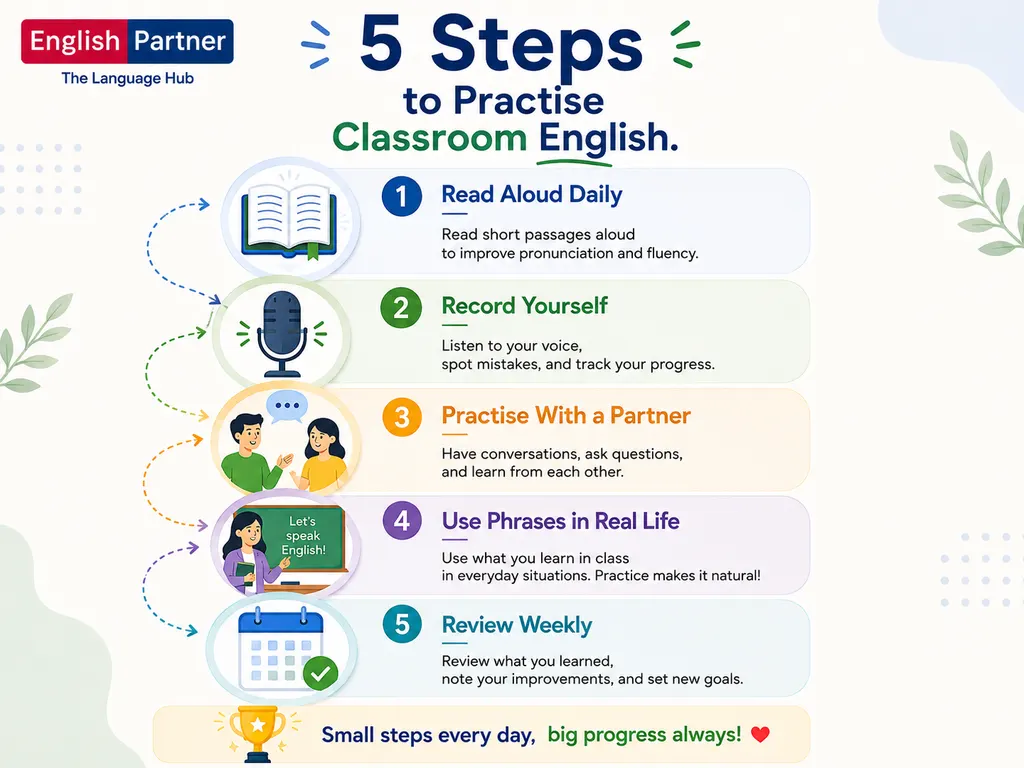
How to Practise Classroom Conversations Step by Step
Reading dialogues is a good start. But real improvement comes from active practice. Here is a simple routine you can follow.
Step 1: Read aloud daily.
Pick one dialogue and read it out loud three times. Focus on clear pronunciation, not speed.
Step 2: Record yourself.
Use your phone to record your voice. Listen back and notice where you can sound clearer.
Step 3: Practise with a partner.
Ask a friend or family member to play the teacher. Take turns swapping roles.
Step 4: Use the phrases in real life.
The next time you are in class, try one new phrase. Small steps build big confidence.
Step 5: Review weekly.
Go back to old dialogues each week. Repetition is the key to remembering naturally.
Common Mistakes Learners Make in Class
Knowing what to avoid is just as useful as knowing what to say. Here are gentle reminders, not criticisms.
Mixing your mother tongue.
It is normal to slip into Tamil, Hindi, or Telugu mid-sentence. With practice, you will pause less and speak more in English.
Staying silent out of fear.
Many learners stay quiet to avoid mistakes. But mistakes are part of learning, and teachers expect them.
Speaking too softly.
A quiet voice can hide good answers. Speaking a little louder helps your teacher hear and respond to you.
Remember, fluency is a journey. Most learners improve steadily with regular, low-pressure practice over a few weeks.
When Self-Practice Is Not Enough
Practising at home is excellent for building basics. But sometimes you need guidance to move faster and feel more confident.
If you feel stuck, nervous in every class, or unsure about your pronunciation, a structured programme can help.
A trained mentor can spot the exact areas you need to work on.
Guided learning gives you something self-study cannot: real conversation practice with feedback.
This is often the missing piece for learners who feel they have “stopped improving.” You can read more about the value of interactive practice from research shared by Cambridge English.
Final Thoughts and Your Next Step
Classroom conversations are simple once you learn the patterns. Greetings, questions, and polite requests all follow easy structures you can master with practice.
The secret is to start speaking, even if you make small mistakes. Every sentence you say out loud builds your confidence a little more.
If you find yourself nervous in class or unsure where to begin, a quick assessment can help you understand exactly where to start.
To discover which course matches your current level and goals, explore ourspoken English classes in coimbatoreprogrammes on EnglishPartner.com.
If you are in Bangalore, Chennai, or Hyderabad and ready to speak with real confidence, our team is here to guide you through the next step at your own pace.
Frequently asked questions
How can I start a conversation with my teacher in English?
Begin with a polite greeting like "Good morning, teacher." Then add a simple question such as "May I ask something?" Starting small makes it easier each time.
What should I say if I don't understand the teacher?
You can politely say, "Can you repeat that, please?" or "I didn't understand this word." Teachers appreciate honest questions and are happy to explain.
Is it rude to ask the teacher to repeat something?
Not at all. Asking for clarification is polite and shows you are paying attention. Just use a courteous tone and a simple phrase.
How do I ask for permission politely in class?
Use "May I" instead of "Can I" for extra politeness. For example, "May I go to the restroom?" sounds respectful and clear.
I feel nervous speaking in class. Is that normal?
Yes, it is completely normal. Many learners feel the same way. With consistent practice and gentle exposure, this nervousness usually fades over a few weeks.
How long does it take to speak confidently in class?
This depends on your current level and how often you practise. Most learners notice real improvement with daily practice over a few weeks to a few months.
Can I improve classroom English by practising at home?
Yes, home practice builds a strong base. Reading dialogues aloud and recording yourself are simple, effective methods you can start today.
When should I join a structured English programme?
If you feel stuck, stay silent in class, or want faster progress with feedback, a guided programme may be the right next step for you.