How to Learn Fluent English in 30 Days: A Realistic Step-by-Step Guide
 Vishaleni
Content Writer
Last Updated
Time to read
8 minutes
Vishaleni
Content Writer
Last Updated
Time to read
8 minutes

Can You Really Learn English in 30 Days?
Let us be honest with you from the start. You cannot become completely fluent in English in 30 days. Anyone who promises that is not telling you the truth.
But here is the good news. You can absolutely learn English in 30 days to a level where you speak with more confidence, form clearer sentences, and handle daily conversations without freezing up.
We will show you exactly what to do each day, what results to expect, and how to keep going after day 30.
Think of these 30 days as the foundation. With consistent daily practice, real improvement is possible within a month.
What "Fluent English" Actually Means
Fluency is not about knowing every word in the dictionary. It is about speaking smoothly, expressing your ideas clearly, and understanding others without translating every sentence in your head.
Many learners confuse fluency with perfection. Native speakers themselves make small grammar mistakes when they speak. What matters is communication, not perfection.
According to the Cambridge English research on language learning, regular speaking practice improves fluency faster than passive activities like reading alone.
So when we talk about becoming more fluent in 30 days, we mean:
- Speaking without long pauses
- Thinking in English instead of translating
- Building sentences without fear
- Understanding everyday conversations comfortably
Why Most Learners Struggle to Improve in 30 Days
Before we dive into the plan, let us look at why many people fail to see progress, even after a month of effort.
They focus only on grammar books. Grammar is important, but it does not help you speak. You need active practice.
They study in silence. You cannot learn to speak English by reading alone. You must use your mouth, voice, and ears.
They wait until they feel ready. Many learners delay speaking because they fear mistakes. This habit blocks progress more than anything else.
They have no daily routine. Random practice leads to random results. A clear daily plan is essential.
If any of these sound familiar, do not feel bad. These are very common patterns. The 30-day plan below is designed to fix all of them.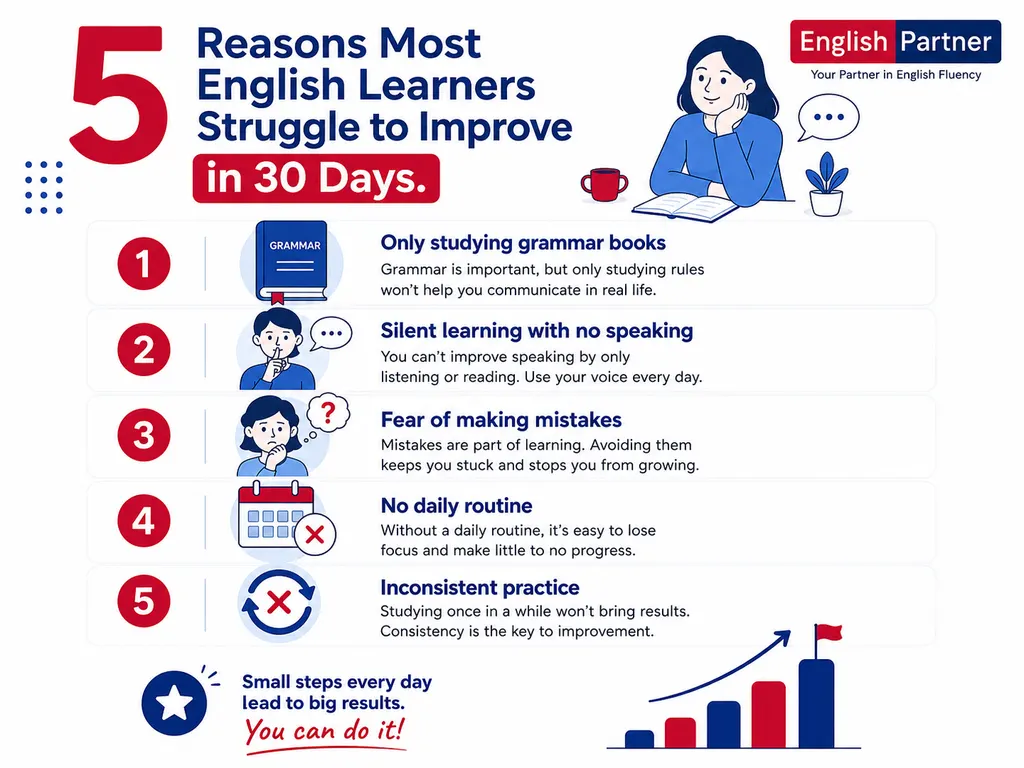
The Realistic 30-Day English Fluency Plan
This plan is built on four core skills practiced daily: listening, speaking, reading, and writing. Each week has a clear focus that builds on the previous one.
You will need about 60 to 90 minutes per day. If you can only spare 45 minutes, that works too, as long as you stay consistent.
Week 1: Build the Foundation (Days 1 to 7)
The first week is about getting comfortable with English again. You will reduce fear and start using simple, useful sentences.
Daily focus:
- 15 minutes of listening to slow English podcasts or YouTube videos
- 20 minutes of speaking practice (talk to yourself in the mirror or record voice notes)
- 15 minutes of vocabulary (learn 5 new words and use each in a sentence)
- 10 minutes of writing (write about your day in simple English)
By the end of week 1, you should feel less nervous and more willing to speak. Do not worry about grammar mistakes yet.
Week 2: Strengthen Sentence Building (Days 8 to 14)
Now that the fear is reducing, focus on forming complete sentences. Many learners know words but struggle to connect them.
Daily focus:
- 20 minutes of shadowing (repeat after a native speaker word by word)
- 20 minutes of conversation practice with a partner, tutor, or AI tool
- 15 minutes of reading aloud from a simple article or short story
- 15 minutes of grammar focus (pick one topic like present tense or articles)
Try this real example. A learner from Chennai we worked with practiced shadowing English news clips for 20 minutes daily. By day 14, she could form full sentences without long pauses.
Week 3: Think in English (Days 15 to 21)
This is the most important week. You will train your brain to stop translating from your mother tongue.
Daily focus:
- 25 minutes of watching English shows with English subtitles
- 25 minutes of speaking about random topics for 2 minutes each
- 15 minutes of writing a short journal entry in English
- 10 minutes of reviewing common phrases and idioms
When you describe your morning in English without first thinking in Tamil, Hindi, or Telugu, you are making real progress.
Week 4: Apply and Polish (Days 22 to 30)
The final week is about using English in real situations and fixing small weaknesses.
Daily focus:
- 20 minutes of real conversations (with colleagues, online groups, or tutors)
- 20 minutes of recording yourself and listening back to fix pronunciation
- 20 minutes of role-play (job interview, ordering food, phone calls)
- 15 minutes of reviewing your weakest area
By day 30, you should be able to hold a 5-minute conversation on a familiar topic with reasonable confidence.
How to Practice Each Skill Effectively
Knowing the plan is one thing. Practicing the right way is another. Here is how to get the most out of each skill area.
Listening: Train Your Ears Daily
Listening is the foundation of speaking. If you cannot understand spoken English, you cannot respond naturally.
Start with slow, clear content like BBC Learning English or simple podcasts. Move to natural-speed content as your ears adjust.
Try the shadowing technique: play a short audio clip, pause after each sentence, and repeat exactly what you heard, including the tone and rhythm.
Speaking: Use Your Mouth Every Day
Speaking is a physical skill. Just like learning to drive or swim, you must practice it physically.
If you do not have a speaking partner, talk to yourself. Describe what you are doing, what you see, or what you plan to do tomorrow. This sounds silly but it works.
Record yourself for 2 minutes daily. Listen back. You will hear your own mistakes and improve faster than any book can teach you.
Reading: Build Vocabulary Naturally
Read short articles, news summaries, or simple stories every day. Do not stop at every unknown word. Try to understand the meaning from context first.
Keep a small notebook of new words and use each one in your own sentence within 24 hours. Words you do not use are words you will forget.
Writing: Organize Your Thoughts
Writing slows down your thinking and helps you build cleaner sentences. Write a few lines about your day, your goals, or your opinions on a topic.
You do not need fancy English. Simple, correct sentences are better than long, confusing ones.
Daily Time Breakdown Table
Here is a simple table showing how to split your time each day during the 30-day plan.
| Activity | Time per Day | Best Time |
|---|---|---|
| Listening practice | 15 to 25 minutes | Morning commute |
| Speaking practice | 20 to 25 minutes | Evening or anytime alone |
| Reading practice | 15 to 20 minutes | Lunch break |
| Writing practice | 10 to 15 minutes | Before bed |
| Vocabulary review | 10 minutes | Anytime |
You can adjust this based on your schedule. The key is consistency, not perfection.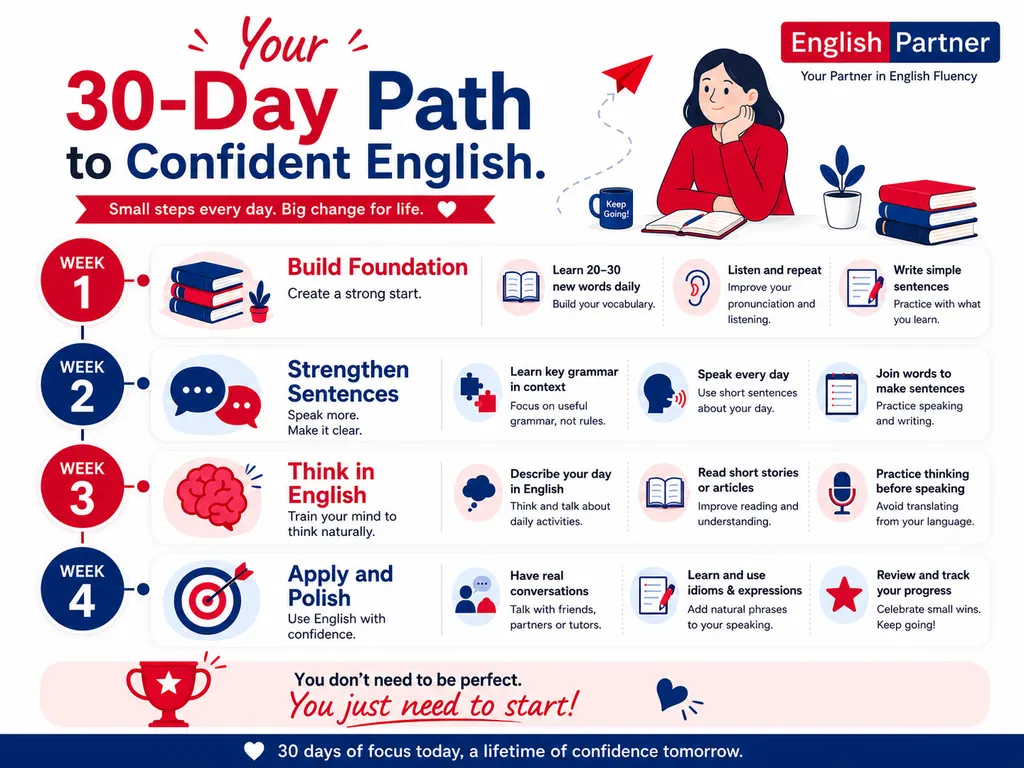
Common Mistakes to Avoid During Your 30 Days
Even with a great plan, certain habits can slow you down. Watch out for these.
Comparing yourself to others. Your starting point is unique. Focus on your own progress, not someone else’s.
Skipping speaking practice. This is the most important skill, yet most learners avoid it. Speak even if it feels uncomfortable.
Using translation apps too much. Try to understand English in English. Use translation only when truly stuck.
Studying long hours on some days and zero on others. Thirty minutes daily beats three hours once a week.
Expecting perfection. Mistakes are part of learning. Every error you make is a step toward fluency.
What to Expect After 30 Days
By the end of 30 days of honest practice, you should notice clear improvements in these areas:
- You can introduce yourself and talk about your background fluently
- You understand most everyday conversations
- You can ask and answer common questions without freezing
- Your vocabulary has grown by 150 to 300 new words
- Your fear of speaking has reduced significantly
You will not sound like a native speaker yet. That takes years. But you will sound like someone who can communicate clearly and confidently in English.
Results may vary based on your starting level, how regularly you practice, and how willing you are to step outside your comfort zone.
When Self-Study Is Not Enough
Self-study works well for many learners, especially in the early stages. But there comes a point when you need guided support to move forward.
You may need structured learning if:
- You have practiced for weeks but feel stuck at the same level
- You cannot identify your own mistakes
- You need to prepare for interviews, exams, or workplace communication
- You lack a regular speaking partner
A proper assessment with a trained mentor can help you understand exactly which areas to focus on.
Structured online spoken english course programmes provide real-time feedback, correction, and consistent speaking practice, which is hard to get on your own.
Frequently asked questions
Is it really possible to learn English in 30 days?
You cannot become completely fluent in 30 days, but you can make significant progress in confidence, vocabulary, and basic conversation skills with daily practice.
How many hours per day should I study English?
Around 60 to 90 minutes per day is ideal. If you can only manage 45 minutes, consistency matters more than the exact duration.
Can I learn English without a teacher?
Yes, especially in the early stages. However, for faster progress and proper correction, guided learning with a mentor or course often helps.
What is the fastest way to improve English speaking?
Daily speaking practice, even alone, combined with the shadowing technique and real conversations is the fastest path to improvement.
Should I focus on grammar or speaking first?
Focus on speaking first. Basic grammar comes naturally as you speak more. Deep grammar study can come later.
How do I stop translating from my mother tongue?
Practice describing everyday things directly in English. Watch English content with English subtitles. Over time, your brain will start thinking in English
Will watching English movies make me fluent?
Movies help with listening and vocabulary, but they will not make you fluent alone. You must also practice speaking actively.
What if I miss a day in the 30-day plan?
Do not give up. Just continue the next day. Missing one day is normal. Missing one week is a problem. Be kind to yourself but stay consistent.