English Pronunciation for Telugu Speakers: The 6 Habits to Fix
 Dhinesh Kumar
Content Writer
Published
Time to read
8 minutes
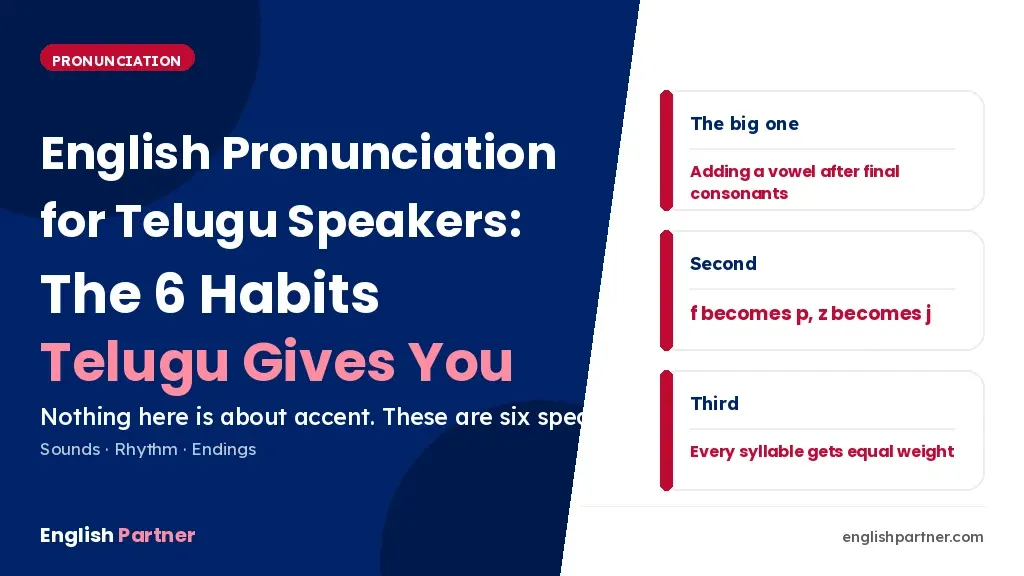
Quick answer: Six habits, in order of how much they affect being understood: the extra vowel after final consonants (“friend-u”), f becoming p, z becoming j, short and long vowels merging, th becoming a retroflex t or d, and equal stress on every syllable. Each has a physical fix below.
English pronunciation for Telugu speakers is a muscle habit, not an accent problem
Almost everyone who searches for this is looking for the same thing: a way to stop being asked to repeat themselves on calls. That is a clarity problem, and clarity is fixable. An accent is not a problem at all.
Here is what is actually happening. Telugu gave your mouth a set of rules in your first few years, and those rules run automatically. English needs some different ones. Nobody ever told you which ones, so your mouth kept using the Telugu set. That is the whole story.
Six habits do nearly all the damage. Fix the first one alone and most listeners will notice the difference.
Habit 1: the vowel you add at the end
This is the big one, and almost nobody knows they are doing it.
Telugu words overwhelmingly end in a vowel sound. పుస్తకం, ఇల్లు, మంచి. Your mouth is built to close a word with a vowel. So English words that end in a bare consonant feel incomplete, and your mouth helpfully adds one.
- friend → friend-u
- bus → bus-su
- doubt → doubt-u
- book → book-u
The fix is physical, not mental. Say the word and stop your mouth at the last consonant. For friend, your tongue touches the roof of your mouth for the d and stays there. Do not release it into a vowel. It will feel like you cut the word off too early. That feeling is correct — that is what English sounds like.
Practise with words ending in d, t, k, p, g and s. Ten words, twice a day, for two weeks. This one habit is worth more than the other five combined.
Habit 2: f turns into p
Telugu's ఫ is an aspirated p — your lips press together and release with a puff of air. English f is nothing like it. Your top teeth touch your lower lip and you push air through the gap. The lips never meet.
So file becomes pile, food becomes pood, coffee becomes copy. In an office, “send me the file” and “send me the pile” are a genuine misunderstanding, not a small one.
Put a finger lightly on your lower lip and say fan. If your finger gets pushed by your top teeth, you have it. If your lips close, you are still saying pan.
Habit 3: z turns into j
Telugu has no z. The nearest sound your brain reaches for is j, so zero becomes jero and zoo becomes Jew.
The fix takes about ten seconds to learn. Say a long sssss. Now, without moving your tongue or lips at all, switch your voice on. The hiss becomes a buzz. That buzz is z.
Worth knowing: this one matters more than it looks, because z appears at the end of most English plurals. Jobs, cars, dogs, files — all of those end in a z sound, not an s sound.
Habits 4 and 5: vowel length and the th sounds
Vowel length is the one where Telugu is already helping you and you are not using it. Telugu distinguishes short and long vowels clearly — అ and ఆ, ఇ and ఈ. English does the same, but in English the pairs sit closer together, so learners flatten them into one.
Ship and sheep. Full and fool. Bit and beat. Hold the long one roughly twice as long as the short one, and the difference becomes obvious to the listener immediately.
The th sounds — there are two, and both need your tongue tip between your teeth, which no Telugu sound requires. In thin, three and month, there is no voice, just air. In this, that and mother, your voice is on.
Say them in front of a mirror. If you cannot see the tip of your tongue, you are producing a retroflex t or d instead, and thin is coming out as tin.
Habit 6: the rhythm, which matters more than any single sound
This is the one almost no pronunciation guide covers, and it affects how you sound more than f or z ever will.
Telugu is syllable-timed. Every syllable gets roughly the same amount of time, which is part of what makes spoken Telugu sound even and musical. English is stress-timed: one syllable in each word is longer and louder, and the others get squeezed short.
- important → im-POR-tant, not im-por-tant
- everybody → EV-ry-body, and the second syllable nearly vanishes
- comfortable → COMF-ta-ble, three syllables, not four
When every syllable gets equal weight, English sounds flat and strangely fast to a listener, and they lose the shape of the word. Stressing one syllable per word is the single change that makes people stop asking you to repeat.
Practise with long words: opportunity, necessary, interesting, development, particular. Find the strong syllable, make it clearly longer, and let the rest shrink.
Why your ear changes last
There is a stage in this that feels like failure and is not. For the first few weeks you will fix a sound while concentrating, then lose it the moment you speak naturally.
That is the expected order. Your mouth learns before your ear does, because your brain plays you the sound you intended, not the one you made. This is why recording yourself matters — a recording is the only way to hear what the listener hears.
Record thirty seconds today. Do not analyse it. Put it aside, work through the plan, and listen to both at the end of week six.
What actually matters at work
If you are prioritising, this is the honest order for a call-heavy job:
- Final consonants — the extra vowel is the single clearest marker
- Word stress — it is what makes people ask you to repeat
- f and z — these create real misunderstandings, not just an accent
- Vowel length — matters for specific words, less for overall clarity
- th — honestly the least important of the six for being understood
Most learners work on th first because it is the famous one. It belongs last.
If you want the phonetic detail behind these sounds, the British Council has free pronunciation resources with audio for each one.
Your 6-week plan
Ten minutes a day, in front of a mirror, out loud. Reading about mouth positions does nothing — this is entirely a physical practice.
When self-practice is not enough
Pronunciation has a problem no other part of English has: you cannot hear your own mistake. Your brain replays your intention, not your output. Recordings help, but only after someone has told you what to listen for.
That is what a trainer does here — names the exact sound, shows the mouth position, and catches it the next time it slips, explained in Telugu first. Learners can join our spoken English classes in Coimbatore, our spoken English classes in Chennai, or our spoken English classes in Pondicherry.
Final thoughts and your next step
You do not have a pronunciation problem. You have six habits, each with a physical fix, and the biggest one is a vowel you have been adding without ever noticing it.
Start today with the final consonants. Ten words ending in d, t and k, said out loud, stopping your mouth at the consonant. Two weeks of that and the people on your calls will hear the difference before you do.