English Pronunciation for Tamil Speakers: The 8 Sounds That Give You Away
 Dhinesh Kumar
Content Writer
Published
Time to read
9 minutes
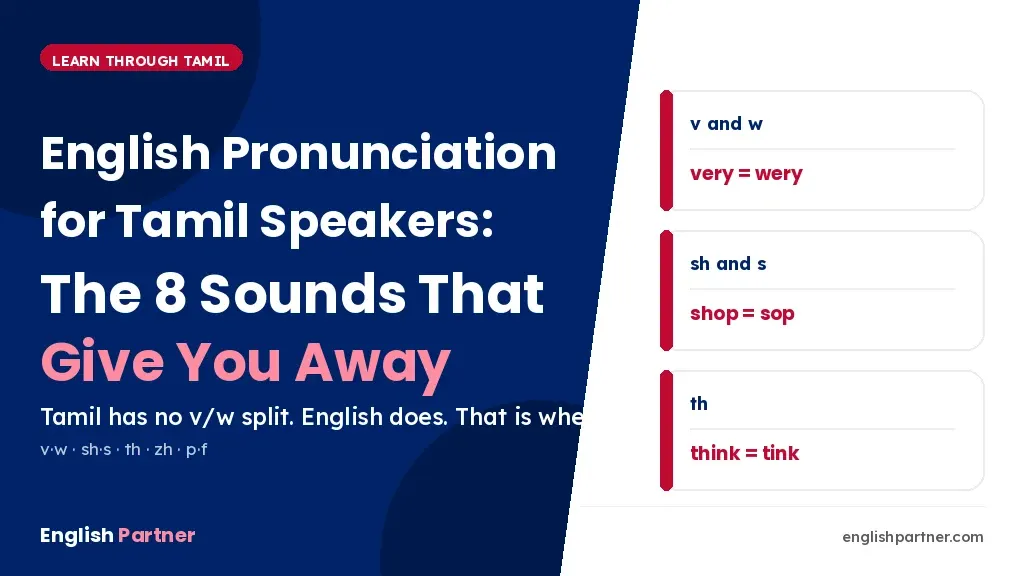
Quick answer: Tamil does not have a separate v and w, no sh, no th, no z and no f. Your mouth has never been asked to make those shapes. Each one has a physical fix — where the tongue sits, where the teeth go — and one week of daily practice per sound. All eight are below.
This is not an accent problem
People call it an accent, which makes it sound permanent and a bit shameful. It is neither.
Tamil has around eighteen consonant sounds. English has roughly twenty-four. The ones English has and Tamil does not were never practised by your mouth, because no Tamil word ever required them. That is the whole story.
So this is a muscle problem, not a talent problem. Your tongue has a habit, and habits are changed by moving the tongue somewhere else, repeatedly, until the new position feels normal. Adults do this perfectly well — often faster than children, because an adult can be told precisely where to put the tongue and will actually follow the instruction.
English pronunciation for Tamil speakers: the 8 sounds
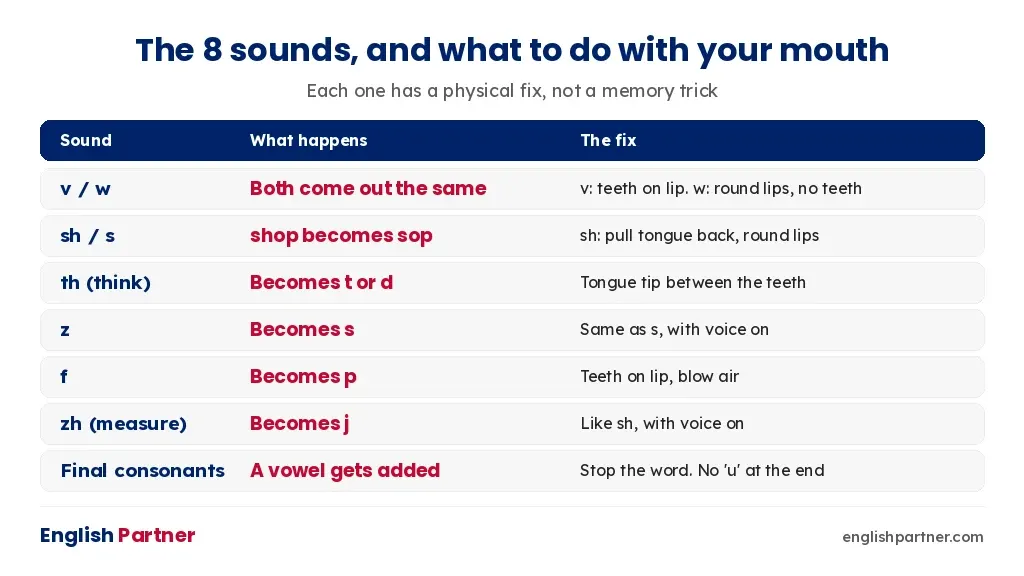
Read the third column, not the second. Knowing that you confuse v and w changes nothing. Knowing that v needs your top teeth on your lower lip changes everything.
The v and w split, in detail
This is the one that gives Tamil speakers away fastest, so it is worth doing properly before anything else.
For v: top teeth rest lightly on the lower lip. Push air through. You should feel a buzz on the lip. very, van, vote, five, love.
For w: lips round into a small circle, teeth nowhere near the lip. water, well, want, we, would.
Put a finger on your lower lip and say very, then water. If your finger feels your teeth both times, the w is wrong. If it feels them neither time, the v is wrong.
| Tamil | English |
|---|---|
| தண்ணி வேணும் | I want water. (w, w) |
| ரொம்ப நல்லா இருக்கு | It is very good. (v) |
| அஞ்சு நிமிஷம் காத்திருங்க | Wait five minutes. (w, v) |
| நாங்க வெள்ளிக்கிழமை போறோம் | We leave on Friday. (w, F) |
Three rules that fix most of it
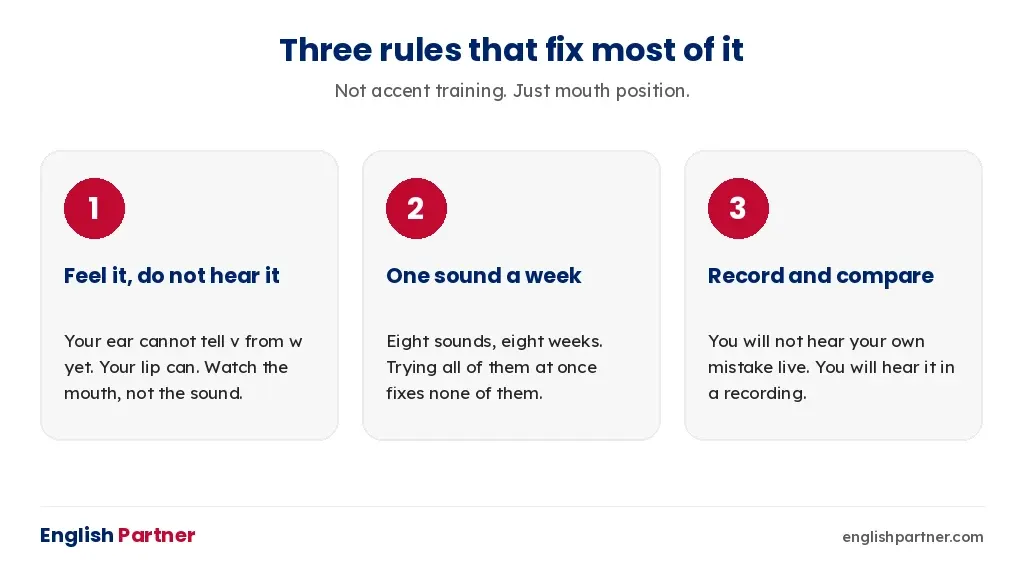
1. Feel it, do not listen for it. Your ear cannot yet tell v from w — that is exactly why they come out the same. Your lip can tell. Use a mirror and watch your mouth instead of straining to hear a difference you cannot detect yet.
2. One sound a week. Eight sounds, eight weeks. People who attack all eight at once fix none of them, because no single habit gets enough repetition to replace the old one.
3. Record and compare. You will not catch your own mistake while speaking — your brain hears what you intended. Play it back and you will hear it immediately.
Word pairs that sound identical to you right now
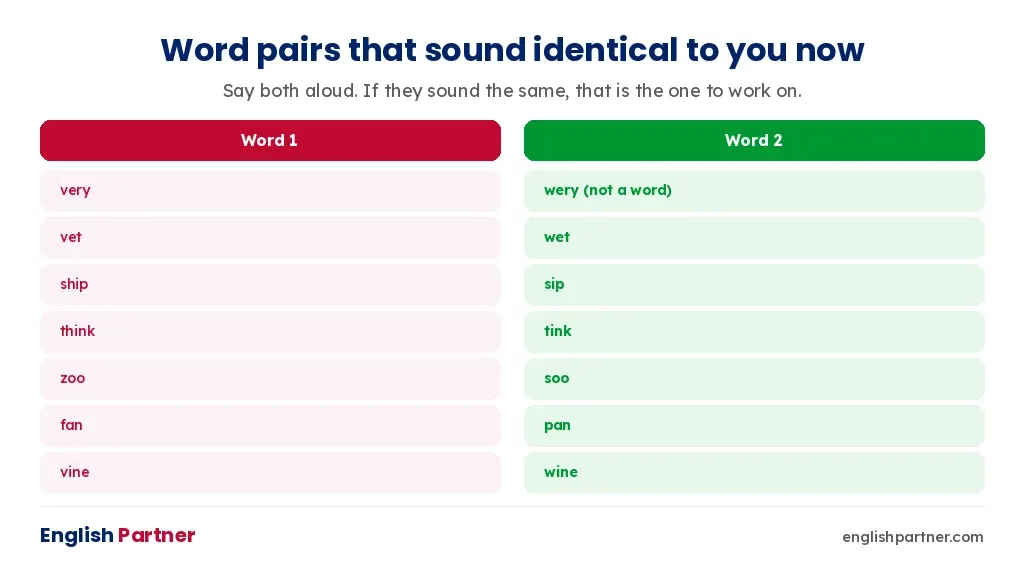
Say each pair aloud, slowly. If the two words come out sounding the same, that sound belongs on your list.
| Pair | What separates them |
|---|---|
| very / wery | teeth on lip vs rounded lips |
| ship / sip | tongue pulled back vs forward |
| think / tink | tongue between teeth vs behind them |
| zoo / Sue | voice on vs voice off |
| fan / pan | air through teeth vs lips popping |
| vest / west | teeth on lip vs rounded lips |
Record yourself saying all six pairs today. Keep the file. You will use it again in week eight.
The th sound, which has two versions
Worth separating out, because most learners only learn one of them and then use it everywhere.
Soft th — no voice, just air. think, three, thank, bath, month. Tongue tip lightly between the teeth, blow.
Hard th — same tongue position, voice on. this, that, they, mother, brother.
Both feel strange at first because no Tamil sound puts the tongue outside the teeth. It will feel exaggerated for about a week and then stop feeling like anything at all.
Why your ear is the last thing to catch up
There is a reason this feels harder than grammar, and knowing it saves a lot of frustration.
By about the age of one, a baby's brain stops treating every sound in the world as meaningful and keeps only the ones its own language uses. Tamil never used a separate v and w, so your brain filed them as one sound and stopped listening for the difference. That filter is still running today.
This is why people can repeat a word after a trainer ten times and still not hear that their version is different. The ear is not being careless — it has been trained for decades to ignore exactly that distinction.
The way around it is to stop relying on your ear in the early weeks. Use your eyes in a mirror and your fingers on your lip. Those give you information your ear cannot. Once the mouth starts producing the sound correctly, the ear catches up on its own, usually in two or three weeks.
What actually matters at work
Worth saying plainly, because a lot of pronunciation advice sets the wrong target.
Nobody at an interview, on a client call or at a counter is judging whether you sound British. What costs you is having to repeat yourself — the second attempt makes you sound uncertain even when you are not, and after two repeats people start simplifying their English for you, which is worse.
Fix the eight sounds and the repeats stop. That is the whole practical goal. Everything beyond it is preference, not clarity.
3 habits that carry straight over from Tamil
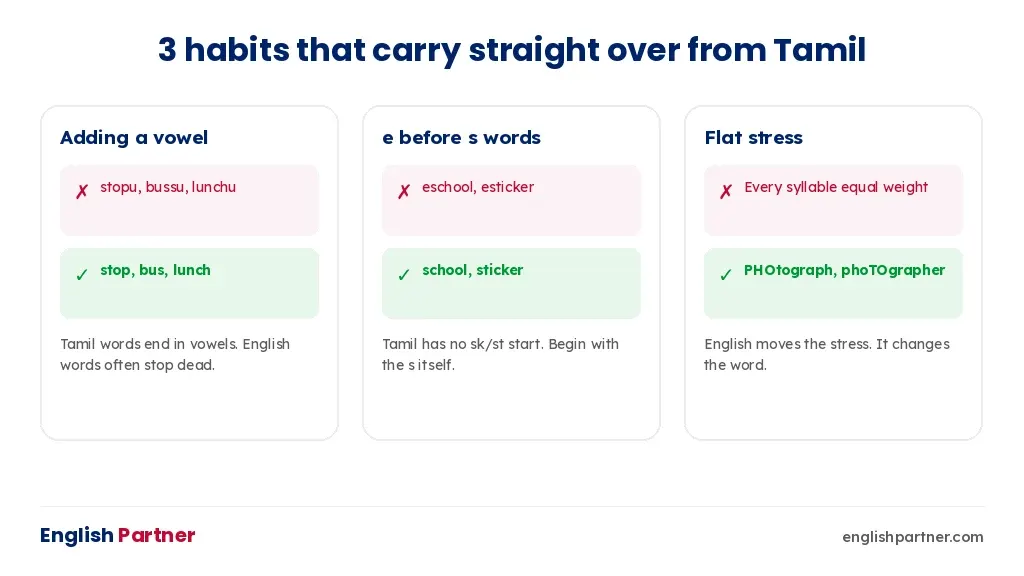
Habit 1 – adding a vowel at the end. Stopu, bussu, lunchu. Tamil words end in vowels, so your mouth supplies one automatically. The fix is to end the word and close your mouth — nothing after the final consonant.
Habit 2 – an e before s-clusters. Eschool, esticker, estation. Tamil has no word beginning with sk or st, so a vowel gets inserted to make it sayable. Start with the s itself, hold it for a moment, then continue.
Habit 3 – flat stress. Tamil gives each syllable fairly equal weight. English moves the stress around, and moving it changes the word: PHOtograph, phoTOgrapher, photoGRAPHic. Same root, three different shapes.
Stress matters more than people expect. A correct sound with the wrong stress is often harder to follow than a slightly wrong sound with the right stress. The British Council covers the same point in its pronunciation material.
Your 8-week plan
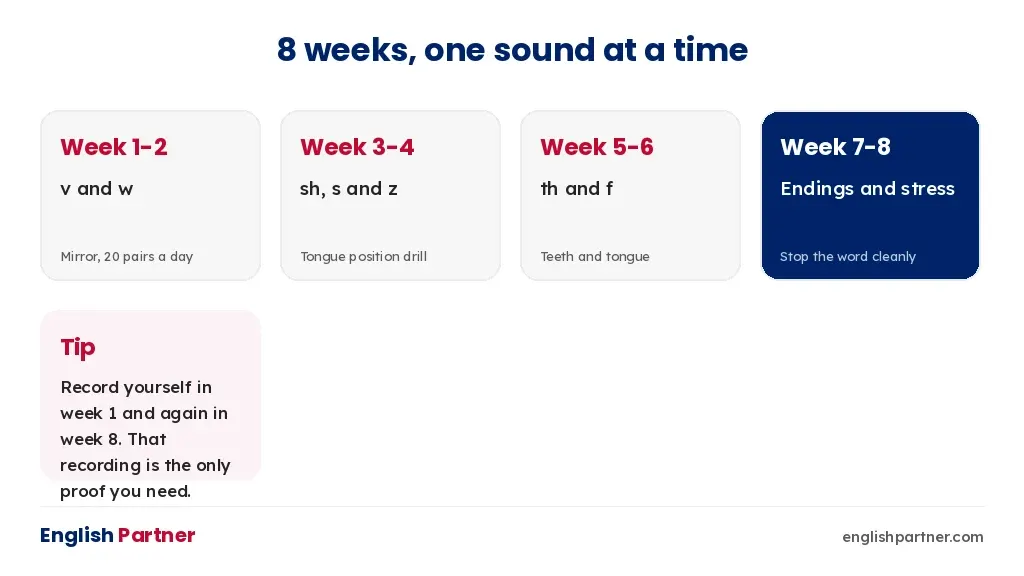
Weeks 1–2: v and w. Mirror, finger on lip, twenty word pairs a day.
Weeks 3–4: sh, s and z. All three are tongue-position changes you can see.
Weeks 5–6: th and f. Teeth and tongue, both versions of th.
Weeks 7–8: word endings and stress. Stop the word cleanly, then work on which syllable carries the weight.
Ten minutes a day is enough. This is muscle training, and muscles respond to frequency, not to long sessions.
When self-practice is not enough
Pronunciation has one problem no other part of English has: you cannot hear your own mistake. Your brain plays you the sound you intended, not the one you made. Recordings help, but only after someone has told you what to listen for.
That is what a trainer does here — names the exact sound, shows the mouth position, and catches it the next time it slips. Learners can join our spoken English classes in Coimbatore, our spoken English classes in Chennai, or our spoken English classes in Pondicherry.
Final thoughts and your next step
Eight sounds, each with a mouth position you can learn. The goal is not to sound British or American — it is for people to understand you the first time, every time.
Tonight, put a finger on your lower lip and say very, water, vest, west ten times each. That is week one started, and it is the sound that changes the most.
Want someone to tell you which sounds are costing you most? Send “Hi” on WhatsApp for a free five-minute level test in Tamil.