English for TNPSC, Bank and SSC: What Each Exam Actually Tests
 Dhinesh Kumar
Content Writer
Published
Time to read
9 minutes
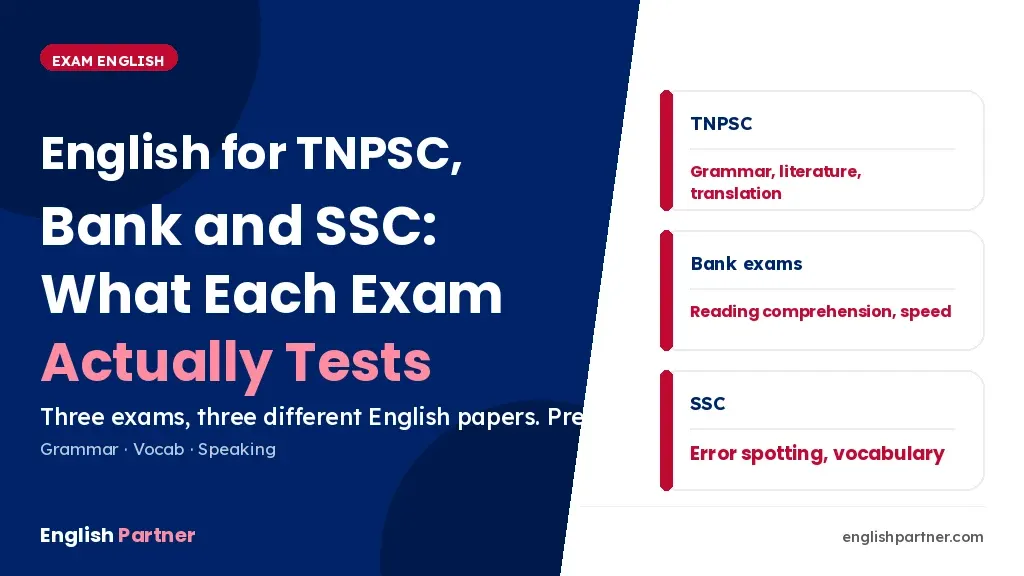
Quick answer: TNPSC tests detailed grammar, literature-linked vocabulary and Tamil-to-English translation. Bank exams are dominated by timed reading comprehension, cloze and para jumbles. SSC leans on error spotting, synonyms and idioms. The grammar base is shared — the papers are not.
English for competitive exams: why aspirants plateau
Most aspirants in Tamil Nadu prepare for English the same way regardless of which exam they are writing: buy a grammar book, read it front to back, memorise a word list, attempt mock papers.
It works up to a point and then stops, usually at the same mark for months. The reason is that the three exam families test genuinely different things, and general preparation improves all three slightly instead of improving one decisively.
Worth saying plainly before anything else: if your schooling was in Tamil medium, that is not a disadvantage in this paper. Nearly every successful candidate in this state came through Tamil medium. What matters is whether the rule was explained to you in a language you fully understood.
What each exam actually tests
Three practical conclusions from that table.
If you are writing TNPSC, translation and the descriptive paper are yours to win. They are skippable in the other exams, which means most shared study material under-prepares you for them.
If you are writing bank exams, your bottleneck is almost certainly time, not knowledge. Candidates who can answer every comprehension question correctly still lose marks because they could not reach the last passage.
If you are writing SSC, error spotting and vocabulary carry the section. These are the most learnable parts of English, which is good news — they reward pattern recognition rather than fluency.
The ten error-spotting patterns that repeat
This is the highest-return section in the whole paper, because the same structures appear year after year. Learn these ten and you will recognise most questions on sight.
| Pattern | Wrong | Correct |
|---|---|---|
| One of + plural noun | One of my friend is coming | One of my friends is coming |
| Senior / junior take "to" | He is senior than me | He is senior to me |
| Discuss takes no preposition | Discuss about the issue | Discuss the issue |
| Each / every take singular | Each of the boys are ready | Each of the boys is ready |
| Comparative with "than" | More better than this | Better than this |
| Article before vowel sound | A hour, an university | An hour, a university |
| Since / for | Since five years | For five years |
| Hardly / scarcely take "when" | Hardly had I reached than | Hardly had I reached when |
| No sooner takes "than" | No sooner I reached when | No sooner had I reached than |
| Cope / comprise | Cope up with, comprise of | Cope with, comprise |
Two weeks on this table is worth more than two months of general reading, and that is not an exaggeration — it is simply where the marks are concentrated relative to the hours required.
Reading comprehension, which is really a timing test
Bank aspirants lose more marks here than anywhere else, and almost never because the passage was too difficult.
Four changes that work:
- Read the questions first. You are hunting for specific information, not studying the topic.
- Practise with a clock from day one. Untimed practice builds a habit you cannot use in the hall.
- Mark where each answer sits as you read, rather than finishing and then searching backwards.
- Leave the inference questions for last. Fact questions are faster and worth the same mark.
The mental switch that matters: during practice you are not reading to understand the passage. You are reading to locate answers. Those are different activities, and only one of them is being tested.
Vocabulary that survives exam pressure
Almost every aspirant has downloaded a thousand-word list. Almost none of those words show up when needed, because a word memorised in isolation has nothing to attach to.
What works instead: twenty words a week, each written into three of your own sentences. Sixty sentences a week, about your own life, your own district, your own preparation. Slower on paper, and vastly more of it stays.
For TNPSC specifically, link vocabulary to the literature portion rather than treating them as separate subjects — the overlap is real and studying them together halves the work.
The round that decides the final list
This is the part this article exists for, and it is the part most aspirants postpone.
Once the written results are out, candidates near the cut-off are separated by the interview. By then there are four to six weeks left — and spoken confidence is a muscle that does not build in four weeks, particularly for someone who has spent two years reading English silently without speaking a sentence of it.
What the panel is assessing is not vocabulary. It is whether you can hold a position, answer a follow-up you did not expect, and stay composed when challenged. Three things to start now, not later:
- Answer out loud, not in your head. Reading a model answer is not practice. Saying it is.
- Record yourself weekly. You cannot hear your own hesitation live, only in a recording.
- Practise the follow-up. “Why do you think so?” is the question that separates candidates, and it is unrehearsable alone.
For current exam patterns and official syllabi, always check the commission's own notification — the TNPSC official website publishes the syllabus and any changes for each notification.
Cloze tests and para jumbles
These two appear in every bank and SSC paper and almost never in TNPSC, and both are pattern work rather than knowledge.
Cloze test. The blank is usually testing one of four things: a preposition after a specific verb, a connector (however, therefore, although), a collocation (take a decision, make an effort), or a tense that has to agree with the rest of the paragraph. Identify which of the four before looking at the options, and two of the four choices usually eliminate themselves.
Para jumbles. Find the opening sentence first — it introduces a subject by full name rather than by a pronoun. Then follow the pronouns: a sentence starting with this, these, it, such or he must come after the sentence that named the thing. Chain two pairs confidently and the rest usually falls into place.
Neither rewards reading more. Both reward doing thirty of them and noticing what repeats.
The descriptive paper
TNPSC, SBI and several SSC posts include a written paper, and it is marked by a human — which changes the strategy completely. Structure and clarity earn more than vocabulary.
| Part | What to do |
|---|---|
| Essay opening | Define the topic in one line, then state what the essay will argue. No long introduction. |
| Essay body | Three paragraphs, one idea each, each with an example. Examples from India score better than abstract ones. |
| Essay close | A balanced conclusion, not a slogan. Acknowledge the other side in one sentence. |
| Letter format | Follow the prescribed format exactly — marks are allotted to it. Content errors cost less than format errors here. |
| Precis | Roughly one third of the original, your own words, no examples, no opinions. |
| Handwriting | Legible beats elegant. An examiner who cannot read a line cannot award it. |
One practical note: write with simple sentences you fully control. A complex sentence that collapses halfway costs more marks than a plain one that lands. Examiners are marking clarity, not ambition.
3 habits that cost marks
The third one is the expensive one. A candidate with a strong written mark and a weak interview loses to a candidate who scored slightly lower and spoke well. That trade happens in every list, every year.
Your 8-week plan
One hour a day on English is enough — if it is spent on the section that is actually costing you marks. Most aspirants spend that hour on the part they already find comfortable, which is why the score does not move.
When self-practice is not enough
Grammar rules and error-spotting patterns you can learn from a book and from this page. What you cannot build alone is the interview round, because its entire difficulty is the question you did not prepare for.
Live mock rounds with a trainer build exactly that — unexpected follow-ups, pressure, and feedback in Tamil straight afterwards so the correction actually lands. Learners can join our spoken English classes in Coimbatore, our spoken English classes in Chennai, or our spoken English classes in Pondicherry.
Final thoughts and your next step
Find out which paper you are actually writing, then prepare for that one. Error spotting first, reading speed second, vocabulary in context third, and spoken practice running alongside all of it rather than after it.
This week, take the ten-pattern table above and write five sentences for each pattern — correct versions, in your own words. Fifty sentences, one sitting. That is the fastest fifty marks available to you in this paper.