English for BPO and Voice Process Jobs: The Rounds and What Each Tests
 Dhinesh Kumar
Content Writer
Published
Time to read
9 minutes
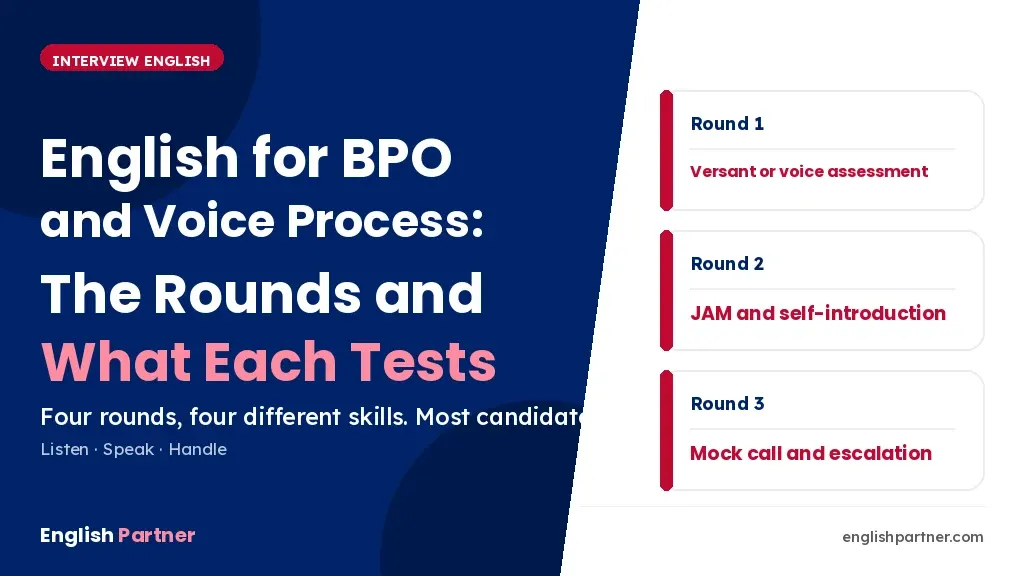
Quick answer: Four rounds. A versant or voice assessment (clarity and listening), an HR round (self-introduction), a JAM round (speak for one minute without stopping), and a mock call (composure with a difficult customer). The phrases for each are below.
English for BPO interviews: what is actually being scored
The common assumption is that a voice process wants perfect English and an American accent. Neither is true, and believing it makes people prepare for the wrong thing.
What is scored is narrower and more practical: can a stranger on a phone line understand you the first time? That is clarity, not accent. A candidate with a clear Tamil accent and crisp word endings outperforms one with a strained American accent and swallowed consonants, every time.
The second thing scored is continuity — can you keep speaking without long gaps. And the third is composure — do you stay level when the person on the line is not.
None of those three is vocabulary. All three are trainable in weeks.
Round 1: the versant or voice assessment
An automated test, usually over a phone or a computer. It plays sentences for you to repeat, asks short questions, and scores pronunciation, fluency, sentence construction and listening.
Four things that move the score:
- Finish your word endings. The system hears “friend” and “friend-u” differently, and consonant endings are where most Indian candidates lose points.
- Speak at a normal pace. Rushing to sound fluent produces slurring, which the system penalises hard.
- Answer in full sentences. One-word answers score lower even when correct.
- Do not pause to plan. The scoring includes response latency. Start speaking, then think.
It is a machine, so it is also consistent — which means practice genuinely improves the score rather than depending on who is listening.
Round 2: self-introduction
Sixty seconds, four parts, and it should sound spoken rather than recited. A memorised paragraph is audible within about five words.
- Who and where. “I'm Arun, from Coimbatore.”
- Education or last role. “I finished my B.Com last year and worked six months at a retail showroom handling customer queries.”
- One strength, with a real example. “I'm comfortable handling people who are upset — at the showroom I dealt with returns and billing complaints daily.”
- Why this role. “I want to build on that in a proper voice process where there's structure and training.”
One strength with evidence beats three adjectives without any. “I'm a hard worker, dedicated and a good team player” gives the interviewer nothing to believe.
Round 3: the JAM round
Just A Minute. A topic is given, and you speak for sixty seconds without long pauses. Typical topics are deliberately ordinary — my favourite festival, social media, my hometown, work from home, my first job.
The panel is not testing what you know. It is testing whether you stop.
Three techniques that fill a minute reliably:
- Split the topic in two. “There are two sides to this — the convenience and the cost. Taking the convenience first…” That sentence alone buys you ten seconds and a structure.
- Use your own example. “In my own house, for instance…” You can always talk about your own life, and it is more interesting than a general claim.
- Never stop to find a better word. Use the simple one and keep moving. The score drops for silence, not for simplicity.
Round 4: the mock call
This is the round that decides it, and it always includes a customer who is annoyed about something.
The structure of a well-handled call is fixed, and knowing it is most of the preparation:
Open properly. “Thank you for calling, my name is Arun. How may I help you today?”
Let them finish. Do not interrupt an angry customer. Let the complaint land, then acknowledge it once: “I understand, and I'm sorry about that.” Once — not four times.
Move to what you can do. This is the single most important move in the round. Never leave a no sitting on its own. “Unfortunately I can't reverse the charge from here. What I can do is raise it for you right away — would that help?”
Hold properly. Ask before putting someone on hold, and thank them when you come back. “May I put you on hold for a moment while I check? … Thank you for holding.”
Confirm before closing. “Just to confirm, I've updated your address to the new one, and you'll get an SMS within an hour. Is there anything else I can help you with today?”
The two sentences that carry the whole call
If you memorise nothing else from this page, memorise these.
“Let me check that and come back to you in a moment.” This replaces “I don't know”, which is the fastest way to fail a mock call. Not knowing is fine and happens on every real call. Leaving the caller with nothing is what fails.
“What I can do is…” This replaces a flat no. Every refusal in customer service should be followed by an alternative, even a small one. A caller who cannot get what they asked for will usually accept something, and the panel is specifically watching for whether you offer it.
Clarity, and what it actually means
Three fixable habits cover most clarity problems on a line:
- Word endings. Account, confirm, request, update — the final consonant has to land. On a phone line a swallowed ending is simply lost.
- Pace. Slightly slower than your normal conversation speed. Not slow — just not rushed.
- Numbers. Say them in pairs and confirm: “That's four-four-two, eight-nine. Is that right?” Account numbers are where calls go wrong most.
For free listening practice with varied accents, which is the part most candidates under-prepare, the British Council publishes graded audio material.
The HR questions that come up every time
Between the voice test and the mock call sits a short HR round. The questions barely change, and the answers below are the shape rather than the script.
| Question | What they are checking | Shape of a good answer |
|---|---|---|
| Tell me about yourself | Fluency and structure | Who, education or last role, one strength with proof, why this job |
| Are you comfortable with night shifts? | Whether you will stay | Yes, with a concrete reason — travel sorted, family aware |
| Why do you want to work in a BPO? | Genuine interest, not desperation | Communication skills, structured training, growth into team lead |
| How would you handle an angry customer? | Composure | Listen fully, acknowledge once, move to what you can do |
| Where do you see yourself in two years? | Retention | Within the same company — senior agent, quality, team lead |
| Why should we hire you? | Self-awareness | One relevant strength with a real example, not a list of adjectives |
The night-shift question deserves care, because a hesitant yes reads as a no. If you are willing, say so cleanly and attach the practical detail: "Yes — I've checked the cab route and my family is fine with it." That one added clause does more than any amount of enthusiasm.
Listening, the half nobody practises
Every candidate practises speaking. Almost none practise listening, and on a real line that is the harder half — a caller speaking fast in an accent you have not heard before, with background noise.
Three things that help:
- Listen to varied accents daily. American, British, Australian, Filipino. Fifteen minutes, podcasts or support calls on YouTube.
- Practise the repeat request. "I'm sorry, could you repeat that for me, please?" said calmly is completely professional. Guessing what was said is what causes a bad call.
- Confirm back what you heard. "So the charge appeared on the 14th and you haven't used the card since — is that right?" This catches a misunderstanding before you act on it, and panels mark it.
That last habit is the one experienced agents use constantly and new candidates almost never do.
3 mistakes that end an interview early
The second one is the most common and the most counter-productive. Candidates speed up because they believe fast English sounds fluent. On a phone line it sounds unclear, and unclear is the one thing a voice process cannot hire.
Your 5-day plan
Record every single round. In a voice process the recording is literally the thing being judged — the interview should not be the first time you have heard how you sound on a line.
When self-practice is not enough
You can memorise all twenty phrases this week. What you cannot practise alone is the moment the customer interrupts your sentence, or asks something the script does not cover, and you have four seconds to respond without going quiet.
Live mock calls with a trainer build exactly that — real interruptions, an actually difficult customer, and feedback in your mother tongue immediately afterwards. Learners can join our spoken English classes in Coimbatore, our spoken English classes in Chennai, or our spoken English classes in Pondicherry.
Final thoughts and your next step
Clarity over accent, continuity over vocabulary, composure over scripting. Four rounds, and each one is trainable.
Today, record a sixty-second self-introduction on your phone and listen to it once. You will hear two things you want to fix immediately — and fixing those two is a real step, taken in ten minutes.