If-Clauses: Conditional Sentences Types 0–3 with Daily Examples
 Dhinesh Kumar
Content Writer
Published
Time to read
9 minutes
Dhinesh Kumar
Content Writer
Published
Time to read
9 minutes
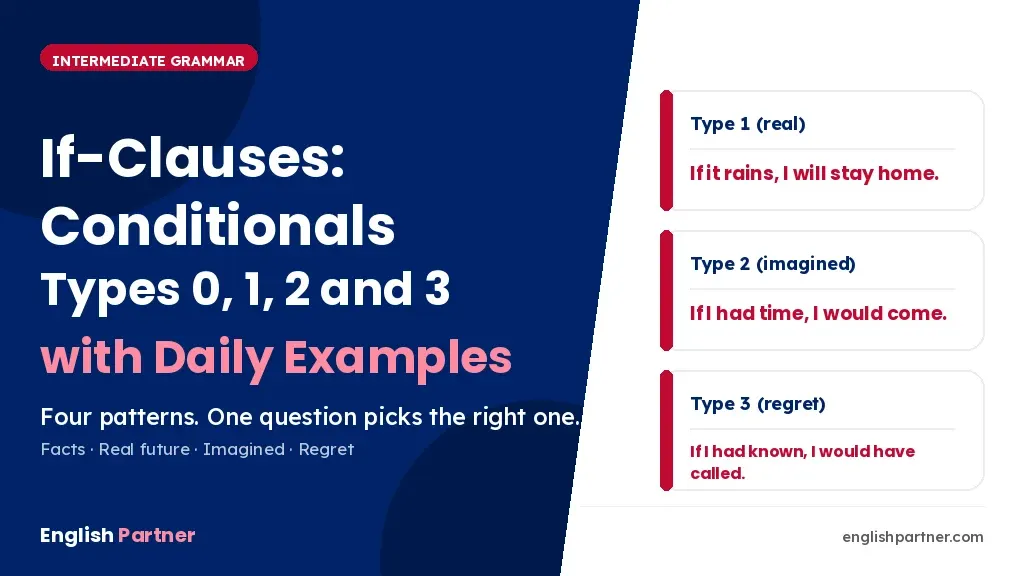
Quick answer: Four patterns cover every if-sentence. Type 0 for facts, Type 1 for something that may really happen, Type 2 for something imagined, Type 3 for a past you cannot change. One question picks the type, and the pattern after that is fixed. Chart, examples and the three common slips are below.
Why if-sentences feel harder than they are
Most learners were taught conditionals as four grammar formulas to memorise, usually the week before an exam. The formulas get learned, and then in conversation the wrong one comes out – or the sentence stalls halfway.
The reason is that the formula is the second step, not the first. Before you can pick a pattern you have to decide what you actually mean: is this a fact, a real plan, a daydream, or a regret? Tamil, Telugu and Hindi handle all four with roughly one construction, so the mother tongue gives no signal about which English shape to reach for.
Once you ask the meaning question first, the pattern follows automatically – and you stop having to recall four formulas at speed.
Conditional sentences: the four types in one chart
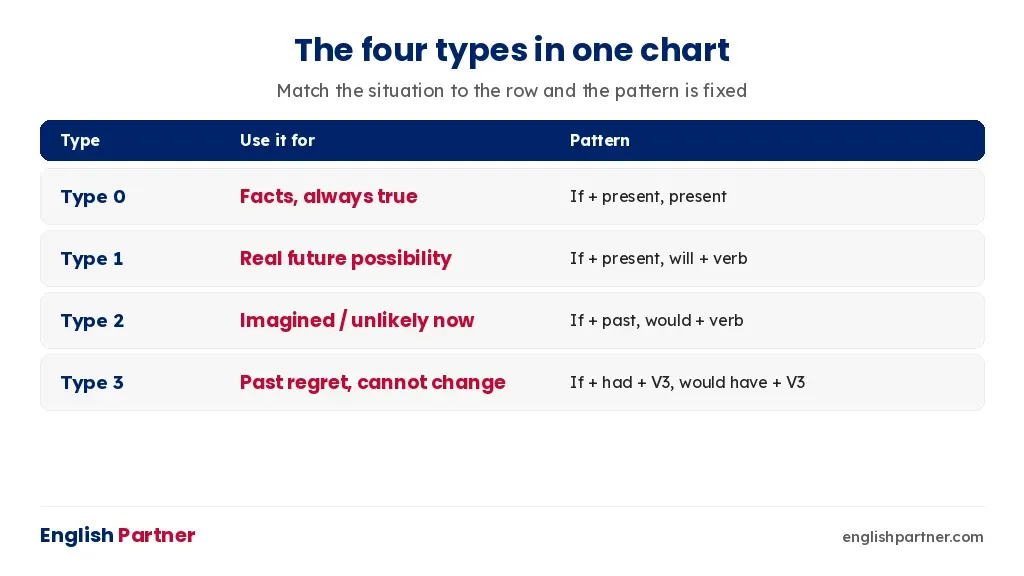
Read the middle column first, not the pattern. The situation is what you choose; the pattern is what follows.
The one question that picks the type
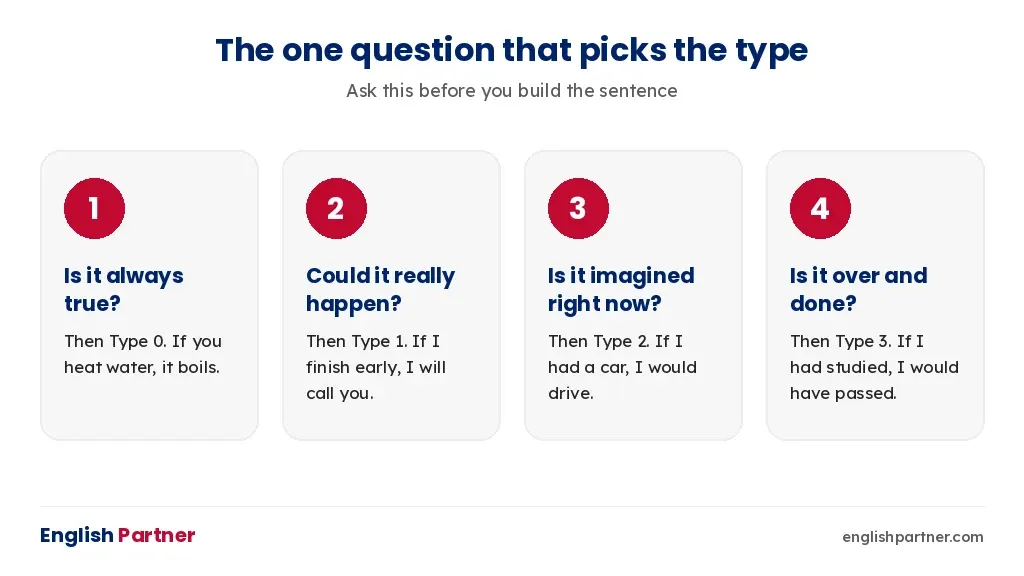
Is it always true? Then Type 0. If you heat water, it boils. If the shop closes at nine, I cannot go after work.
Could it really happen? Then Type 1. If I finish early, I will call you.
Is it imagined right now? Then Type 2. If I had a car, I would drive to work. (I do not have one.)
Is it over and done? Then Type 3. If I had studied, I would have passed. (I did not study, and that cannot change.)
Type 0 and Type 1 with Tamil meaning
Type 0 – facts and rules
| English | Tamil |
|---|---|
| If you heat water, it boils. | தண்ணிய சூடு பண்ணா கொதிக்கும். |
| If it rains, the roads get blocked. | மழை பெஞ்சா ரோடு அடைச்சிடும். |
| If I sleep late, I get a headache. | லேட்டா தூங்கினா தலைவலி வரும். |
| If the office is closed, nobody answers. | ஆபீஸ் மூடி இருந்தா யாரும் பதில் சொல்ல மாட்டாங்க. |
Type 1 – real future possibility
| English | Tamil |
|---|---|
| If I finish early, I will call you. | சீக்கிரம் முடிச்சா உன்னை கூப்பிடுறேன். |
| If it rains, I will stay at home. | மழை பெஞ்சா வீட்லயே இருப்பேன். |
| If he asks, I will tell him the truth. | அவர் கேட்டா உண்மைய சொல்லுவேன். |
| If you need help, just message me. | ஹெல்ப் வேணும்னா மெசேஜ் பண்ணு. |
| If the bus is late, I will take an auto. | பஸ் லேட்டானா ஆட்டோ புடிச்சுக்குவேன். |
Type 1 is the one you will use most. Every plan with a condition attached – at work, at home, on the phone – is a Type 1 sentence.
Type 1 vs Type 2: the pair that confuses most
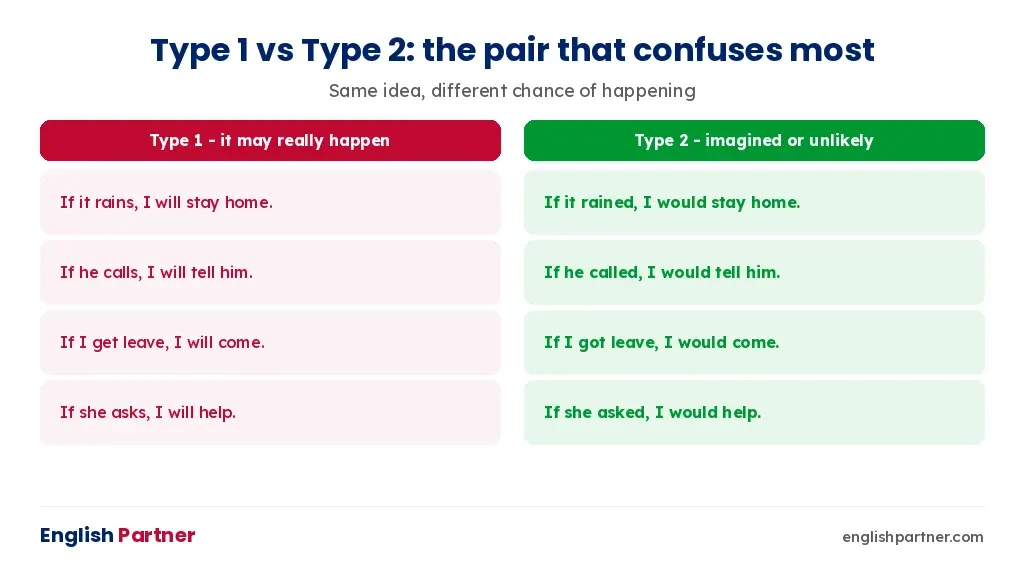
These two describe the same idea with a different level of chance. Read each pair aloud and listen to the shift.
Type 1 says the speaker thinks it may really happen. Type 2 says the speaker is imagining, or thinks it is unlikely. Neither is more correct – they are different messages.
Type 2 also does polite work that Type 1 cannot. “If you could send it today, that would help” is softer than “If you send it today, that will help.” Native speakers use Type 2 constantly for requests, and it is a large part of why some English sounds polite and some sounds blunt.
Type 2 with Tamil meaning
| English | Tamil |
|---|---|
| If I had time, I would join the class. | எனக்கு நேரம் இருந்தா கிளாஸ்ல சேருவேன். |
| If I were you, I would wait. | நான் உன்னோட இடத்துல இருந்தா காத்திருப்பேன். |
| If we had a bigger house, we would call everyone. | பெரிய வீடு இருந்தா எல்லாரையும் கூப்பிடுவோம். |
| If he spoke English, he would get the job. | அவர் ஆங்கிலம் பேசினா வேலை கிடைக்கும். |
Type 3: talking about what cannot be changed
Type 3 is for the past. The situation is finished, the outcome is known, and the sentence is about what would have been different. In conversation it does two jobs: explaining what went wrong, and apologising without excuses. “If I had known you were waiting, I would have come earlier” does more work than a plain sorry.
| English | Tamil |
|---|---|
| If I had known, I would have called you. | தெரிஞ்சிருந்தா கூப்பிட்டிருப்பேன். |
| If I had studied, I would have passed. | படிச்சிருந்தா பாஸ் பண்ணிருப்பேன். |
| If we had left early, we would not have missed it. | சீக்கிரம் கிளம்பி இருந்தா மிஸ் ஆகி இருக்காது. |
| If she had applied, she would have got the seat. | அவங்க அப்ளை பண்ணி இருந்தா சீட் கிடைச்சிருக்கும். |
Both halves change shape here: had + third form in the if-half, would have + third form in the result. If the third forms of verbs are still shaky, the V1 V2 V3 table is the thing to fix first – Type 3 is impossible without it.
Where the if-clause sits, and the comma rule
The if-half can come first or second, and the meaning does not change at all:
If I finish early, I will call you. = I will call you if I finish early.
One thing changes: the comma. When if comes first, you need a comma between the two halves. When it comes second, you do not. That is the entire punctuation rule, and it is worth getting right because it is visible in every email you write.
There is also a useful substitute worth knowing. Unless means if not, and it shortens the sentence: “Unless it rains, we will go” says the same as “If it does not rain, we will go.” Use it and the sentence sounds noticeably more fluent – but never add a second negative after it. “Unless it does not rain” reverses your meaning.
3 mistakes trainers hear at Intermediate
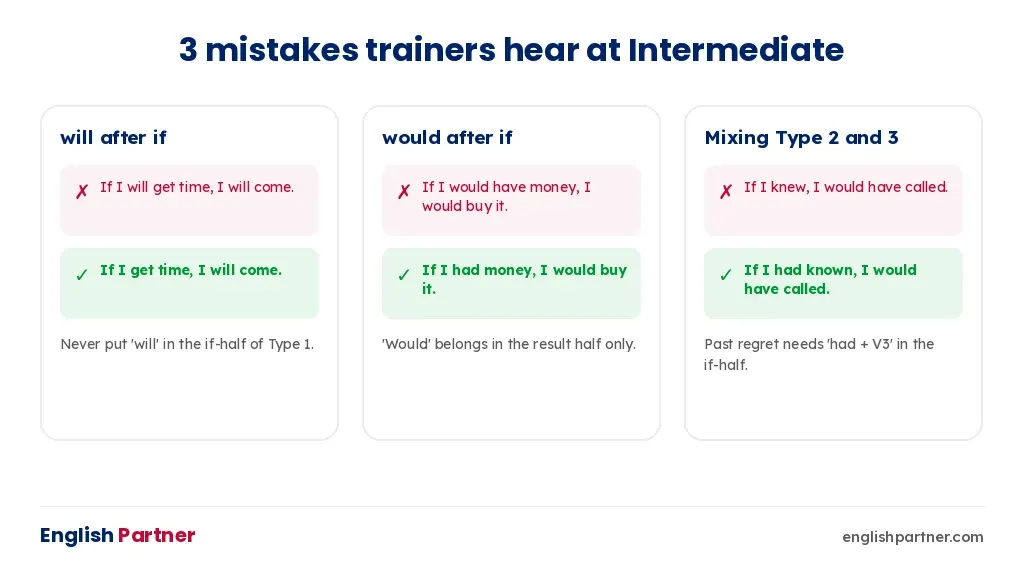
Mistake 1 – will after if. “If I will get time, I will come.” The if-half never takes will: “If I get time, I will come.” The present form is already doing the future work.
Mistake 2 – would after if. “If I would have money, I would buy it.” Would belongs only in the result half: “If I had money, I would buy it.”
Mistake 3 – mixing Type 2 and Type 3. “If I knew, I would have called.” A finished past needs the full Type 3 shape: “If I had known, I would have called.”
All three come from building the result half first and then working backwards. Cambridge English teaches the same order – decide the condition, then the consequence.
Your 3-day practice plan
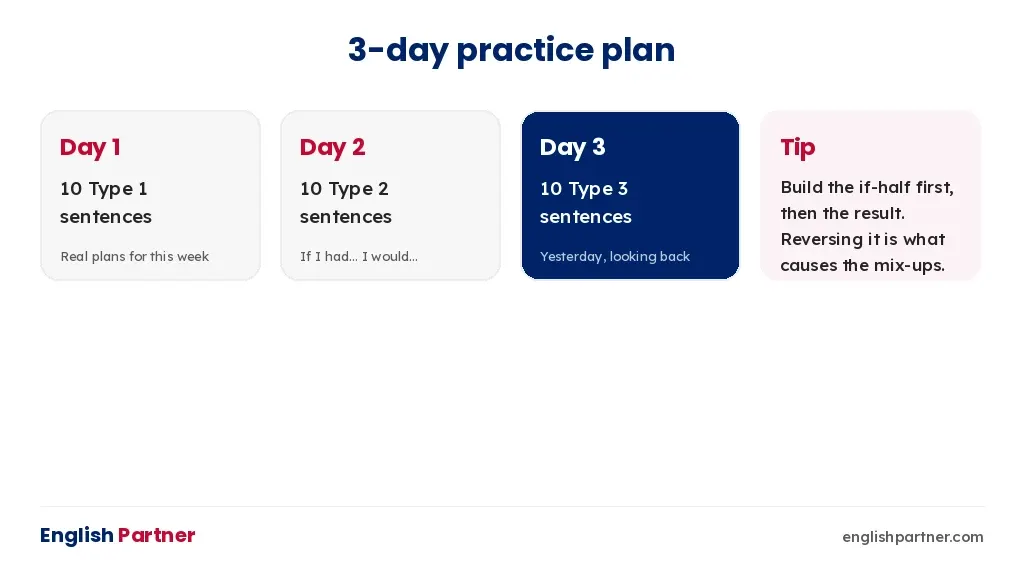
Day 1: Ten Type 1 sentences about this week – real plans with real conditions.
Day 2: Ten Type 2 sentences starting “If I had…” – things you do not have or cannot do right now.
Day 3: Ten Type 3 sentences about yesterday or last month, looking back.
Build the if-half first, out loud, then add the result. Reversing that order is what produces the mix-ups.
When self-practice is not enough
Conditionals are understood quickly and used wrongly for years, because both halves are long enough that by the time you reach the second one you have forgotten which type you started.
Trainer-led practice is what fixes it – someone who catches the slip in the moment and explains it in your mother tongue while the sentence is still in your head. Learners can join our spoken English classes in Coimbatore, our spoken English classes in Chennai, or our spoken English classes in Pondicherry.
Final thoughts and your next step
Ask the meaning question first: fact, real, imagined, or finished. That single decision picks the type, and the pattern after it never varies.
Tonight, say ten Type 1 sentences about tomorrow – real conditions, real plans. That is Day 1 done, and it is the type you will use most.
Not sure whether Intermediate is the right level for you? Send “Hi” on WhatsApp for a free five-minute level test in your language.
Frequently asked questions
What are the four types of conditional sentences?
Type 0 for facts that are always true, Type 1 for a real future possibility, Type 2 for something imagined or unlikely right now, and Type 3 for a past situation that cannot be changed. Each has a fixed pattern, listed in the chart below.
What is the difference between Type 1 and Type 2?
Chance. Type 1 says it may really happen – “If it rains, I will stay home.” Type 2 treats it as imagined or unlikely – “If it rained, I would stay home.” The meaning is the same; only your view of the likelihood changes.
Why can’t I say “If I will get time”?
Because English never puts will in the if-half of a Type 1 sentence. The if-half stays in the present even though it refers to the future: “If I get time, I will come.” This is the single most common conditional mistake.
Is “If I was you” or “If I were you” correct?
“If I were you” is the standard Type 2 form for an imagined situation. You will hear “was” in casual speech, but “were” is the safe choice in writing and at work.
How do I form a Type 3 sentence?
If + had + third form, then would have + third form: “If I had known, I would have called.” Both halves need the past perfect shape, which is why mixing Type 2 and Type 3 is such a common slip.
Can I put the if-clause second?
Yes. “I will call you if I finish early” means exactly the same as “If I finish early, I will call you.” The only change is the comma – you need it when if comes first, not when it comes second.
Are conditionals only used in exams?
No. Type 1 appears constantly in ordinary conversation – making plans, giving conditions, negotiating. Type 2 is normal for polite suggestions, and Type 3 for explaining what went wrong.
Which English Partner course covers conditionals?
Intermediate. It covers conditionals, perfect tenses and reported speech through daily speaking practice, with the rule explained in your mother tongue first.