Active and Passive Voice: The Rule for Every Tense in One Chart
 Dhinesh Kumar
Content Writer
Published
Time to read
9 minutes
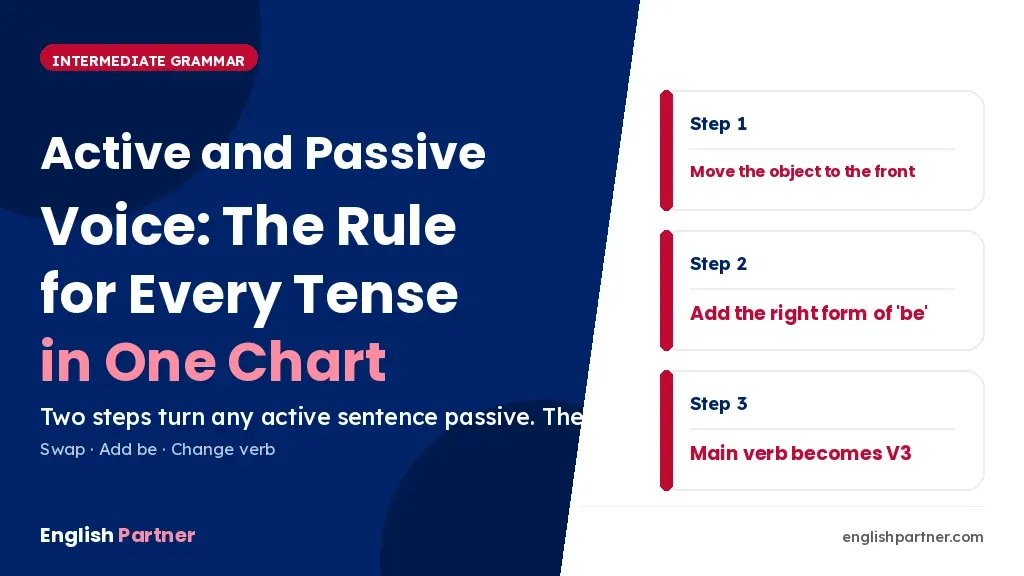
Quick answer: Three steps. Move the object to the front, add “be” in the same tense, change the main verb to V3. “She wrote the report” → “The report was written.” The same three steps work in all twelve tenses, and the full chart is below.
Why voice feels harder than it is
Most people learn active and passive voice as twelve separate rules — one per tense — and then forget eleven of them.
There is only one rule. The main verb is always V3, in every tense without exception. The only thing that changes between tenses is the form of be, and you already know those forms: is, are, was, were, been, being, will be.
Once you see that, the twelve-row chart below stops being something to memorise and becomes something to check.
Active and passive voice: the three steps
Take “The manager approved the report.”
Step 1 — move the object to the front. Ask what received the action. The report did. So the sentence now starts “The report…”
Step 2 — add “be” in the same tense. Approved is simple past, so be becomes was. Now: “The report was…”
Step 3 — main verb to V3. Approve → approved. Final: “The report was approved.”
You can add “by the manager” at the end, but in most real sentences you should not. More on that below.
All twelve tenses in one chart
Read down the right-hand column and notice what repeats. Written appears in every row. The only thing moving is be:
- Simple tenses → is / are / was / were / will be
- Continuous tenses → is being / was being
- Perfect tenses → has been / have been / had been / will have been
- Modals → can be / should be / must be / might be
That is the entire topic. Four patterns of be, plus V3.
When passive is the right choice
School often teaches that passive is weak English and should be avoided. That is too simple, and following it will make some of your writing worse.
Passive is correct — and often better — in four situations:
1. The doer is unknown. “My bike was stolen last night.” You do not know who. Active would force you to invent a subject.
2. The doer is irrelevant. “The road was closed for repairs.” Nobody needs the name of the contractor.
3. The result matters more than the person. “Your application has been approved.” The applicant cares about the approval, not about which clerk processed it.
4. You are describing a process. “The rice is washed, then soaked for twenty minutes, then drained.” Every step in a procedure is naturally passive.
Where passive genuinely goes wrong is when it hides responsibility. “Mistakes were made” is the famous example — grammatically correct, and designed to avoid saying who made them. In a work update, “I missed the deadline” costs you nothing and earns more than the passive version.
Where this shows up at work
Three real situations where voice changes how you come across.
Status updates. “I've sent the file to the client” is active, direct and takes ownership. “The file has been sent” is correct, but it leaves open whether you sent it. In a standup, the active version is almost always the right one.
Official and formal writing. Notices, policies and reports lean passive because the institution is speaking, not a person. “Applications will be reviewed within seven working days.” Making that active would need an awkward subject.
Delivering bad news. This is where the choice gets delicate. “Your request has been declined” softens it; “I declined your request” is blunt but honest. Both are available to you, and knowing you have the choice is the actual skill.
The same idea in Tamil
Tamil does have a passive, but it is used far less often than in English — Tamil tends to drop the subject instead. That is exactly why passive English feels unnatural to produce, even when you can recognise it.
| Tamil | English (active) | English (passive) |
|---|---|---|
| மேனேஜர் ரிப்போர்ட்டை அப்ரூவ் பண்ணினார் | The manager approved the report | The report was approved |
| ரோடு மூடப்பட்டிருக்கு | They closed the road | The road has been closed |
| என் சைக்கிள் திருடு போயிடுச்சு | Someone stole my bike | My bike was stolen |
| கடிதம் அனுப்பப்பட்டது | We sent the letter | The letter was sent |
Look at row three. Tamil says திருடு போயிடுச்சு with no thief named at all. English cannot leave the sentence subjectless, so it reaches for the passive instead. That substitution is the whole reason the structure exists.
Sentences that cannot be made passive
Worth knowing, because exam questions test exactly this.
A passive sentence needs an object to move to the front. Verbs that take no object — sleep, arrive, go, come, happen, die, sit, laugh — have nothing to move, so they have no passive form.
- He slept well. → no passive possible
- The train arrived late. → no passive possible
- An accident happened. → no passive possible
Two tenses are also avoided in the passive because they come out clumsy: future continuous and present perfect continuous. “The report will be being written” is technically formable and nobody says it.
Converting passive back to active
Exams ask for both directions, and the reverse is where people slip, because there is an extra decision: you have to supply a subject.
If the passive sentence names the doer, move it to the front and drop the be:
- The report was approved by the manager. → The manager approved the report.
- The class is taught by Ms Rumana. → Ms Rumana teaches the class.
If it does not name the doer, you have to invent one — and the honest choices are few: they, someone, we, people.
- The road has been closed. → They have closed the road.
- My bike was stolen. → Someone stole my bike.
Notice what happened in that second pair. The active version is longer and adds a word that carries no information. That is a useful signal: when converting to active forces you to invent a vague subject, the passive was the better sentence to begin with.
Passive questions and negatives
Neither is a new rule — the three steps hold, and the question or negative behaves the way it already does in that tense.
| Type | Active | Passive |
|---|---|---|
| Question | Did she send the file? | Was the file sent? |
| Question | Have they approved it? | Has it been approved? |
| Negative | She did not send the file. | The file was not sent. |
| Negative | They have not approved it. | It has not been approved. |
| Wh-question | Who wrote this? | Who was this written by? |
That last row is the one worth memorising, because it looks wrong and is correct. The more formal version is "By whom was this written?", which you will meet in exam papers and almost nowhere else.
3 mistakes trainers hear every week
The second one is the quiet killer. When you move the object to the front, it becomes the new subject — and be has to agree with that word, not the original one. “The reports” is plural, so it takes were, regardless of the fact that one person sent them.
For the full set of structures with more examples, the Cambridge Dictionary entry on the passive voice covers every form.
Your 3-day practice plan
Use sentences from your own sent folder. Converting “I have updated the sheet” into “The sheet has been updated” and deciding which one you actually wanted is worth more than thirty textbook conversions.
When self-practice is not enough
You can learn the three steps in five minutes. What takes longer is the judgement — knowing, in the moment, whether this sentence wants active or passive, and what each one signals to the person reading it.
That judgement comes from being corrected on your own sentences, in real situations, with the reason explained in your mother tongue. Learners can join our spoken English classes in Coimbatore, our spoken English classes in Chennai, or our spoken English classes in Pondicherry.
Final thoughts and your next step
Move the object forward, add be in the same tense, make the main verb V3. One rule, twelve tenses, no exceptions on the V3 part.
Today, take five sentences from an email you sent this week and convert each one. Then ask which version you would actually send. That second question is the one that matters.