Asking for Directions in English — and Actually Understanding the Reply
 Dhinesh Kumar
Content Writer
Published
Time to read
7 minutes
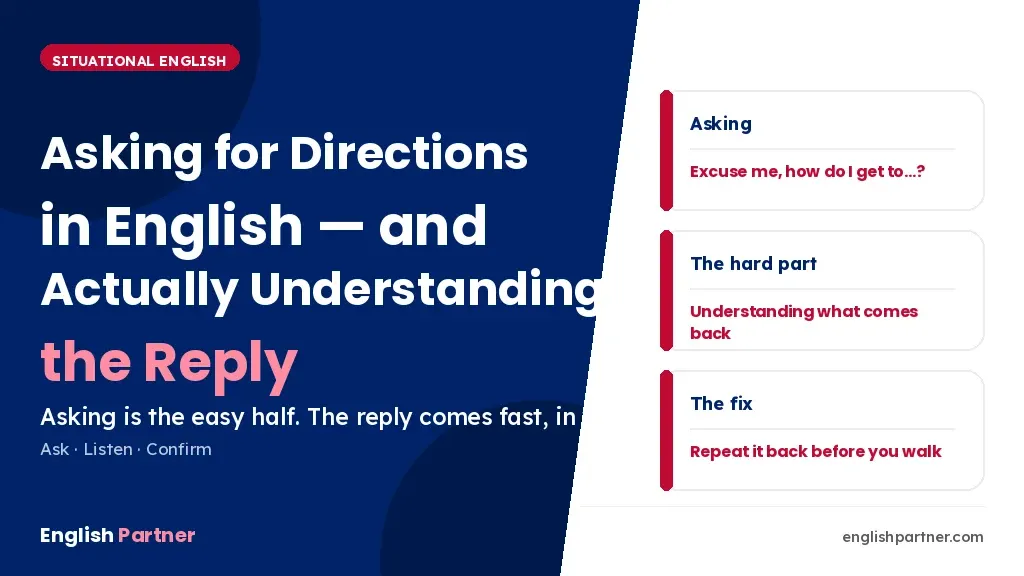
Quick answer: Ask with “Excuse me, how do I get to…?” Then listen for three things — direction, distance and a landmark. Then repeat it back: “So, straight, then left at the temple?” That last step is the one almost everyone skips and the one that prevents getting lost.
Asking is easy. The reply is the problem.
Most people can produce the question. You have seen it in school books, and “Where is the railway station?” gets understood.
What nobody prepares you for is what comes back. A stranger replies at full speed, using words like block, roundabout, opposite, just past, and you catch about forty per cent of it. Then — this is the universal part — you nod, say thank you, and walk off in a direction you are not sure about.
So this page spends most of its time on the half nobody teaches: understanding the answer.
Asking for directions in English: five ways to ask
All five work. Pick one and make it yours, so it comes out without assembly.
- Excuse me, how do I get to the railway station? — the most natural and most common
- Excuse me, could you tell me the way to the bus stand? — slightly more formal
- Excuse me, is this the right road for the hospital? — when you are already walking
- Excuse me, where's the nearest ATM? — for something generic rather than a named place
- Excuse me, do you know if there's a bus from here to Gandhipuram? — for transport
The “excuse me” is not decoration. In English it is the signal that makes a stranger stop walking and turn towards you. Without it, the same question lands as a demand — which is why “Railway station where?” often gets a point and a shrug rather than a real answer.
The reply vocabulary nobody teaches
Seventeen words carry almost every set of directions you will ever receive. Learn these and the fast reply becomes followable.
| Word or phrase | What it means | Tamil |
|---|---|---|
| Go straight | Keep going, do not turn | நேரா போங்க |
| Take the second right | Skip the first turning, take the next | ரெண்டாவது வலது |
| At the signal / junction | At the traffic light or crossing | சிக்னல்ல |
| A block | The stretch between two crossings | ஒரு தெரு |
| Cross the road | Go to the other side | ரோடு கிராஸ் பண்ணுங்க |
| Go past the temple | Walk beyond it, do not stop | கோவிலை தாண்டி |
| Opposite the bank | Directly across from it | பேங்க் எதிர்ல |
| Next to the school | Right beside it | ஸ்கூல் பக்கத்துல |
| On your left | It will appear on your left side | இடது பக்கம் |
| Around the corner | Just after you turn | மூலையை திரும்பினா |
| You can't miss it | It is very easy to spot | ஈஸியா கண்டுபிடிச்சிடுவீங்க |
| It's a ten-minute walk | About ten minutes on foot | பத்து நிமிஷ நடை |
“You can't miss it” is the one that confuses people most, because it sounds like a warning. It is the opposite — it means the place is obvious. If you are still unsure, the right follow-up is “Is there anything I'll pass on the way?”
The step that fixes everything: repeat it back
This is the whole trick, and it takes four seconds.
Before you walk away, say the directions back in your own words:
- “So, straight for two blocks, then left at the temple?”
- “Right at the signal, and it's on my left?”
- “Past the bank, then second right — is that it?”
Three things happen. You find out immediately if you misheard, while the person is still there. They usually add a detail they forgot. And — the part people do not expect — repeating it out loud is what makes you actually remember it two streets later.
If you only take one thing from this page, take this one. It is worth more than all the vocabulary above.
When you did not understand at all
It happens, and it is fine. Four ways out, in increasing order of directness:
- “Sorry, could you say that again?”
- “Sorry, I didn't catch that — could you say it slowly?”
- “Sorry, did you say left or right at the signal?” — the most useful, because it asks about one specific thing
- “Could you show me on the map?” — hold up your phone; this ends the problem completely
Nobody has ever been annoyed by someone asking them to repeat directions. People are annoyed by having given directions to someone who then walks the wrong way, because it means the whole exchange was wasted.
Giving directions, when someone asks you
This comes up more than people expect — at work, to a visitor, to a tourist — and the structure is simple: direction, distance, landmark.
- “Go straight for about five minutes, then take the second left. It's opposite the bank.”
- “Cross the road, turn right at the signal, and it's on your left.”
- “It's a bit far to walk — you're better off taking an auto.”
- “I'm going that way myself, I'll walk with you.”
And the honest one, which is better English than a guess: “Sorry, I'm not from here.”
Directions for auto, cab and bus
In an Indian city, most of the time you are not walking — you are telling a driver where to go, and that is a different set of sentences.
Before you get in. "Will you go to Gandhipuram?" "How much to the railway station?" "Will you come by meter?"
On the way. "Take a left at the next signal." "Could you go a bit slower?" "Stop here, please." "Just before the bank is fine."
At a bus stop. "Does this bus go to Peelamedu?" "Which bus should I take for the airport?" "Could you tell me when to get down?"
That last one deserves its own mention. "Could you tell me when to get down?" said to the conductor or the person next to you solves the whole problem of not knowing the route, and almost everybody says yes.
One note on wording: "get down" is Indian English and is understood everywhere in India. Outside India the phrase is "get off". Both are fine here; neither will cause a problem.
Five questions worth asking before you set off
Asking the right question up front saves more walking than any amount of direction vocabulary.
- "Is it walking distance?" — before you start walking somewhere that turns out to be four kilometres away.
- "What's the nearest landmark?" — a landmark is far easier to find than an address.
- "Is there a shorter way?" — people often give you the main-road route by default.
- "Will I find an auto there?" — useful before walking somewhere you cannot easily leave.
- "Is it open now?" — the question nobody asks and everybody regrets.
3 mistakes that get you lost
The second one is the expensive one. Nodding when you did not follow feels like the polite choice in the moment, and it costs you twenty minutes of walking in the wrong direction. “Sorry, could you say that again?” costs four seconds.
For more listening practice with everyday dialogues like these, the British Council has free audio material at every level.
Your 3-day practice plan
On day three, ask a real person for directions to a place you already know how to reach. There is nothing to lose if it goes badly, and you get the one thing practising at home cannot give you — a reply you did not script.
When self-practice is not enough
Memorised questions work until the reply comes back fast, in an accent you are not used to, with a word you have not met. That is the real skill here, and it is a listening skill rather than a speaking one.
Trainer-led practice builds it — real-time replies, unexpected follow-ups, and feedback in your mother tongue straight afterwards. Learners can join our spoken English classes in Coimbatore, our spoken English classes in Chennai, or our spoken English classes in Pondicherry.
Final thoughts and your next step
Ask with “Excuse me”. Listen for direction, distance and landmark. Repeat it back before you move.
This week, use one line once: “Excuse me, how do I get to…?” Even somewhere you already know. The point is not the directions — it is proving to yourself that the exchange is shorter and easier than it has been feeling.