
Vishaleni
Content Writer


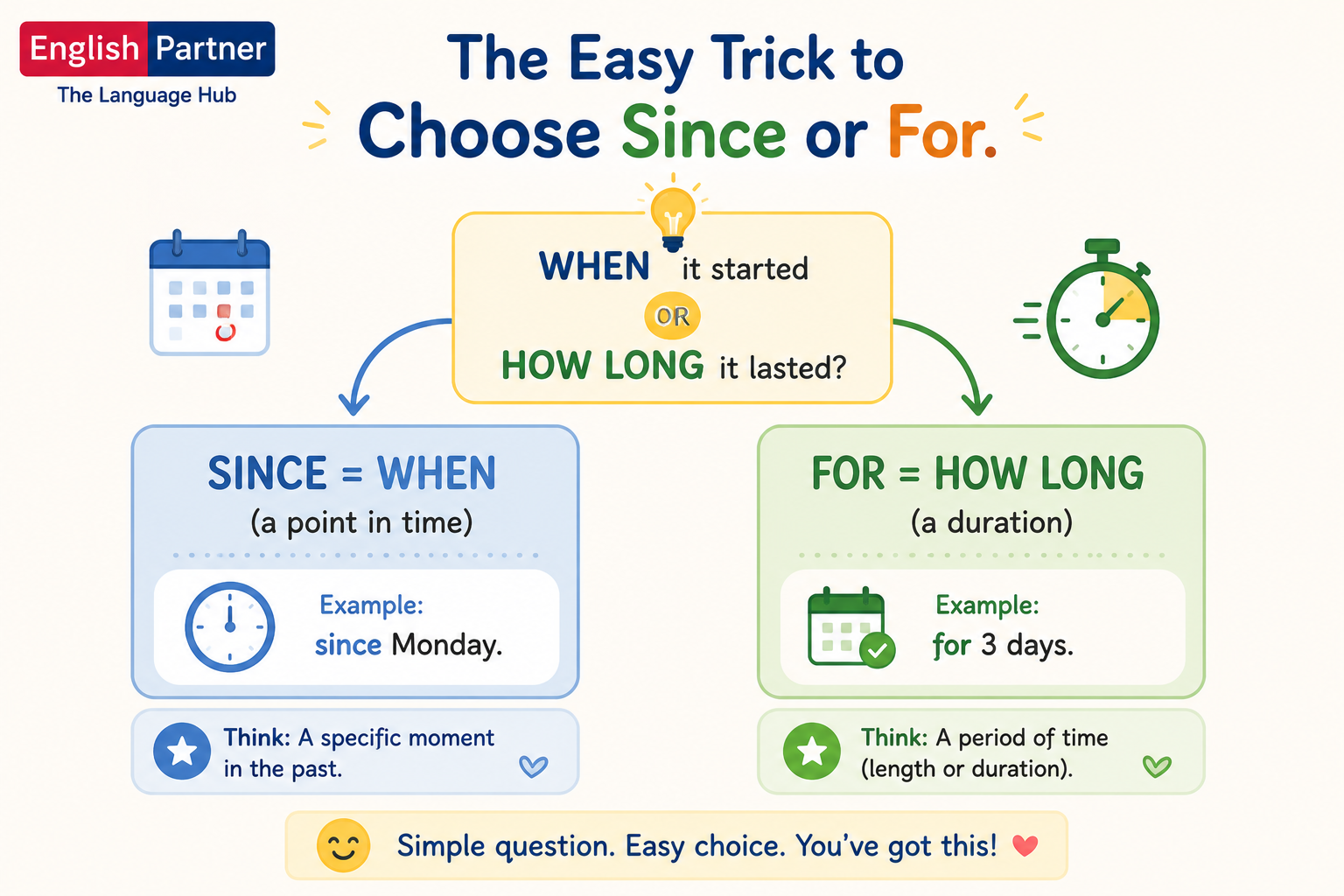
1. “Since” Points to a Starting Time
We use “since” to show when something started. It marks a point in the past.
For example: I have lived in Bangalore since 2019.
Here, 2019 is the exact starting point of the action.
2. “For” Shows a Length of Time
We use “for” to show how long something lasts. It refers to a period, not a point.
For example: I have lived in Bangalore for six years.
Here, “six years” is the total duration.
3. “Since” Answers “Since When?”
When someone asks “Since when?”, the answer uses “since.”
For example: She has been studying since morning.
This tells us the moment the studying began.
4. “For” Answers “How Long?”
When someone asks “How long?”, the answer uses “for.”
For example: She has been studying for three hours.
This tells us the total time spent studying.
5. “Since” Needs a Specific Date or Time
“Since” is always followed by a fixed point — a date, day, year, or event.
Examples include since Monday, since 5 o’clock, since 2015, since I was a child.
Each one is a clear moment in time.
6. “For” Needs a Number or General Duration
“For” is followed by a quantity of time, like hours, days, weeks, or years.
Examples include for two hours, for ten days, for a long time, for ages.
Each one tells us the length, not the start.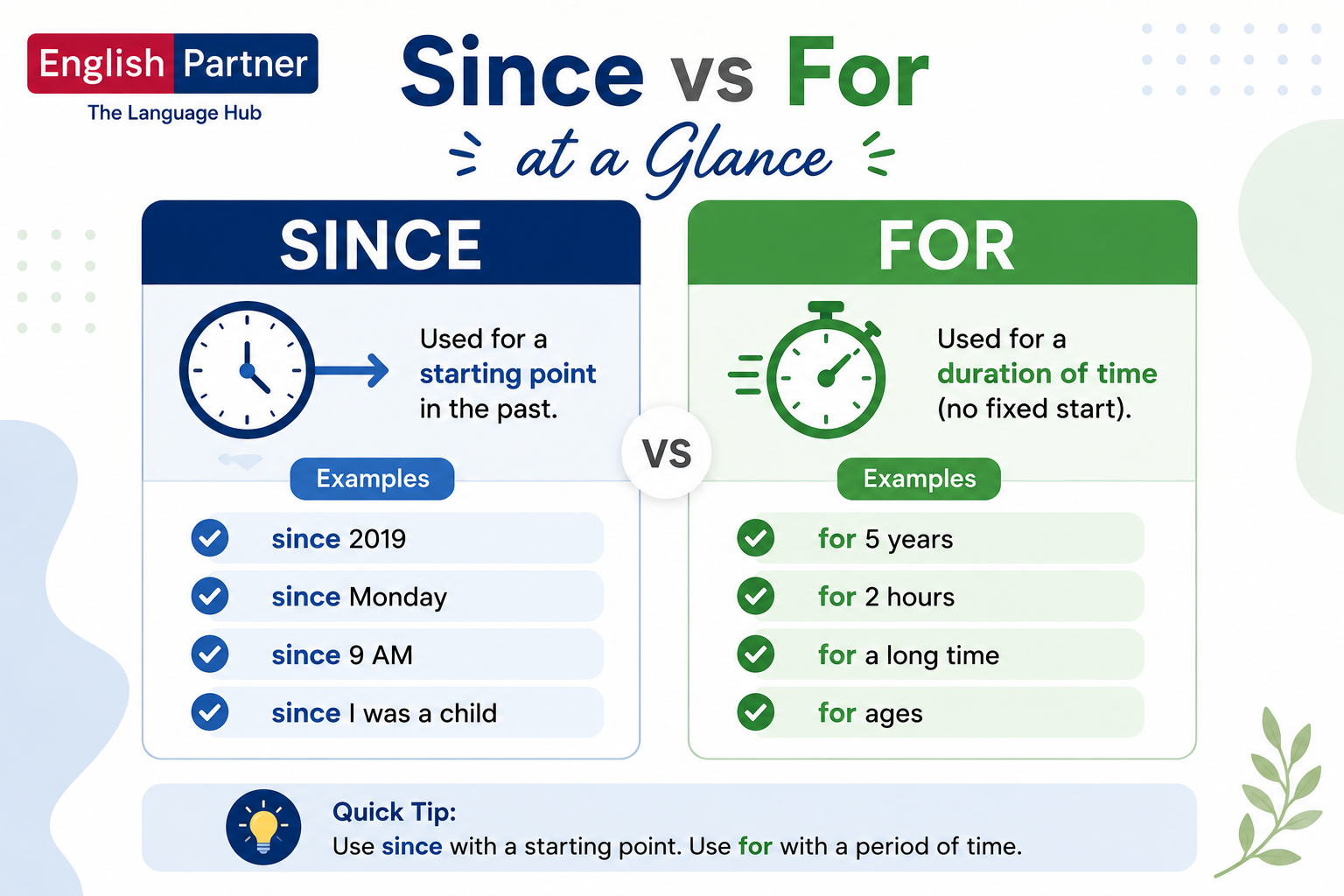
7. “Since” Usually Uses the Present Perfect Tense
“Since” works best with the present perfect tense (has/have + verb). This shows an action that started in the past and continues now.
For example: We have known each other since college.
The friendship started in college and still continues.
8. “For” Can Be Used With More Tenses
“For” is more flexible. It works with present perfect, past simple, and even future tenses.
For example:
She lived in Chennai for ten years. (past simple)
I will stay here for a week. (future)
9. “Since” Can Follow With a Full Clause
Sometimes “since” is followed by a complete event, not just a date.
For example: I have felt happier since I joined the spoken english class.
Here, “I joined the class” is the starting point.
10. “For” Cannot Replace “Since” With Specific Times
This is a common error. We never say “since two hours.” The correct word is “for.”
For example:
✅ We have been waiting for two hours.
❌ We have been waiting since two hours.
11. “Since” Often Pairs With “Ever”
We sometimes use “ever since” to add emphasis to a starting point.
For example: He has been nervous about speaking English ever since school.
This stresses that the feeling started long ago and continues.
12. “For” Can Sometimes Be Left Out
In casual speech, “for” can sometimes be dropped, but “since” cannot.
For example: They have been married (for) ten years.
Both versions are correct. But you cannot remove “since” the same way.
Here is a simple routine you can follow at home.
Step 1: Write five sentences about your own life using “since.”
Example: I have worked here since 2022.
Step 2: Write five sentences using “for.”
Example: I have worked here for three years.
Step 3: Read them aloud daily for one week.
Step 4: Ask a friend or trainer to check them.
This kind of daily practice helps the rules become natural over time.