“I Understand English But Can’t Speak”: Why It Happens and the 4-Week Fix
 Vishaleni
Content Writer
Published
Time to read
9 minutes
Vishaleni
Content Writer
Published
Time to read
9 minutes
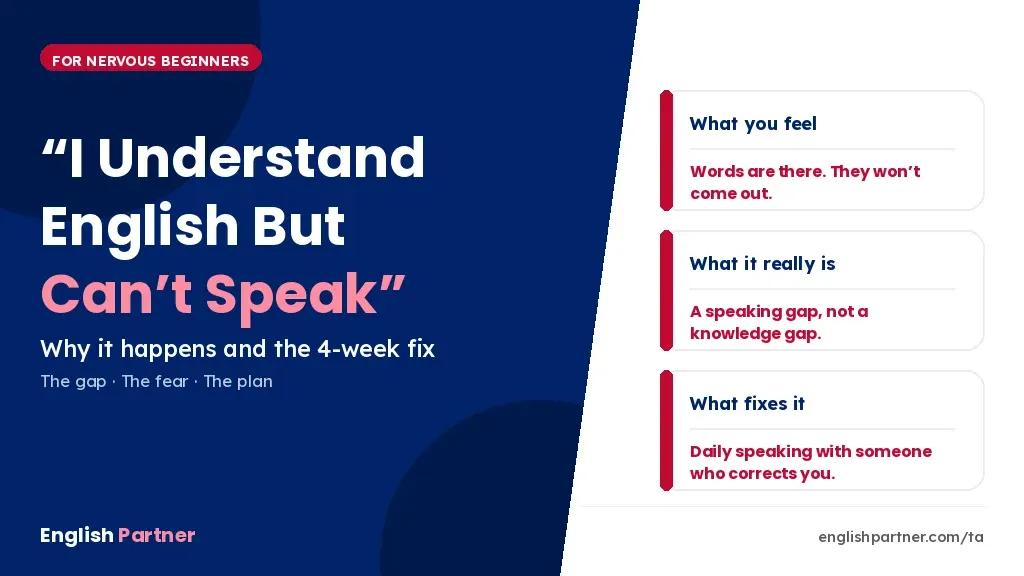
Quick answer: You understand English because you have listened and read for years. You cannot speak it because you have barely spoken – speaking is a separate skill and it is built only by speaking. Most learners also freeze because they translate in their head, which takes longer than a conversation allows. The fix is not more grammar; it is a four-week routine of speaking a little every day, ending with someone who corrects you.
The sentence trainers hear on every first call
When someone messages English Partner on WhatsApp for a level test, the trainer asks them to talk about their day. In English. And almost every time, the reply comes in Tamil:
“Ma’am, English புரியுது. But பேச வரல.”
I understand English. But I can’t speak.
They say it a little embarrassed, as if it is a strange personal failing. It is not. It is the single most common situation among adult learners in this country, and this post explains properly why it happens – because once you see the reason, the fix becomes obvious, and it is not the fix most people try.
Understanding and speaking are two different skills
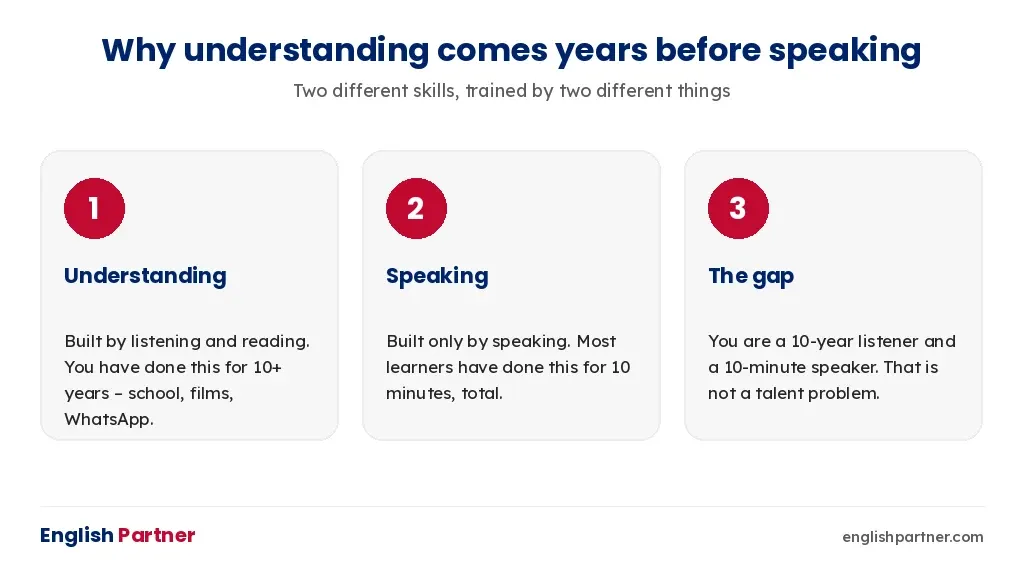
Think about how you learned to understand English. Ten or twelve years of school. English news, English films with subtitles, WhatsApp forwards, YouTube, the labels on everything you buy. Thousands of hours of English going in.
Now think about how many hours of English have come out of your mouth. Real sentences, to a real person. For most learners who join English Partner, the honest answer is: a few minutes, spread across years.
Understanding is built by listening and reading. Speaking is built only by speaking. They are trained by different activities and they grow at different speeds. So you are, quite literally, a ten-year listener and a ten-minute speaker. That is not a talent problem. It is a practice-hours problem, and practice hours can be added.
This is also why more grammar does not help. If you understand English, you already know enough grammar to make simple sentences. Studying more rules just gives your brain more things to check before it lets you open your mouth.
Why you freeze: the four-step detour
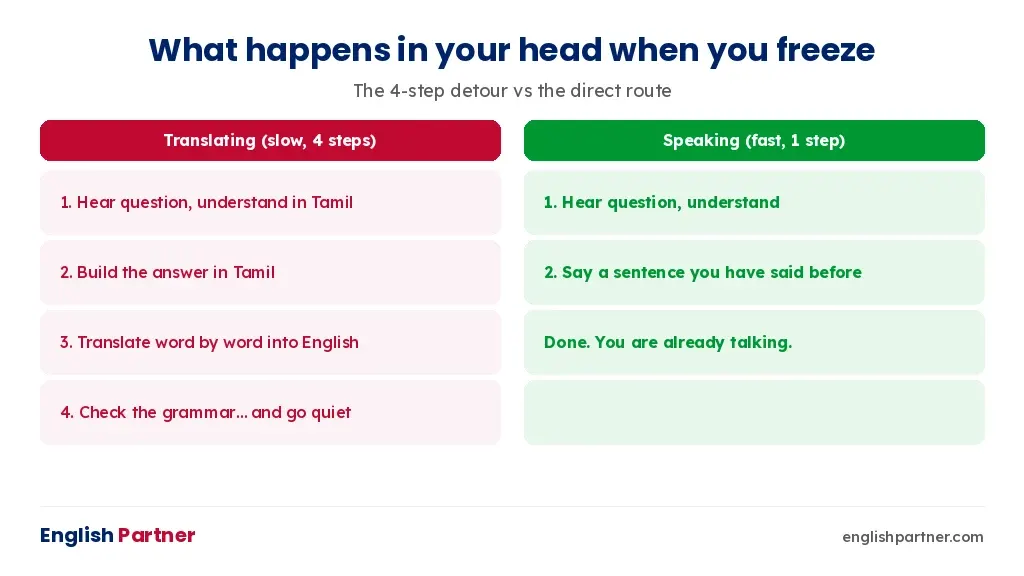
Here is what happens inside your head when a colleague asks, “How was your weekend?”
Step 1: You hear it and understand it – in Tamil. வீக்எண்ட் எப்படி இருந்துச்சு?
Step 2: You build your answer – in Tamil. நல்லா இருந்துச்சு, ஊருக்கு போயிருந்தேன்.
Step 3: You translate it, word by word, into English.
Step 4: You check the grammar. Is it went or go? To my native or at my native? Should it be had gone?
By step four, the colleague has already turned to the next person. And you say “Fine” and feel terrible.
That detour is not stupidity. It is exactly what a careful, educated person does when they have been taught that mistakes are bad. But conversation happens in real time, and the detour is too slow for real time.
Compare it with what happens when someone says “How are you?” You say “I’m fine, thank you” instantly. No translation, no checking. Why? Because you have said that exact sentence a thousand times. It comes out as one piece.
That is the whole secret. Fluency is not translating faster. It is having enough sentences that come out as one piece. And you build that by saying sentences, out loud, again and again – not by studying them.
The 4-week speaking plan
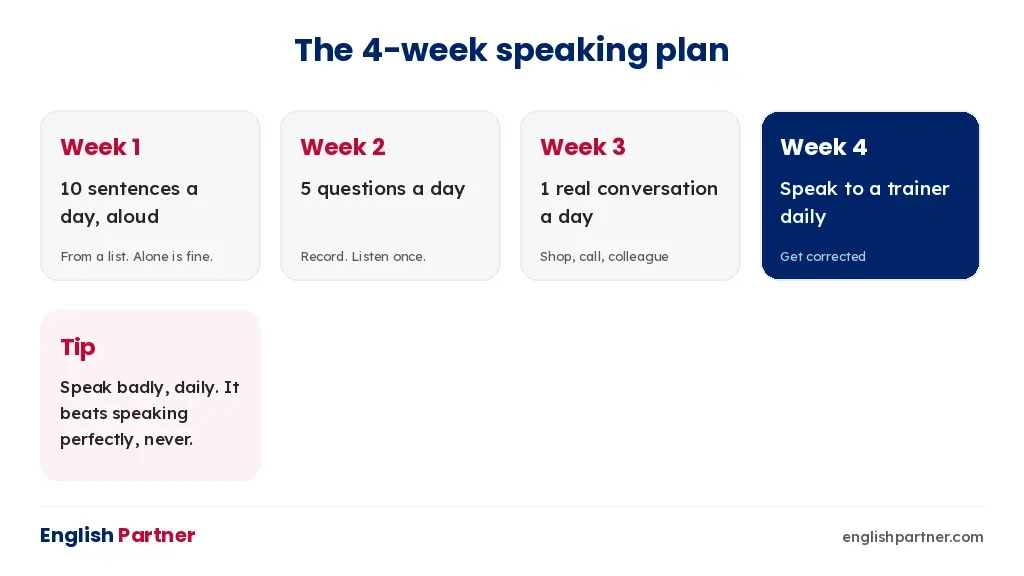
This is the routine English Partner trainers give every learner who starts at “I understand but can’t speak.” It is deliberately small. Ten to fifteen minutes a day. The learners who do it every day are speaking in a month. The ones who do two hours on Sunday are not.
Week 1: Say ten sentences a day, out loud
Take a list of everyday sentences – our 100 Tamil to English everyday sentences is built for exactly this – and say ten of them aloud every day. Not read. Say. Alone in the kitchen is fine. The point is to move the sentences from your eyes to your mouth.
Do not pick hard sentences. Pick the ones you already say in Tamil every day: Food is ready. I will call you later. How much is this?
Week 2: Answer five questions a day, in English
Every morning, ask yourself five questions and answer them out loud. What did you do yesterday? What will you do today? Who did you talk to? What did you eat? How do you feel?
Record the answers on your phone. Listen once. You will hear things you never noticed – long pauses, the same word repeated, a sentence that trails off. That is fine. You are not judging; you are just seeing where you are.
Week 3: One real conversation a day
Two minutes. With a real person. The shopkeeper, the delivery boy, the colleague at the tea stall, your child. Use the sentences from week one. Expect it to be awkward. Do it anyway.
One English Partner learner, a bank clerk in Erode, decided week three would be “English only with the security guard.” The guard thought it was hilarious. By the end of the week they were having real conversations, and she had stopped freezing at the counter.
Week 4: Speak to someone who corrects you, daily
This is the week that changes things, and it is the one you cannot do alone.
By now you are speaking – badly, but speaking. And you are making the same three or four mistakes every single day without knowing it. I am having a headache. Myself Priya. I am agree. Alone, you will repeat those a thousand times and they will set like concrete. With someone who gently corrects you each day, they are gone in a week.
This is what a trainer is for. Not to teach you English – you already understand it. To listen to you speak, every day, and fix the few things that keep repeating.
3 things that keep people stuck
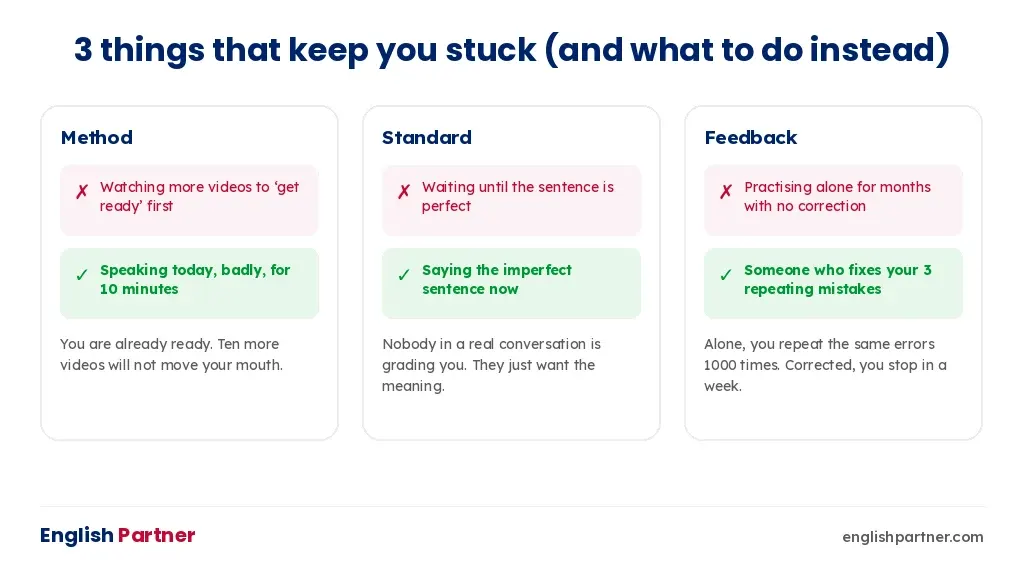
Waiting to be “ready.” One more grammar video. One more vocabulary list. Then I will start speaking. You are already ready. You have been ready for years. Ten more videos will not move your mouth – only your mouth can do that.
Waiting for the perfect sentence. Nobody in a real conversation is grading you. The shopkeeper wants to know what you want to buy. Your colleague wants to know about your weekend. Say the imperfect sentence. It works.
Practising alone for months. Weeks one to three, alone is fine. After that, you need ears other than your own. Without correction, practice just makes your mistakes permanent.
When self-practice is not enough
If you have read this far and thought “I have tried, and I still freeze” – you are not alone. Most of the learners in our Pre-Basic batches have tried apps, videos and books for years before they message us. The thing they were missing was never information. It was a person who speaks their language, listens to them speak every day, and tells them – in Tamil – what to fix.
That is what our Pre-Basic and Basic levels do. Your trainer explains in your mother tongue, you speak every day on WhatsApp and in live classes, and the same three mistakes get fixed instead of repeated. If you want to see how the Tamil track works first, the spoken English in Tamil page explains it.
Final thoughts and your next step
You do not have an English problem. You have a speaking-hours problem, and a translation habit that makes conversations feel faster than they are. Both are fixable, and neither needs another grammar book.
Start week one tonight: ten sentences, out loud. If you are not sure where you stand, send “Hi” on WhatsApp and one of our Tamil trainers will do a free five-minute level test – in Tamil, so you can relax – and tell you exactly where to begin.
Frequently asked questions
Why can I understand English but not speak it?
Because understanding and speaking are two different skills, built by two different activities. You have practised understanding for years – school, films, reading. You have practised speaking for minutes. The gap is in practice hours, not ability.
Is it normal to understand English but not be able to speak?
Yes. It is the most common situation among adult learners in India. Almost everyone who joins our Pre-Basic and Basic batches starts exactly here.
How long does it take to start speaking English?
With daily speaking practice, most learners are holding simple real conversations in four weeks. Not fluent – but speaking, without the freeze. Fluency comes over the following months.
Why do I freeze when someone speaks to me in English?
Because your brain is translating: understand in Tamil, build the answer in Tamil, translate it, check the grammar. That four-step detour takes longer than the conversation allows, so you go quiet. Speaking practised sentences skips the detour.
Should I learn more grammar before I start speaking?
No. If you understand English, you already know enough grammar to speak simple sentences. Grammar study without speaking makes the freeze worse, because you have more rules to check before you open your mouth.
How do I stop translating in my head?
You do not stop it by trying. It fades on its own when you say the same sentences so often that they come out as one piece. Start with sentences you already say in Tamil every day.
Can I fix this by myself?
Weeks one to three of the plan, yes. Week four needs another person – ideally someone who corrects you – because alone you cannot hear your own repeating mistakes.
Which course is right for someone who understands but cannot speak?
Pre-Basic if you freeze on simple sentences, Basic if you can manage a few but hesitate. Both are taught in your mother tongue first. A free five-minute level test on WhatsApp tells you which one.