

Learning Without the “Study Face”
Let’s be honest- most kids don’t jump with excitement when they hear the word “study.”
But what if learning English didn’t feel like studying at all?
Every conversation at the dinner table, every silly joke in English, and every story told before bed can become a mini English lesson, one that’s fun, easy, and pressure-free.
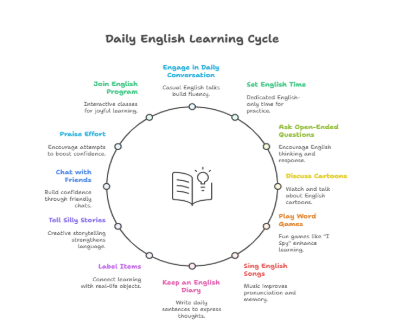
In this blog, we’ll explore 12 simple ways your child can practice English daily without opening a textbook or feeling like it’s “study time.” These are real-life, everyday activities that build confidence, vocabulary, and fluency naturally.
By the end, you’ll see that English isn’t something kids have to study, it’s something they can live with!
Make English a Part of Everyday Fun
The best way to help kids learn English? Don’t make it a “subject”- make it part of everyday life. When English blends into playtime, mealtime, and family chats, kids learn it without even realizing they’re studying.
1. Talk About the Day — in Simple English
You don’t need long or perfect sentences. Start small!
Ask your child things like:
- “How was your day?”
- “What did you eat for lunch?”
- “Who did you play with?”
Even if the answers come in half English and half native language, that’s perfectly okay. What matters most is consistency and comfort, not correctness.
2. Use ‘English Time’ at Home
Make 10 minutes of “English Only Time” every day. During this time, everyone including parents speaks only in English. It can be while setting the dinner table or getting ready for school.
To make it fun:
- Whoever forgets and speaks in another language does a funny dance or tells a joke.
- Add light-hearted rewards for trying, maybe like “English Star of the Day!”
When English becomes a shared game, kids don’t feel pressured instead they feel proud.
3. Ask Questions Instead of Giving Instructions
Instead of saying, “Do your homework,” try:
- “What homework do you have today?”
- “Can you tell me what you learned?”
Questions invite conversation, which means more English, more thinking, and more speaking — all in a stress-free way.
Learning Through Play & Imagination
Children learn best when they’re having fun. Play activates curiosity, memory, and emotion, the three secret ingredients for real learning. By turning games, cartoons, and music into little English moments, your child will start thinking and speaking in English naturally.
4. Turn Cartoons into Conversations
Cartoons aren’t just entertainment, they’re language lessons in disguise!
Watch English shows like Bluey, or Dora the Explorer together. Then, chat about what you saw.
Try questions like:
- “What did Dora do today?”
- “Who was your favorite character?”
- “Can you tell me one funny line?”
This simple habit builds listening and speaking skills- all while keeping things light and fun.
5. Play Word Games & Mini Challenges
Games make English active, not passive. You can start with:
- I Spy: “I spy something red that starts with ‘B’…” (ball!)
- Word Chain: “Apple → Elephant → Tiger…”
- Guess the Object: Describe it: “It’s round, you kick it…” (football!)
Each game builds quick thinking, vocabulary, and confidence — all without the pressure of formal study.
6. Use Music & Songs
Music is one of the easiest ways to remember English words.
Sing rhymes like “Head, Shoulders, Knees, and Toes” or short pop songs together.
Even dancing while singing helps kids learn pronunciation and rhythm naturally.
Why It Works:
Play and imagination remove fear from learning. When kids laugh, sing, and guess — they absorb English effortlessly.
Everyday Creativity in English
Children are naturally imaginative, they see stories in clouds, toys, and even lunchtime conversations!
When English becomes the language they use to express that creativity, it transforms from something they learn into something they live.
7. Create a “Mini English Diary”
Encourage your child to write just one or two sentences a day in English.
No need for perfect grammar — just expression.
Examples:
- “I played football today.”
- “Mom made my favorite noodles.”
- “I saw a rainbow!”
Over time, these short entries build writing confidence and emotional connection with English
- Label the World Around You
Turn your home into a mini English classroom — without any textbooks!
Label common items like:
Window | Door | Chair | Juice
Children will start seeing English words everywhere and begin using them naturally in conversations.
Activity Idea: Have your child make the labels themselves. Writing + reading + seeing = triple learning power!
9. Tell “Silly Stories” Together
Start a story and let your child continue it — no rules, just fun!
Example:
You: “Once upon a time, a cat wanted to fly…”
Child: “So it took a balloon and went to the moon!”
This builds imagination, storytelling, sentence flow, and laughter — all key to language fluency.
Why It Works:
When kids use English creatively — to write, label, and tell stories — they stop seeing it as homework.
It becomes a language of ideas, humor, and feelings.
At English Partner, our Edge Kids Program uses similar storytelling, writing, and vocabulary-building games to spark curiosity and creativity every day. Learn more here
Connection & Confidence Building
Language comes alive only when it’s shared. The more kids use English with others — friends, family, or teachers — the faster they grow in confidence. English becomes more than words; it becomes a bridge for connection and self-expression.
10. Speak to Friends in English (Even a Little!)
Encourage your child to use small English phrases with classmates, cousins, or playmates.
Simple lines like:
- “Let’s play together.”
- “Can I borrow your pencil?”
- “You did great!”
Even short interactions create confidence and reduce fear of “making mistakes.”
- Praise Effort, Not Perfection
Children learn faster when they feel supported.
If your child says, “He go to park,” don’t correct them harshly. Instead, smile and repeat naturally:
“Yes! He goes to the park.”
This builds confidence and reinforces the right form gently.
Remember, confidence grows from encouragement, not correction.
12. Join English Partner’s Edge Kids Program
When children learn in a lively, supportive space, English becomes something they look forward to.
Through English Partner’s Edge Kids Program, children experience:
- Live interactive sessions with fun activities
- Phonics and storytelling for fluency
- Real conversation practice to build confidence
Every class is built to make English joyful, social, and expressive & not mechanical.
Why It Works:
Confidence is built in moments, not lessons.
Every “hello,” every short chat, every proud smile after speaking English adds up.
Make Every Day an English Day
Learning English doesn’t have to feel like schoolwork, it can feel like a game, a song, or a bedtime chat.
When children practice English naturally, they don’t just learn words, they build confidence, creativity, and curiosity that stay with them for life.
Every word spoken, every laugh shared, and every story told brings your child one step closer to fluency, without even realizing they’re studying.
Ready to Make English Fun?
At English Partner, we make learning English a joyful part of daily life. Through our Edge Kids Program, children learn by doing — speaking, playing, imagining, and growing together.
Let your child play, speak, and shine in English every single day.
Vishaleni

Frequently Asked question?
Start small — talk about daily routines, play games, or sing songs in English. When learning feels like play, your child naturally absorbs new words and phrases. The goal isn’t perfection, it’s participation.
Absolutely! Mixing languages (called “code-switching”) is a natural part of learning. It shows your child is thinking in English. With time and practice, they’ll start using more English naturally.
Even 10 to 15 minutes a day is enough — as long as it’s consistent and enjoyable. The key is regular exposure through conversation, music, and play.
Start with safe spaces — at home or with close friends. Ask open-ended questions, read stories together, or join group learning sessions like English Partner’s Edge Kids Program where teachers encourage every child to speak confidently.
Unlike traditional grammar-based learning, English Partner focuses on real communication through games, phonics, storytelling, and interactive speaking practice. Kids don’t memorize — they experience English.