Scoped Year End Sale Offer
For Big dreams, You don’t need big fees. Get 20% Off on all courses | Grab 20% offer soon!    For Big dreams, You don’t need big fees. Get 20% Off on all courses |    Grab 20% offer soon!   

Hurry Up

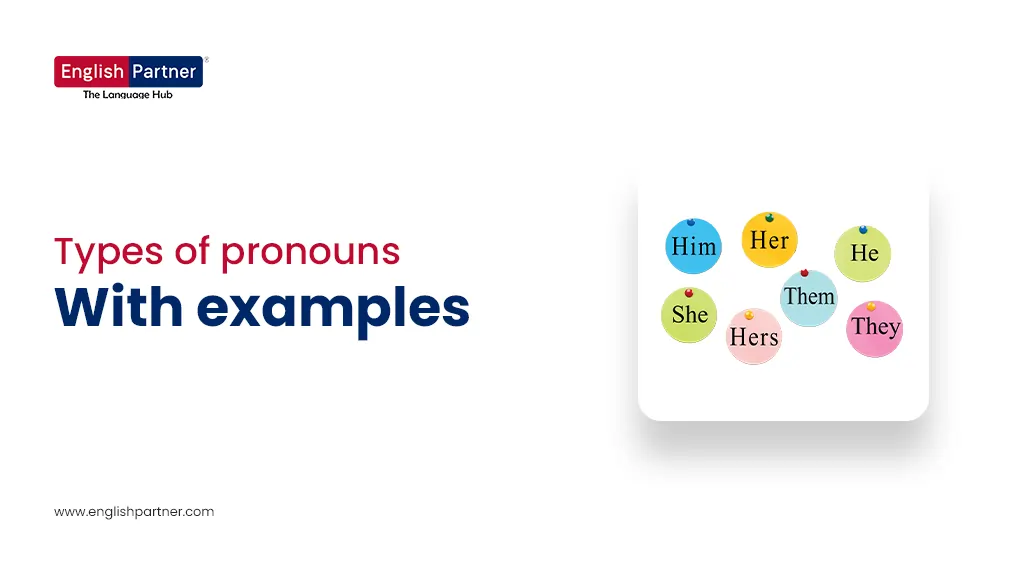
Types of pronouns with examples

Anjali Passport photo modified Types of pronouns with examples

Vishaleni

Content Writer

Blog Images 3 5 Types of pronouns with examples

When Sentences Feel Too Long…

Imagine this:
Ravi met Ravi’s friend at the market. Then Ravi and Ravi’s friend went to Ravi’s house.”
Sounds odd, right?
We don’t talk like that in real life.

Instead, we say:
“Ravi met his friend at the market. Then they went to his house.”

This is the magic of pronouns- short, simple words that help us avoid repeating names again and again.
They make our sentences cleaner, shorter, and easier to say.

No complicated grammar, no boring rules- just what you need to speak better and sound more natural.
Let’s Start.

What Are Pronouns?

Think of Them Like Shortcuts for Nouns
A pronoun is a word that replaces a noun– so you don’t have to keep saying the same name again and again.

Types of Pronouns

1. Personal Pronouns

Personal pronouns are used to talk about people or things directly.
They replace names and help make sentences shorter and smoother.

Examples:

I, you, he, she, it, we, they, me, him, her, us, them’

  • He is my brother.
  • I love this song.
  • Can you help me?

2. Possessive Pronouns

Possessive pronouns show that something belongs to someone.
They take the place of both the person and the thing they own.
Examples:

mine, yours, his, hers, ours, theirs

  • This bag is mine.
  • That phone is hers.
  • The house is theirs.

3. Reflexive Pronouns

Reflexive pronouns are used when the subject and the object of a sentence are the same person.
It means the person is doing something to themselves.

Examples:

myself, yourself, himself, herself, itself, ourselves, themselves

  • I made this cake myself.
  • She hurt herself.
  • They taught themselves.

4. Demonstrative Pronouns

Demonstrative pronouns are used to point at specific things.
They show whether the object is near or far, and if it’s one or many.
Examples:
this, that, these, those

  • This is my book.
  • That is your pen.
  • These are new shoes.

5. Interrogative Pronouns

Interrogative pronouns are used to ask questions.
They help us get information about people or things.
Examples:
who, whom, what, which, whose

  • Who is there?
  • What do you want?
  • Which is your bag?

6. Relative Pronouns

Relative pronouns connect two parts of a sentence and give more information about a noun.
They act like a bridge between two ideas.

Examples:

who, whom, whose, which, that

  • The girl who won the prize is my cousin.
  • This is the book that I borrowed.

7. Indefinite Pronouns

Indefinite pronouns refer to people or things without being exact.
We use them when we don’t know or don’t say exactly who or what.

Examples:

someone, anyone, everyone, nobody, something, everything

  • Someone is calling you.
    Everything is ready.
  • Nobody came to class.

8. Take care

Reciprocal pronouns are used when two or more people are doing the same thing to each other.
They show a shared action or feeling between two or more people.

Examples:

each other, one another

  • Ravi and Meera respect each other.
  • The students helped one another during the project.

3 Quick Rules to Remember When Using Pronouns

These small rules will help you use pronouns correctly in everyday English.

1. Always match the pronoun with the noun it replaces

The pronoun should match the person (I/he/they), number (one/many), and gender (he/she) of the noun.

Examples:

Anita is kind. She helps others.
My friends are helpful. They support me.

2. Use reflexive pronouns when the subject and object are the same

When someone does something to themselves, use words like myself, himself, themselves, etc.

Examples:

  • I prepared dinner myself.
  • They cleaned the room themselves.

3. Use one pronoun instead of repeating the noun

Once you’ve said the name of a person or thing, use a pronoun the next time.

Examples:

  • Ravi has a bicycle. He rides it every day.
  • I met your sister. She is very polite.

Mini Practice Challenge: Use the Right Pronoun

Let’s see how well you remember what you’ve learned!

Below is a sentence that repeats the same noun too many times.

2Can you replace the repeated words with the correct pronouns?

Original Sentence:

Priya is a teacher. Priya teaches children. Priya’s students love Priya because Priya is kind.

Your Task:

Try rewriting this using pronouns instead of repeating “Priya”.
(Think about which pronouns to use: she, her, hers, etc.)

Answer:

Priya is a teacher. She teaches children. Her students love her because she is kind.

You did it! See how pronouns made the sentence shorter and smoother?

Want to Speak English with Ease? Try English Partner

Learning grammar like pronouns is a great step- but using them while speaking is where the real progress happens.

That’s where English Partner can help.

With our online spoken English course Salem  , you don’t just learn grammar- you practice real conversations, speak with friendly mentors, and get step-by-step guidance in simple English.
Thousands of learners across India are already using English Partner to speak better every day.
Start your journey now: englishpartner.com/in

Vishaleni

Vishaleni is a results-driven content creator and copywriter who turns ideas into powerful words. With a knack for engaging storytelling and SEO-savvy writing, she helps brands connect, convert, and grow.
Anjali Passport photo modified Types of pronouns with examples

Frequently Asked question?

A pronoun is a word that replaces a noun to avoid repeating names. Words like he, she, it, they, and we are pronouns.
There are eight main types: personal, possessive, reflexive, demonstrative, interrogative, relative, indefinite, and reciprocal pronouns.
Pronouns help us speak and write clearly. They make sentences shorter and easier to understand by replacing repeated nouns.
Start by using simple pronouns like I, you, and they in your daily conversations. Try small sentences and gradually use different types of pronouns.

Like what you read? Share with a friend

Facebook
Twitter
LinkedIn

Ready to transform your communication?

Reach out today and take the next step

Select Your Language