

Have you ever stopped yourself from speaking because you were scared of making a grammar mistake?
Maybe you knew the answer in class but stayed quiet.
Maybe you had a great idea in a college presentation but didn’t say it.
Maybe you wanted to share a thought in a meeting, but something inside you froze.
Or maybe you simply wanted to talk in English… but your brain whispered:
“Don’t speak. What if your grammar is wrong?”
You’re not alone.
Millions of English learners lose their voice because they fear grammar mistakes more than silence.
But here’s the truth:
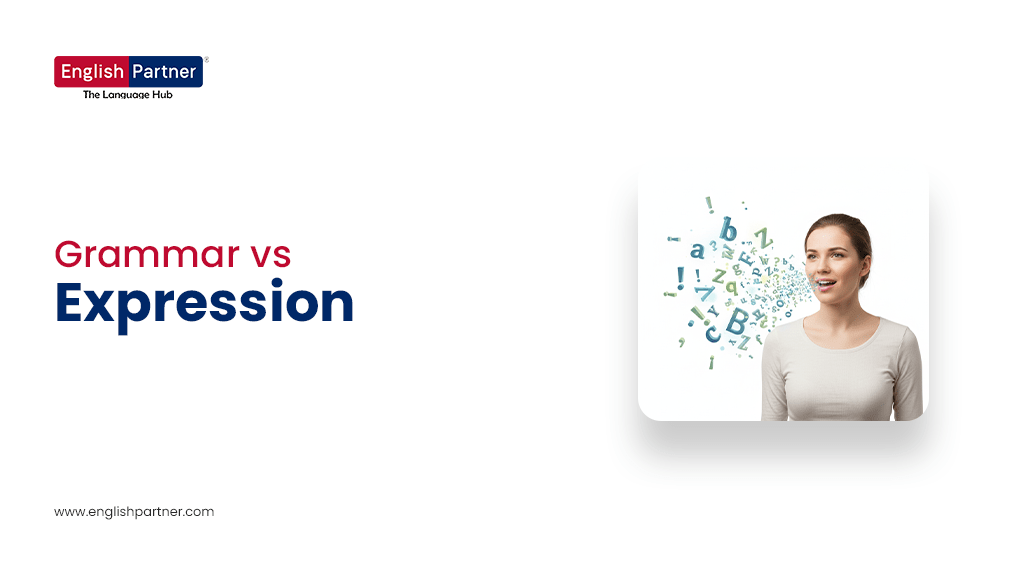
Grammar is a tool. Expression is your voice.
When the tool becomes more important than the voice, communication dies.
This blog will help you understand how to balance grammar and expression so you can speak freely, honestly, and confidently, without letting rules choke your thoughts.
And yes, if grammar fear is holding you back, English Partner helps you practise daily English conversations without pressure.
What Is Grammar?
Grammar is the structure of a language- the rules that keep sentences in order.
Grammar includes:
- Tenses
- Sentence patterns
- Prepositions
- Articles
- Subject-verb agreement
- Word order
Grammar helps you make sense.
Grammar helps your listener follow your idea.
Grammar helps writing become correct and clean.
But grammar is not the real goal of communication.
It’s just the framework.
Think of grammar like the walls of a house.They give structure.
But the life inside the house, the people, the stories, the emotions, that’s expression.
What Is Expression?
Expression is everything grammar cannot measure.
Expression is:
- Your thoughts
- Your feelings
- Your tone
- Your personality
- Your creativity
- Your natural speaking style
- Your intention
Expression is your voice.
Even if your grammar isn’t perfect, expression makes people connect with you.
Example:
“I am not perfect English, but I want to say something important.”
Not perfect grammar.
But full of honesty and feeling. Human beings respond to emotions, not just rules.
The Real Problem: When Grammar Overthinking Silences You
Most English learners don’t have a language problem.
They have a confidence problem caused by grammar fear.
Here’s what grammar fear does to you:
1. You pause too much while speaking
You correct yourself every two seconds.
You lose flow.
You sound unsure.
2. You stay silent even when you know the answer
You’re not scared of English.
You’re scared of judgment.
3. You think in your mother tongue, then translate
This slows you down and increases mistakes.
4. You compare your English with others
Comparison kills confidence instantly.
5. You believe “good speakers never make mistakes”
Even native speakers make grammar mistakes every day.
6. You lose your natural voice
You speak like a textbook, robotic, dry, emotionless.
The more you overthink grammar, the more your authentic voice disappears.
Grammar vs Expression — Key Differences
Feature | Grammar | Expression |
Purpose | Accuracy | Meaning |
Listener Reaction | Understands structure | Connects emotionally |
Flexibility | Strict | Free |
Weakness | Can kill spontaneity | Can be incorrect |
Strength | Gives clarity | Shows personality |
Works Best For | Writing & exams | Speaking & communication |
Both are important.
But in everyday communication, expression leads, grammar supports.
When Grammar Starts Blocking Your Voice
1. When you freeze before speaking
You want to talk but you replay your sentence 10 times in your head.
By the time you’re ready, the moment is gone.
2. When you keep correcting yourself mid-sentence
Your meaning gets lost.
Your confidence drops.
3. When you avoid participating
Group discussions, interviews, meetings — all missed because of grammar fear.
4. When your English becomes “lifeless”
You sound correct but not natural.
Grammar wins.
Your personality loses.
5. When you apologize too much
“Sorry, my English is bad.”
“Sorry, I may be wrong.”
“Sorry, I’m weak in grammar.”
These apologies don’t show respect.
They show fear.
Why Expression Matters More Than Perfect Grammar
Here’s the simple truth:
People remember your message, not your mistakes.
A sentence with emotion, clarity, and honesty is more powerful than a perfect sentence spoken with fear.
Expression matters because:
- People connect with feelings
- Humans understand stories, not rules
- Communication is about meaning, not perfection
- A confident voice is more trusted than a flawless sentence
- Expression makes your personality visible
Think about the world’s greatest speakers.
They don’t speak perfect grammar.
They speak with clarity, passion, and emotion.
How to Balance Grammar + Expression
Here’s how to speak freely without letting grammar block you:
1. Speak First, Correct Later
Don’t stop your idea to fix a small mistake.
2. Use Simple Sentence Patterns
“I want to explain something.”
“This is my idea.”
“I feel this is correct.”
Simple = powerful.
3. Don’t aim for 100% accuracy
Aim for 70% accuracy + 100% clarity.
4. Learn grammar slowly, not forcefully
One rule a day.
Not ten.
5. Practise real conversations daily
You learn speaking by speaking — not by memorizing rules.
6. Accept your accent
Clarity matters.
Accent does not.
7. Use expression words
“I think…”
“I believe…” “In my opinion…”
“These words show your voice.
Conclusion
Grammar gives structure.Expression gives life.
Together, they make you a powerful communicator.
But if you let grammar rules take over your mind, your voice becomes weak.
Your personality disappears.
Your ideas stay hidden.
Remember:
People don’t remember perfect sentences.
They remember honest voices.
Vishaleni
Vishaleni is a results-driven content creator and copywriter who turns ideas into powerful words. With a knack for engaging storytelling and SEO-savvy writing, she helps brands connect, convert, and grow.

Frequently Asked question?
Speaking first, grammar second.
Expression builds confidence; grammar improves accuracy.
Because you overthink correctness instead of focusing on meaning.
Yes, every single day.
Nobody cares because the expression is clear.
Use simple sentences, express your thoughts, and practise daily.
For communication, yes.
For exams, grammar matters.
For life, expression matters more.
Speak freely → correct slowly → improve naturally.
Because you’re focusing on rules instead of emotions.